Просмотр новости
Найдите то, что Вас интересует
 Спутники
 РН
РН SpaceX
 Роскосмос
 NASA
NASA
СпутникиРНSpaceXРоскосмосNASAThe Himalayas is a global hotspot for landsliding that is also highly sensitive to the effects of anthropogenic climate change. Shifting patterns of precipitation and temperature are amplified in high mountain regions like nowhere else on Earth, as glaciers retreat and permafrost degrades, accelerating rates of erosion and sediment transport. Especially unpredictable cascading hazards (i.e. chains […]
The post Climate change in High Mountain Asia appeared first on Domů.
The Himalayas is a global hotspot for landsliding that is also highly sensitive to the effects of anthropogenic climate change. Shifting patterns of precipitation and temperature are amplified in high mountain regions like nowhere else on Earth, as glaciers retreat and permafrost degrades, accelerating rates of erosion and sediment transport. Especially unpredictable cascading hazards (i.e. chains of hazards linking together) are occurring with increasing frequency.
GFÚ researcher, John Jansen (Surface Processes & Palaeoclimate) co-authored a letter published in the journal Nature Geoscience that identified a growing gap between the vulnerability of mountain communities and institutional responses to the increasing scale and frequency of hazards linked to landslides and floods.
Most recently, in a study led by Jansen’s PhD student, Chengbin Zou, and published this week in National Science Review the authors ask: Has climate change escalated landsliding in high mountain regions? Based on their inventory of >8000 climate-related landslides in the eastern Himalayas, they report a five-fold increase in annual landslide volumes at high elevations over the past three decades. The landslide distribution is observed migrating upslope in the wake of retreating glaciers and melting permafrost—a trend underpinned by a warming-induced shift in precipitation falling as rain rather than snow.
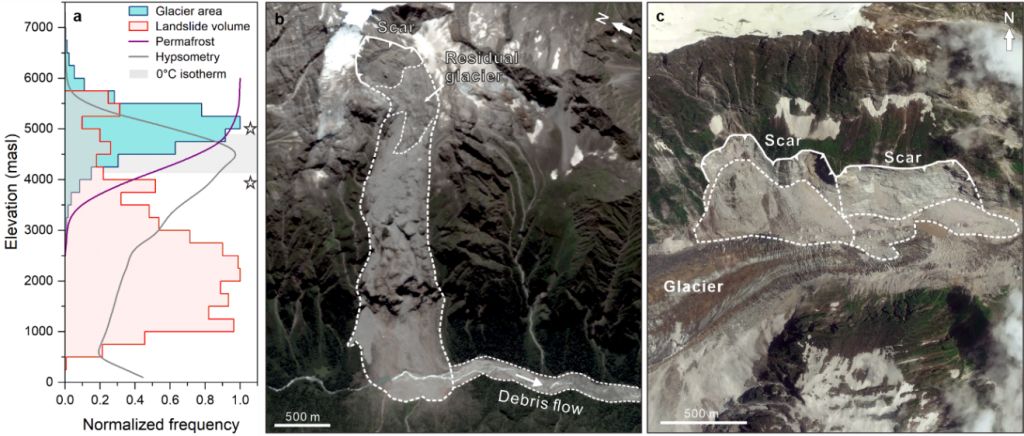
Landslides in the eastern Himalayas.
(a) Elevation relationships between landslide volumes, the distribution of glaciers and permafrost (fractional area per elevation bin), the 0°C isotherm and hypsometry. Given the hypsometric maximum in surface area at ~ 4000–5000 metres above sea level, even a modest rise in the 0°C isotherm or ELA increases the potential for new landslides. Upper-lower stars indicate headwall elevations of landslides in b, c, respectively.
(b) Landslide induced possibly by permafrost degradation/freeze-thaw intensification (Planet image, August 6, 2020).
(c) Landslide related to glacier retreat (Jilin-1 image, July 6, 2022).
| # | Наименование новости | Тональность | Информативность | Дата публикации |
|---|---|---|---|---|
| 1 | Climate Change Is Making Himalayan Rivers Change Course Faster | 0 | 13.62 | 30-07-2026 |
| 2 | Warming Himalayas demand a rethink on development | 0 | 9.22 | 13-10-2026 |
| 3 | Perché il Nepal e l’Himalaya stanno diventando così fragili | 0 | 15.2 | 27-08-2026 |
| 4 | Assessing Increased Glacier Ablation Sensitivity to Climate Warming Using Degree-Day Method in the West Nyainqentanglha Range, Qinghai–Tibet Plateau | 0 | 6.1 | 05-08-2026 |
| 5 | A new mechanism behind the growth of giant mud volcano flows in Azerbaijan | 0 | 6.46 | 22-06-2026 |
| 6 | The first continental-scale Eurasian Ice Sheets | 0 | 10.84 | 25-06-2026 |
| 7 | Los glaciares suizos se derriten a un ritmo alarmante por el calor extremo en Europa | 0 | 10.8 | 11-07-2026 |
| 8 | St. Mary’s Glacier Succumbs To Climate Change | 0 | 9.41 | 18-09-2026 |
| 9 | Supercooled clouds over the highest mountains respond differently to climate change | 0 | 5.95 | 16-10-2026 |
| 10 | Ancient 100-kilometer Himalayan glacier once reached lower than many of India's famous hill stations | 0 | 7 | 09-07-2026 |