Просмотр новости
Найдите то, что Вас интересует
 Спутники
 РН
РН SpaceX
 Роскосмос
 NASA
NASA
СпутникиРНSpaceXРоскосмосNASAPearls have long been favored as objects of beauty. Now, Purdue University innovators are using the gem to provide potential new opportunities for spectral information processing that can be applied to spectroscopy in biomedical and military applications. The Purdue team demonstrated light transport-assisted information processing by creating a pearl spectrometer. Spectrometers probe interactions of matter and light […]
Technology
Pearls have long been favored as objects of beauty. Now, Purdue University innovators are using the gem to provide potential new opportunities for spectral information processing that can be applied to spectroscopy in biomedical and military applications.

Published November 14, 2020 · Updated July 20, 2026 · How we edit
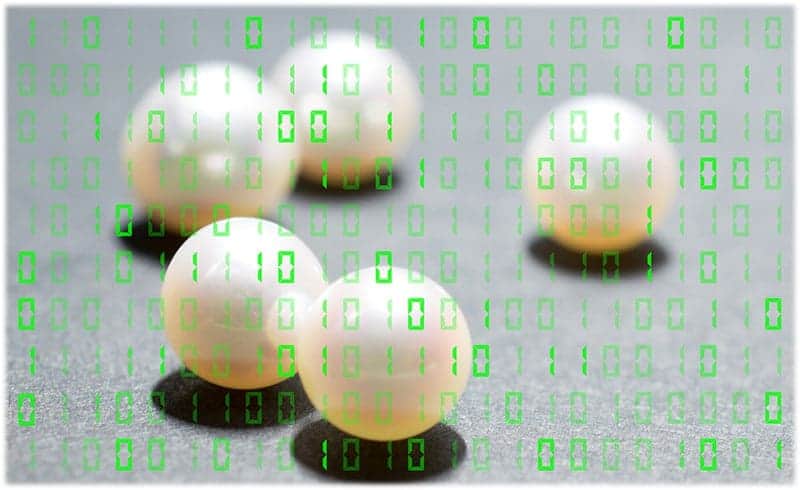 Purdue University innovators are using pearls to provide potential new opportunities for spectral information processing that can be applied to spectroscopy in biomedical and military applications. (Image provided)
Pearls have long been favored as objects of beauty. Now, Purdue University innovators are using the gem to provide potential new opportunities for spectral information processing that can be applied to spectroscopy in biomedical and military applications.
The Purdue team demonstrated light transport-assisted information processing by creating a pearl spectrometer.
Spectrometers probe interactions of matter and light as a function of the electromagnetic spectrum and are commonly used in biomedical and military applications. For example, they have been used for diagnostics of various types of cancer and for military gas sensing.
“Unfortunately, widespread uses and practical adaptions of spectroscopy are often limited due to the need of conventional spectrometers,” said Young Kim, an associate professor of biomedical engineering at Purdue. “The current spectrometers rely on complex device assembly, high-precision alignment and large physical size or dimension, all of which prevent rapid translation into practical applications.”
The work, which was funded by the U.S. Air Force Research Laboratory, is published in Nano Letters.
“We discovered that pearls are an ideal natural object for Anderson localization of light, named after Nobel laureate Philip Anderson, whose concept has been extended to describe how light undergoes on and off resonances inside materials due to their strong scattering,” Kim said.
Yunsang Kwak, a postdoctoral fellow in the lab at Purdue, said, “Anderson light localization offers high randomness that is extremely helpful for compressive sensing, in particular to conduct information processing with a thin and plat form factor, by simply attaching a pearl-like multispectral filter array on a conventional camera.”
Kim said, “We do not think that the direct use of a pearl would be a good option for mass production of multispectral filter arrays. Instead, pearls teach us how to design disordered nanostructures of Anderson light localization to develop a new class of spectral information processing machine.”
The Purdue researchers are looking to their new discovery to provide scientists with an idea of hybridizing material and digital properties, which could be useful for innovations in biomedical and defense applications.
The innovators worked with the Purdue Research Foundation Office of Technology Commercialization to file a patent application for this technology.
The researchers are looking for partners to continue developing their technology. For more information on licensing and other opportunities, contact D.H.R. Sarma of OTC at [email protected] and mention track code 2021-KIM-69261.
| # | Наименование новости | Тональность | Информативность | Дата публикации |
|---|---|---|---|---|
| 1 | В Перми придумали, как улучшить кварцевое стекло, применяемое в лазерах и телескопах | 0 | 6.57 | 04-08-2026 |
| 2 | Пермские ученые повысили качество кварцевого стекла для лазеров и телескопов | 0 | 7.59 | 31-07-2026 |
| 3 | Turning low-value diamond dust into high-performance quantum materials | 2 | 7 | 24-06-2026 |
| 4 | В Перми придумали, как улучшить кварцевое стекло, применяемое в лазерах и телескопах | 0 | 6.99 | 03-08-2026 |
| 5 | World-first photonic time crystal opens a new era of light control | 0 | 8.93 | 31-07-2026 |
| 6 | Record-breaking photodetector captures light in just 125 picoseconds | 0 | 13.76 | 05-03-2026 |
| 7 | Infrared filter could help detect pollution and disease | 5 | 7 | 23-06-2026 |
| 8 | Разработаны биосовместимые люминесцентные материалы для медицины и электроники | 0 | 0 | 17-09-2025 |
| 9 | Interactive photonics: bringing flat optics to life | 7 | 8 | 20-07-2026 |
