Просмотр новости
Найдите то, что Вас интересует
 Спутники
 РН
РН SpaceX
 Роскосмос
 NASA
NASA
СпутникиРНSpaceXРоскосмосNASATest your NATO knowledge and see how you compare to U.S. adults. Americans answer half of five factual questions correctly, on average.
 (Jonathan Raa/NurPhoto via Getty Images)
The North Atlantic Treaty Organization, or NATO, has been in the news a lot this year.
How much do you know about the organization? And how does your knowledge stack up against the U.S. public’s as a whole?
Take our quiz below to find out. Then read our analysis of Americans’ knowledge about NATO, based on a March 2026 Pew Research Center survey of 3,507 U.S. adults.
About this researchThis Pew Research Center analysis examines Americans’ knowledge of NATO and related topics.
Why did we do this?
Pew Research Center does research to help the public, media and decision-makers understand important topics. This analysis builds on our previous work examining Americans’ knowledge of NATO and international affairs.
Learn more about Pew Research Center.
How did we do this?
For this analysis, we surveyed 3,507 U.S. adults from March 23 to 29, 2026. Everyone who took part in the survey is a member of the Center’s American Trends Panel. The survey represents the views of the full U.S. adult population.
Here are the survey questions used for this analysis, the detailed responses and the survey methodology.
How much do Americans know about NATO?Americans more likely to answer some NATO questions correctly than others
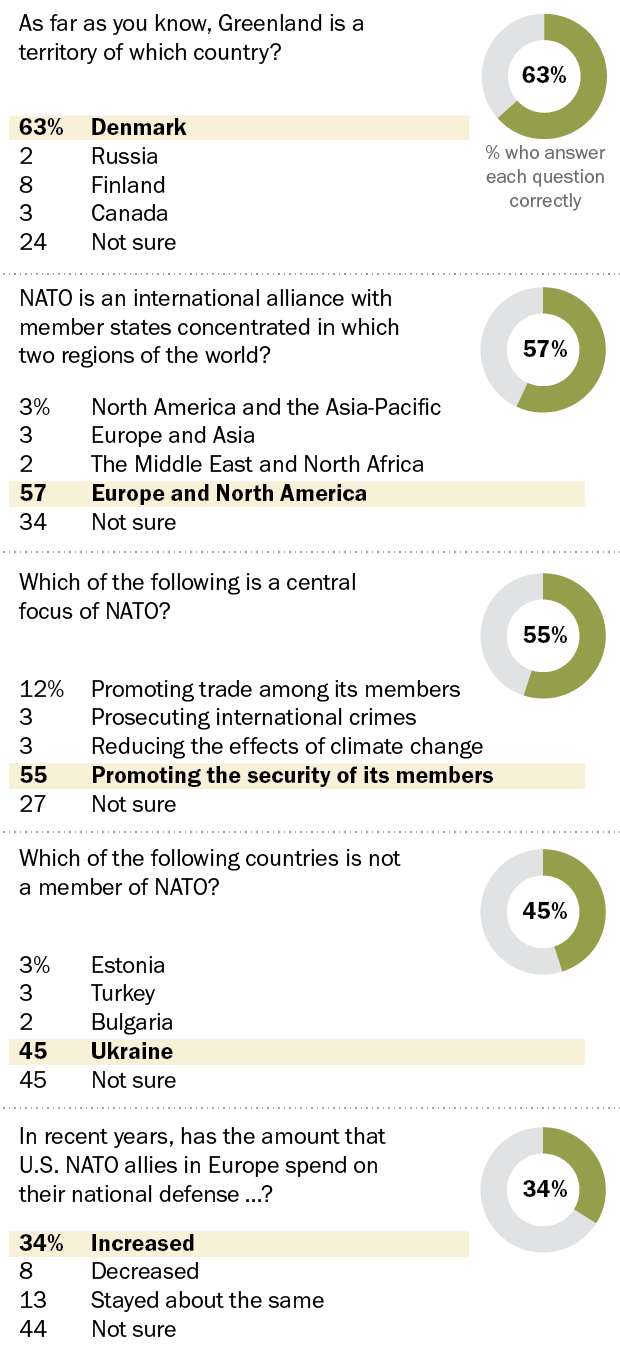
Note: Correct answers are in bold. The order of the multiple-choice answer options were randomized for each respondent and “Not sure” appeared at the bottom of each set. For the question on spending, only the order of “Increased” and “Decreased” were randomized. Those who did not answer are not shown.
Source: Survey of U.S. adults conducted March 23-29, 2026.
PEW RESEARCH CENTER
Americans more likely to answer some NATO questions correctly than others
| Question | Response | Percent |
|---|---|---|
| As far as you know, Greenland is a territory of which country? | Denmark (Correct) | 63% |
| Russia | 2 | |
| Finland | 8 | |
| Canada | 3 | |
| Not sure | 24 | |
| NATO is an international alliance with member states concentrated in which two regions of the world? | North America and the Asia Pacific | 3% |
| Europe and Asia | 3 | |
| The Middle East and North Africa | 2 | |
| Europe and North America (Correct) | 57 | |
| Not sure | 34 | |
| Which of the following is a central focus of NATO? | Promoting trade among its members | 12% |
| Prosecuting international crimes | 3 | |
| Reducing the effects of climate change | 3 | |
| Promoting the security of its members (Correct) | 55 | |
| Not sure | 27 | |
| Which of the following countries is not a member of NATO? | Estonia | 3% |
| Turkey | 3 | |
| Bulgaria | 2 | |
| Ukraine (Correct) | 45 | |
| Not sure | 45 | |
| In recent years, has the amount that U.S. NATO allies in Europe spend on their national defense… | Increased (Correct) | 34% |
| Decreased | 8 | |
| Stayed about the same | 13 | |
| Not sure | 44 |
Note: Correct answers are in bold. The order of the multiple-choice answer options were randomized for each respondent and “Not sure” appeared at the bottom of each set. For the question on spending, only the order of “Increased” and “Decreased” were randomized. Those who did not answer are not shown.
Source: Survey of U.S. adults conducted March 23-29, 2026.
PEW RESEARCH CENTER
To better understand what Americans know about NATO, we asked five factual questions about the organization and related issues.
A majority of Americans got each of the following three questions correct:
Fewer than half of adults got the other two questions correct:
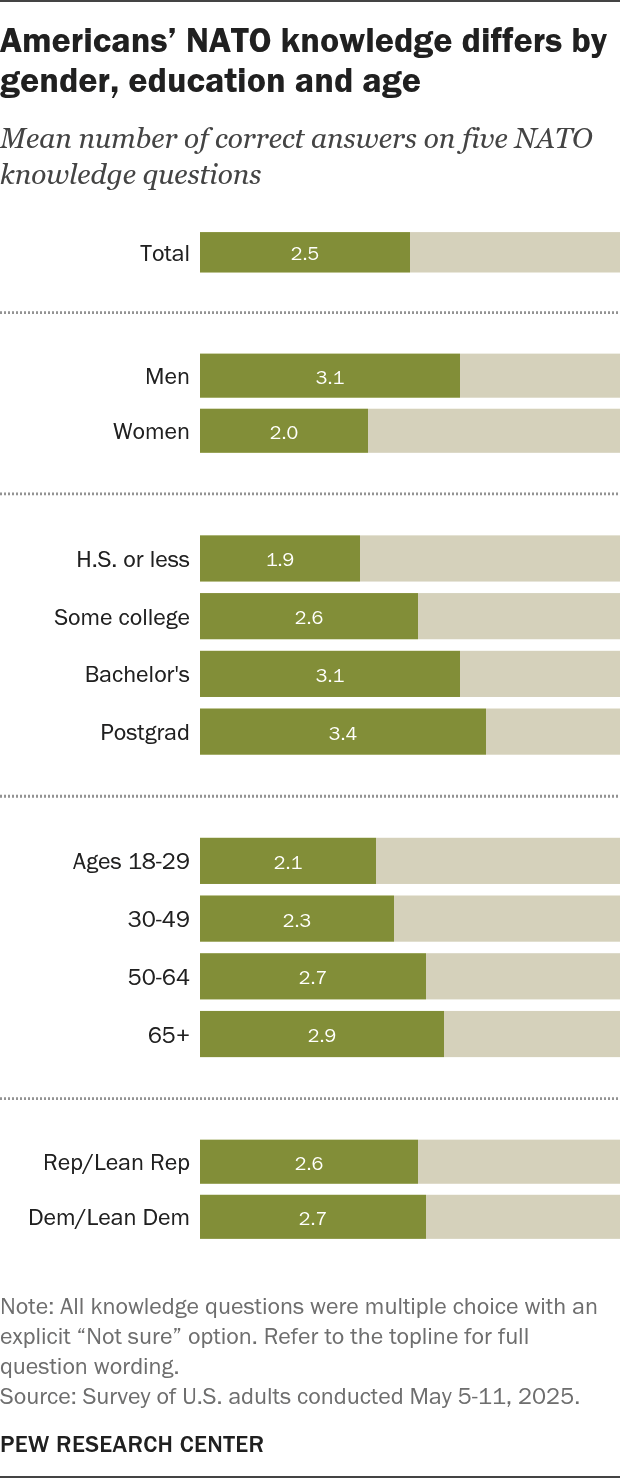
On average, Americans answered half of our NATO knowledge questions correctly, with a mean score of 2.5. The median score was 3.
Americans’ NATO knowledge differs by gender, education and age
Mean number of correct answers on five NATO knowledge questions
Note: All knowledge questions were multiple choice with an explicit “Not sure” option. Refer to the topline for full question wording.
Source: Survey of U.S. adults conducted May 5-11, 2025.
PEW RESEARCH CENTER
Americans’ NATO knowledge differs by gender, education and age
Mean number of correct answers on five NATO knowledge questions
| Group | Mean number correct | Grey bars | Grouping |
|---|---|---|---|
| Total | 2.5 | 2.5 | Total |
| Men | 3.1 | 1.9 | Gender |
| Women | 2.0 | 3.0 | Gender |
| H.S. or less | 1.9 | 3.1 | Education |
| Some college | 2.6 | 2.4 | Education |
| Bachelor’s | 3.1 | 1.9 | Education |
| Postgrad | 3.4 | 1.6 | Education |
| Ages 18-29 | 2.1 | 2.9 | Age |
| 30-49 | 2.3 | 2.7 | Age |
| 50-64 | 2.7 | 2.3 | Age |
| 65+ | 2.9 | 2.1 | Age |
| Rep/Lean Rep | 2.6 | 2.4 | Party |
| Dem/Lean Dem | 2.7 | 2.3 | Party |
Note: All knowledge questions were multiple choice with an explicit “Not sure” option. Refer to the topline for full question wording.
Source: Survey of U.S. adults conducted May 5-11, 2025.
PEW RESEARCH CENTER
Americans’ NATO knowledge varies somewhat by demographic group:
There is no significant difference by political party. On average, Republicans and Republican-leaning independents answered 2.6 questions correctly, compared with 2.7 among Democrats and Democratic leaners.
Does public opinion about NATO vary based on NATO knowledge?Notably, public opinion about NATO tends to be more positive among those who know more about the alliance. Adults who answered four or five of these knowledge questions correctly are more likely to have a favorable view of NATO than those who answered none or one of the questions correctly (63% vs. 47%).
Americans with more knowledge of NATO are also more likely than those with less knowledge to say the U.S. benefits from being a member of the alliance.
How has Americans’ NATO knowledge changed over time?We asked three of these same NATO knowledge questions in a 2024 survey.
Since then, there has been no major change in the share of U.S. adults who correctly say NATO draws its membership from Europe and North America (57% know the answer today, versus 56% in 2024).
But there have been slight increases in the share of Americans who know that Ukraine is not a member of NATO (45% vs. 41%) and the share who know that NATO’s central focus is to promote the security of its members (55% vs. 51%).
Note: Here are the survey questions used for this analysis, the detailed responses and the survey methodology.

Kirsten Lesage is a research associate focusing on religion at Pew Research Center.

Moira Fagan is a senior researcher focusing on global attitudes research at Pew Research Center.
| # | Наименование новости | Тональность | Информативность | Дата публикации |
|---|---|---|---|---|
| 1 | Think You’re Smarter Than a Slate Staff Writer? Find Out With This Week’s News Quiz. | 0 | 8.34 | 24-07-2026 |
| 2 | Washington quizzes NATO allies on support for Trump – Bloomberg | 0 | 10.34 | 14-08-2026 |
| 3 | "Россия учится быстрее, чем альянс тратит": НАТО проигрывает РФ | 0 | 8.92 | 30-07-2026 |
| 4 | Американская бронегруппа понесла поражение от украинских военных на учениях НАТО | 0 | 10 | 12-08-2026 |
| 5 | Republicans have become less likely to say NATO membership benefits the U.S. | 0 | 14.4 | 06-04-2026 |
| 6 | Try This Quiz on Literary Quotations About American Life | 0 | 5 | 06-07-2026 |
| 7 | В США захотели выяснить, насколько союзники по НАТО лояльны Трампу | 0 | 7.23 | 14-08-2026 |
| 8 | США хотят оценить лояльность стран НАТО, — Bloomberg | 0 | 8.98 | 14-08-2026 |
| 9 | If You Can Get 50/50 On This Official US Animals Quiz, You're Either Super Smart Or A Really, REALLY Good Guesser | 0 | 2 | 29-06-2026 |