Просмотр новости
Найдите то, что Вас интересует
 Спутники
 РН
РН SpaceX
 Роскосмос
 NASA
NASA
СпутникиРНSpaceXРоскосмосNASAResearchers at the University of Turku have demonstrated a solid-state organic laser microcavity fabricated entirely by solution processing. The device operates in the strong light–matter coupling regime, where light and […]
The post Turku researchers demo solid-state organic laser microcavity fabricated entirely by solution processing appeared first on Electronics Weekly.
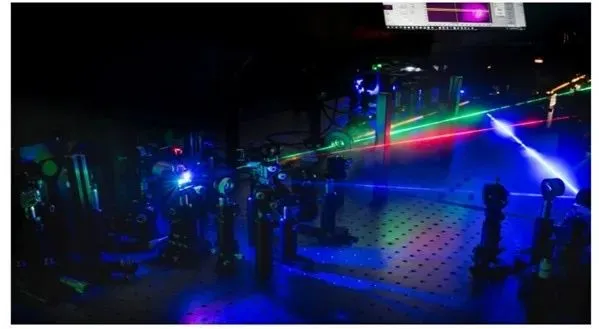
Researchers at the University of Turku have demonstrated a solid-state organic laser microcavity fabricated entirely by solution processing.
The device operates in the strong light–matter coupling regime, where light and matter form hybrid states called polaritons.
This makes the platform not only a new type of solution-processed laser but also a powerful way to study nonlinear polariton interactions.
Solid-state lasers are used in many modern technologies, from telecommunications and sensing to medical diagnostics and data storage. However, their fabrication often requires complex and energy-intensive manufacturing methods.
This new work shows that organic laser devices can be made in a much simpler way, by coating each layer from a liquid solution rather than depositing it in vacuum.
“Our main result is that we can make a complete solid-state laser microcavity using only solution processing. This is important because it shows that simple and scalable fabrication can still produce the high optical quality needed for advanced laser physics,” says Associate Professor Konstantinos Daskalakis.
In the new device, both the mirrors that trap light and the organic light-emitting layer were fabricated by spin coating. The high quality of the microcavity allowed the researchers to reach the strong light–matter interaction regime, where light and molecules mix together and form hybrid states called polaritons.
These polaritons allow the device to operate as a polariton laser. In simple terms, this means that the laser-like emission is produced through the collective behaviour of light and matter together, rather than by light alone.
“The exciting part is that we are not only making a simple solution-processed structure but also a working solid-state polariton laser. This gives researchers a much more accessible way to study these devices,” says Postdoctoral Researcher Hassan Ali Qureshi.
The study also revealed an unusual behaviour when the laser was driven strongly. Instead of emitting only from the centre of the excited area, the light redistributed outward and formed a ring-like pattern. This effect was reversible and could be controlled by changing the optical design of the cavity.
“For us, this was very interesting because we could see the effect of polariton interactions as a visible, macroscopic change in the emitted light. By tuning the cavity, we can control how strongly this redistribution appears. This gives us a practical knob for studying nonlinear polariton behaviour,” says Senior Researcher Henri Lyyra.
The researchers believe that the new platform can make organic laser and polariton research more accessible. In the longer term, it may support the development of low-cost photonic devices and help progress toward future organic lasers that are electrically driven.
The study was carried out at the Department of Mechanical and Materials Engineering at the University of Turku in Finland, with collaboration from the University of Eastern Finland.
Read the research article: https://www.nature.com/articles/s41467-026-75118-1

David Manners has more than forty-years experience writing about the electronics industry, its major trends and leading players. As well as writing business, components and research news, he is the author of the site's most popular blog, Mannerisms. This features series of posts such as Fables, Markets, Shenanigans, and Memory Lanes, across a wide range of topics.