Просмотр новости
Найдите то, что Вас интересует
 Спутники
 РН
РН SpaceX
 Роскосмос
 NASA
NASA
СпутникиРНSpaceXРоскосмосNASAAfter a relatively cool June, the Fennoscanian countries Norway, Sweden and Finland were hit by an intense heatwave that lasted for about two weeks from mid-July, with maximum temperatures repeatedly exceeding 30°C.
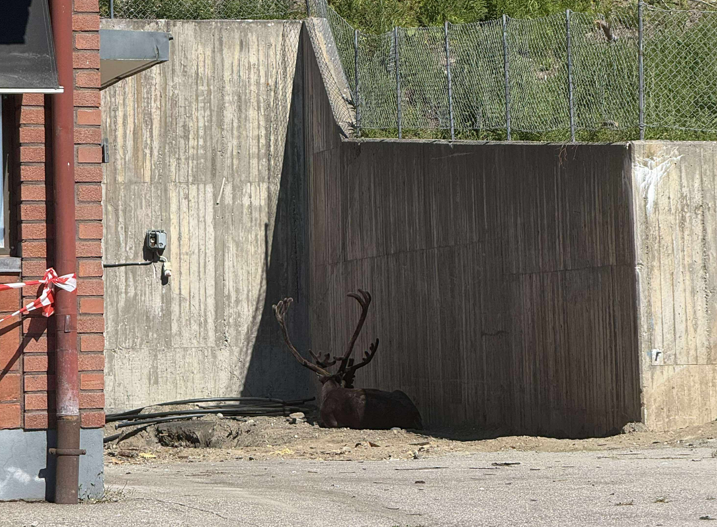 A reindeer rests in the shade during the heatwave in Tärnaby, Sweden. In summer, reindeer normally move to higher areas to escape insects and heat, but warmer conditions on hills and mountains mean those areas now offer less relief. Photo by Amanda Nilsson.
After a relatively cool June, the Fennoscanian countries Norway, Sweden and Finland were hit by an intense heatwave that lasted for about two weeks from mid-July, with maximum temperatures repeatedly exceeding 30°C.
In Namsskogan and Gartland, Norway, temperatures reached 30°C and more for 13 days in a row, while in Ylitornio, Finland maximum temperatures stayed above 25°C for 26 days in a row, something hitherto unknown this far north in Europe. While many heat records in the three countries were set in 2018, the last time a similarly strong heatwave affected Fennoscania, the duration of this 2025 event put enormous strain on the healthcare system, with many more hospital admissions, and hospitals struggling to cool buildings (NRK, 2025; TV2, 2025). At least 28 people in Finland (YLE News, 2025), 31 in Sweden (GP, 2025) and 8 in Norway (NTB, 2025) died in July due to drowning.
The heat also disrupted wildlife. Reindeer were spotted in towns, likely trying to escape the heat and find water and relief from biting insects, (Euronews, 2025; BBC, 2025). In Norway, drivers were warned about the danger of encountering them in tunnels as they fled the heat, and reindeer deaths were reported in Finland (Folkebladet, 2025; Itrosmo, 2025; RTE, 2025). The hot weather also dried out the soil and vegetation, creating favourable conditions for wildfires. As a result, numerous wildfires occurred across the region, including in Lapland. Algal blooms in the Baltic Sea, as well as lakes in Finland, have been unusually extensive this summer due to high temperatures (Sweden Herald, 2025; STTINFO, 2025) .
Researchers from Norway, Finland, Sweden, Denmark, the United States and the United Kingdom collaborated to assess to what extent human-induced climate change altered the likelihood and intensity of the extreme heat in the region. The analysis focuses on the 14 hottest days and nights over the three countries: Norway, Sweden and Finland. Figure 1 shows the magnitude of the event for both the hottest 14 days (tx14x; left) and nights (tn14x; right), crosses marked locations where temperature records have been broken.
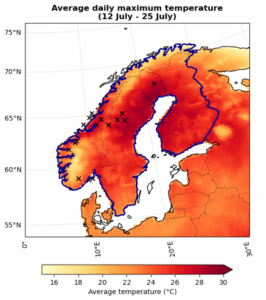
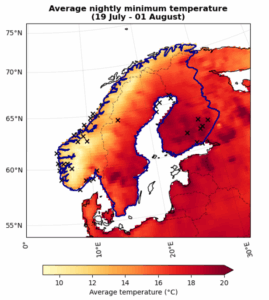 Figure 1: Highest 14-day averaged daily maxima (left) and daily minima (right) over Fennoscandia in 2025. The study region is outlined in dark blue. Crosses mark locations where temperature records were broken.
Main Findings
Figure 1: Highest 14-day averaged daily maxima (left) and daily minima (right) over Fennoscandia in 2025. The study region is outlined in dark blue. Crosses mark locations where temperature records were broken.
Main Findings
| # | Наименование новости | Тональность | Информативность | Дата публикации |
|---|---|---|---|---|
| 1 | Fossil fuel emissions have rapidly worsened European heatwaves in just a few decades | 0 | 8.95 | 26-06-2026 |
| 2 | Europe swelters through record heat as drought and wildfires intensify | 0 | 7.92 | 12-08-2026 |
| 3 | Switzerland braces for fourth heatwave of the summer | 0 | 6.29 | 24-07-2026 |
| 4 | Heatwave across western Europe – in pictures | 0 | 7 | 10-07-2026 |
| 5 | What’s behind this summer’s heat, and why 2027 could be worse | 0 | 13.63 | 13-08-2026 |
| 6 | Western Europe records its hottest June as heat waves surge: EU monitor | 0 | 7 | 09-07-2026 |
| 7 | How the heatwave crippled Europe (PHOTOS, VIDEOS) | -2 | 6 | 30-06-2026 |
| 8 | Нева и Финский залив нагрелись выше +20°C | 0 | 5 | 14-07-2026 |
| 9 | Central Europe sizzles as heat records are smashed in Switzerland, Denmark and Czech Republic | 0 | 7 | 27-06-2026 |