Просмотр новости
Найдите то, что Вас интересует
 Спутники
 РН
РН SpaceX
 Роскосмос
 NASA
NASA
СпутникиРНSpaceXРоскосмосNASAThe Vera C. Rubin Observatory has only just begun its survey, yet it has already discovered its first ultra-faint Milky Way satellite, Aquarius IV.
The post 1st ultra-faint Milky Way satellite galaxy found by Rubin first appeared on EarthSky.
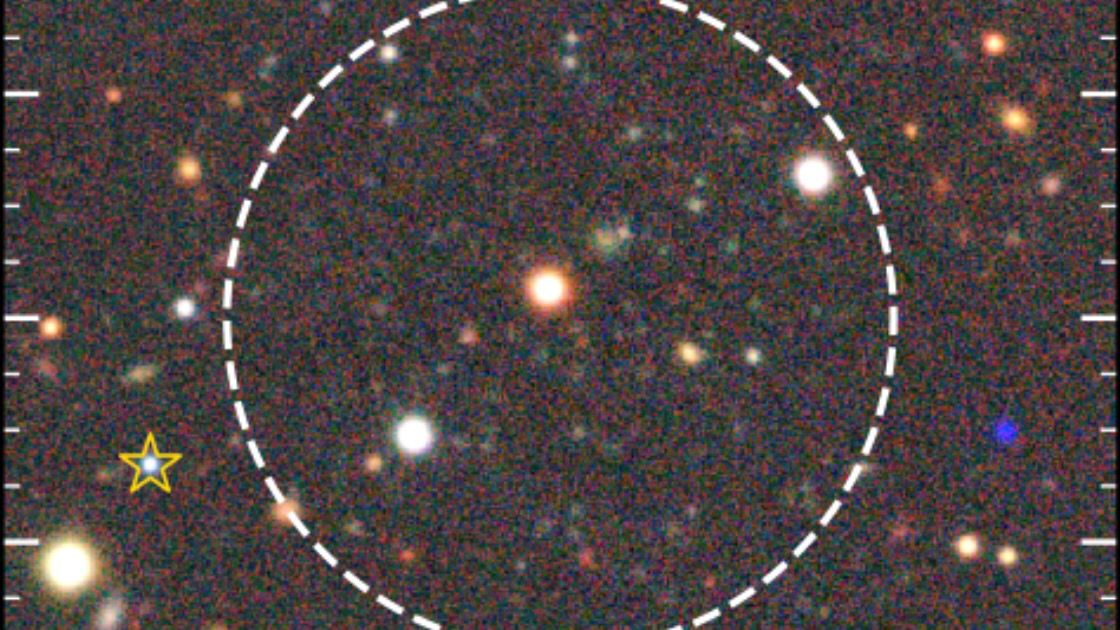 This starfield shows the newly discovered Milky Way satellite galaxy at the center. The point of light at left marked by the star shape indicates a star that was crucial in determining the distance to this little galaxy. Image via William Cerny/ Rubin Observatory/ arXiv.
New Milky Way satellite galaxy
This starfield shows the newly discovered Milky Way satellite galaxy at the center. The point of light at left marked by the star shape indicates a star that was crucial in determining the distance to this little galaxy. Image via William Cerny/ Rubin Observatory/ arXiv.
New Milky Way satellite galaxy
This month, scientists using the preliminary data from the Vera C. Rubin Observatory in Chile said they’ve discovered an ultra-faint satellite galaxy orbiting our home galaxy, the Milky Way. It’s a first for Rubin, which officially began a 10-year survey of the universe in June 2026.
The astronomers dubbed the new galaxy Aquarius IV. It’s one of the faintest of the roughly 60 little galaxies currently known to be orbiting (or closely associated with) the Milky Way.
The Vera C. Rubin Observatory – on the summit of Cerro Pachón in northern Chile – features a 3.2-gigapixel camera, roughly the size of a small car, making it the largest digital camera ever built for astronomy. This camera’s resolution is so high that displaying a single full-size image would require hundreds of 4K ultra-HD television screens. Astronomers are using this camera for the 10-year Legacy Survey of Space and Time (LSST), which began in late June.
The new satellite galaxy is one of the first of what scientists expect will be many discoveries. Researchers found the galaxy in Rubin’s Early Data Preview 2 dataset.
The researchers, led by William Cerny of Yale University, published their study in arXiv on August 4, 2026. This study has not yet been peer-reviewed.
Tiny galaxy hidden in Milky Way’s outskirtsAquarius IV lies about 355,000 light-years from Earth, in the Milky Way’s outer halo. After detecting the galaxy in the Rubin data, the team confirmed the discovery in archival images from a second astronomical camera located in Chile, the Dark Energy Camera installed at the Victor M. Blanco 4-meter (13-foot) Telescope at Cerro Tololo.
Astronomers believe Aquarius IV is an ultra-faint dwarf galaxy. The paper said these types of galaxies:
… are the least luminous, least chemically enriched and most dark matter-dominated galaxies known, making them powerful probes of galaxy formation and dark matter physics.
Scientists found the first ultra-faint dwarf galaxy orbiting the Milky Way about 20 years ago. Today, there are roughly 60 other discoveries. But astronomers believe there are still hundreds of small galaxies near our Milky Way left to find.
And it’s already looking like Rubin will have a good chance of discovering them. The Early Data Preview 2 doesn’t even come from the start of the LSST survey. It came from a testing phase, before the survey began, between April 2025 and January 2026.
What else do we know about Aquarius IV?Aquarius IV has an apparent magnitude of 18.3. That is incredibly faint, but – by stacking images and filtering out “noise” – the LSST survey can see even fainter objects. Still, galaxies like Aquarius IV are incredibly dim; they consist of diffuse stars of low luminosity. So they’re challenging to find!
The stars in Aquarius IV are poor in heavy elements, indicating that they are quite ancient, perhaps about 13 billion years old. That would mean they formed early in the universe’s history.
But the researchers caution that their classification of Aquarius IV as an ultra-faint dwarf galaxy is still preliminary. There is a chance it could be an unusually large globular cluster. The researchers said they need to do more observations to get spectroscopic measurements from more of its stars before they can confirm its true nature.
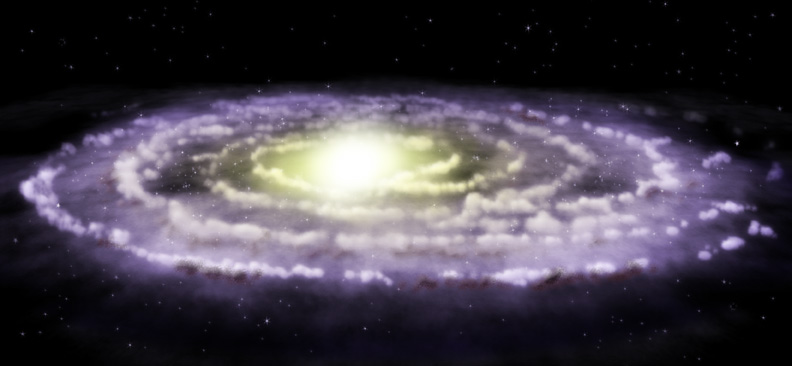 Artist’s concept of our Milky Way galaxy. The galaxy’s halo is a large sphere encompassing the entire Milky Way. Inside this sphere, astronomers said they have just discovered an ultra-faint satellite galaxy. Image via NASA.
Why ultra-faint galaxies matter
Artist’s concept of our Milky Way galaxy. The galaxy’s halo is a large sphere encompassing the entire Milky Way. Inside this sphere, astronomers said they have just discovered an ultra-faint satellite galaxy. Image via NASA.
Why ultra-faint galaxies matter
Ultra-faint dwarf galaxies are the least luminous and least chemically enriched (oldest) galaxies known. They are also believed to be the most dark matter-dominated. Dark matter is a mysterious substance believed to make up roughly 85% of all the universe’s matter (or 27% of the total universe). Dark energy, meanwhile, makes up the majority of the universe.
Astronomers study ultra-faint dwarf galaxies in part because they hold clues about how the first galaxies formed and how dark matter shaped the early universe.
Just the beginning for RubinAquarius IV is already an exciting discovery using just the earliest observations from the Rubin Observatory. As the paper says:
Aquarius IV is among the faintest known Milky Way satellites in the distant halo, demonstrating Rubin’s ability to reveal ultra-faint satellites at the limits of existing surveys, even in its initial phases of operation. The sensitivity of Rubin LSST will steadily increase, and systems similar to Aquarius IV are expected to be detectable with more than 85% efficiency using the same search algorithm applied here. Rubin LSST thus stands poised to revolutionize the census of ultra-faint Milky Way satellites.
Bottom line: The Vera C. Rubin Observatory has only just begun its survey, yet it has already discovered Aquarius IV, an ultra-faint satellite galaxy of the Milky Way.
Read more: Rubin Observatory begins 10-year timelapse of the universe
Read more: Rubin Observatory launches real-time alert system
Kelly Kizer Whitt writes and edits some of the most fascinating stories at EarthSky.org. She's been writing about science, with a focus on astronomy, for decades. She began her career at Astronomy Magazine and made regular contributions to other outlets, including AstronomyToday and the Sierra Club. She has nine published books, including a children's picture book, Solar System Forecast, and a young adult dystopian novel, A Different Sky.
| # | Наименование новости | Тональность | Информативность | Дата публикации |
|---|---|---|---|---|
| 1 | Dwarf Galaxy Has "Too Many" Satellites | 0 | 9.03 | 09-03-2026 |
| 2 | A first! 3 supermassive black holes discovered in 1 galaxy | 0 | 8.88 | 21-08-2026 |
| 3 | 🌌 Обсерватория Веры Рубин сфотографировала более 500 тысяч галактик в ... | 0 | 10.23 | 04-08-2026 |
| 4 | Galaxien: Lichtschwache Zwerggalaxie bei Andromeda entdeckt | 0 | 5 | 30-06-2026 |
| 5 | The Milky Way’s arms might not look as we thought | 0 | 7 | 03-07-2026 |
| 6 | MAGAZ3NE: Confirming Dust Deficiency and Quiescent Nature of Ultramassive Galaxies at 3 < z < 4 with ALMA Observations | 0 | 14.1 | 29-07-2026 |
| 7 | Получены первые снимки самого яркого квазара текущей Вселенной | 0 | 0 | 19-05-2023 |
| 8 | 🌌✨ Найдена галактика-призрак рядом с Андромедой Представьте: в двух шагах ... | 8 | 7 | 30-06-2026 |
| 9 | The largest digital camera ever built begins decade-long survey of the universe | 5 | 7 | 30-06-2026 |