Просмотр новости
Найдите то, что Вас интересует
 Спутники
 РН
РН SpaceX
 Роскосмос
 NASA
NASA
СпутникиРНSpaceXРоскосмосNASAHyundai Motor Group installed its first industrial 3D printer in 1996. Nearly 30 years later, Hyundai Motor and Kia have opened an entire facility dedicated to additive manufacturing research and production: the Additive Manufacturing Solution Center (AMSC), located at the…
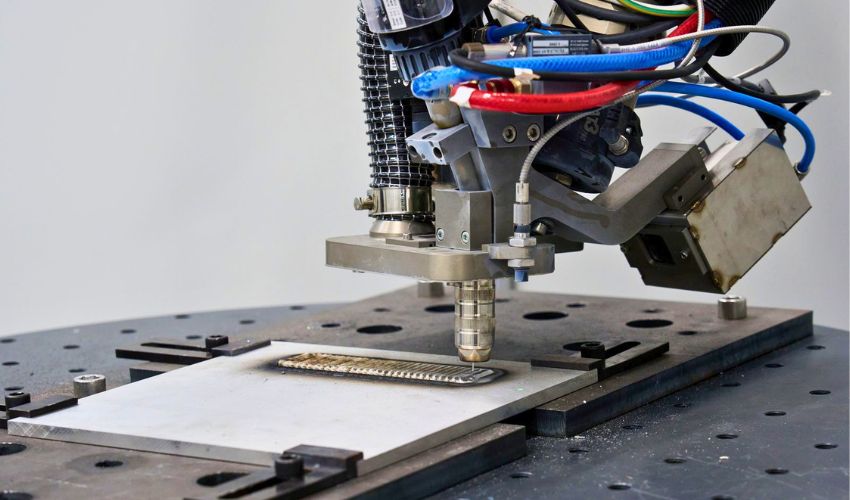
Hyundai Motor Group installed its first industrial 3D printer in 1996. Nearly 30 years later, Hyundai Motor and Kia have opened an entire facility dedicated to additive manufacturing research and production: the Additive Manufacturing Solution Center (AMSC), located at the Namyang R&D Center in South Korea.
The AMSC is one of four Namyang facilities Hyundai has been detailing in a series on its digital R&D infrastructure, alongside the Driving Simulator, the Digital Measuring Center and the NOVA Lab for electrical architecture validation. It resides in a newly built facility inside the Advanced Mobility Solutions building and runs both polymer and metal processes.
Two Materials, One Facility“We are rapidly internalizing additive manufacturing technologies through a growing range of applications across the Group. Beyond vehicle components, we are expanding their use in high-value applications such as equipment consumables and manufacturing tools.” – Hanwoo On, Senior Manager of the Additive Manufacturing Solutions Team, Hyundai Motor and Kia
For polymer parts, the AMSC uses two vat photopolymerization techniques, digital light processing (DLP) and stereolithography (SLA), along with polymer powder bed fusion (polymer PBF). DLP and SLA handle the finely detailed work: design validation and prototypes where dimensional accuracy matters most. Polymer PBF is preferred for larger, more robust parts.
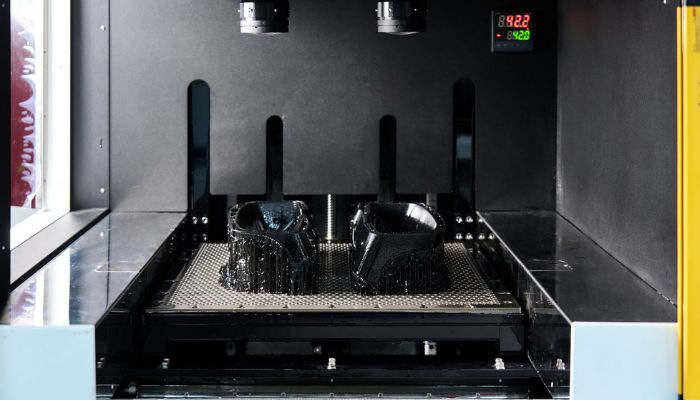
Vat photopolymerization cures liquid resin layer by layer using light.
Metal applications include laser powder bed fusion (LPBF) and directed energy deposition (DED). The DED line includes wire arc additive manufacturing (WAAM), which works with steel, stainless steel, aluminum and titanium.
Hyundai showcased one vehicle motor housing twice over: once as printed in WAAM, and once after CNC machining. Large-format metal AM gets you close to the shape; CNC machining gets you to the finished part.
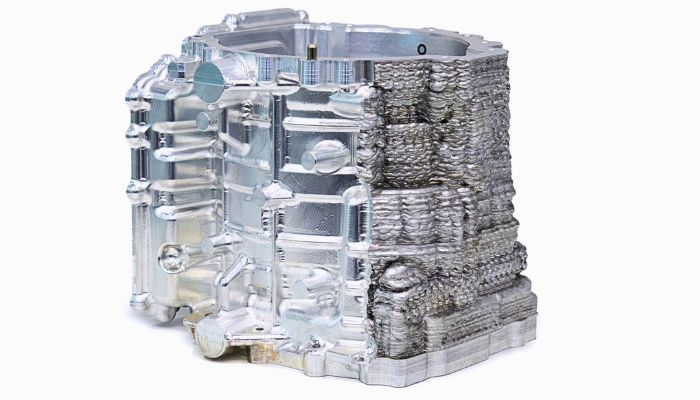
A sample metal component after partial CNC machining, demonstrating post-processing of an additively manufactured part.
The AMSC is also building up design for additive manufacturing (DfAM) skills: part consolidation, lattice structures, lighter geometries. That is where the payoff sits, in parts optimized for weight and performance rather than for what the tooling allows.
Every fabricated component undergoes dimensional and mechanical testing in the center’s Quality Inspection Cell. Hyundai says parts are evaluated against production-equivalent standards, with material verification and metallurgical analysis also carried out in house.
Real-World ApplicationsBeyond prototyping, the AMSC already produces jigs and fixtures, service parts for discontinued models where conventional tooling no longer makes economic sense, and motorsport components including anti-roll bar blades, damper brackets and brake duct rails. Engineers are also using 3D scanning and reverse engineering to recreate obsolete parts for heritage restoration, including a reproduced side-sill for the Hyundai Pony, the first car Hyundai ever produced.
<span data-mce-type=bookmark style="display: inline-block; width: 0px; overflow: hidden; line-height: 0;" class=mce_SELRES_start></span>
With design, production, post-processing and quality inspection all under one roof, the AMSC shortens the path from digital blueprint to finished hardware. It also gives engineers more freedom to optimize parts for weight, geometry and performance without being limited by conventional tooling.
Do you think other automakers will follow Hyundai’s lead and build dedicated in-house AM centers, or will most continue relying on outside suppliers? Let us know in a comment below or on our LinkedIn and Facebook pages! Don’t forget to sign up for our free weekly Newsletter here, the latest 3D printing news straight to your inbox! You can also find all our videos on our YouTube channel.
*All Photo Credits: Hyundai Motor Group
| # | Наименование новости | Тональность | Информативность | Дата публикации |
|---|---|---|---|---|
| 1 | Inside Hyundai Motor Group’s Additive Manufacturing Solution Center | 0 | 6.24 | 10-08-2026 |
| 2 | Hyundai launches IONIQ 3 production to embolden Türkiye's EV ambitions | 0 | 14.49 | 14-08-2026 |
| 3 | Завод "Немак Рус" в Ульяновске вложит 1,7 млрд рублей в проект для автомобилей Hyundai | 0 | 0 | 10-07-2020 |
| 4 | Hyundai открыл в Петербурге крупнейший в России завод по производству двигателей | 0 | 0 | 09-09-2021 |
| 5 | Hyundai Launches Mobile Healthcare Demo in Indonesia | 0 | 9.18 | 14-08-2026 |
| 6 | Hyundai построила завод в КНР | 0 | 0 | 01-06-2023 |
| 7 | Hyundai motor Türkiye’den yeni batarya yatırımı | 5 | 7 | 18-06-2026 |
| 8 | HD Korea Shipbuilding, Schneider Electric Partner on Offshore Data Center Technology | 0 | 5 | 09-07-2026 |
| 9 | 💰📣Правительство и ведущие концерны Южной Кореи продолжают раскрывать свои грандиозные ... | 5 | 8 | 05-07-2026 |