Просмотр новости
Найдите то, что Вас интересует
 Спутники
 РН
РН SpaceX
 Роскосмос
 NASA
NASA
СпутникиРНSpaceXРоскосмосNASASurviving Hurricane Katrina inspired Elliott White Jr.’s scientific journey to studying how humans and climate change impact wetlands.
Being from New Orleans, La., Elliott White Jr. has a clear understanding of the importance of healthy wetland ecosystems. He was 12 when Hurricane Katrina struck the Louisiana coast, which is home to vast wetlands. After the destructive storm, his family had to relocate to Galveston, Texas. “That was actually the driving force for me studying wetlands,” he says. “Since then, I have a more scientific reason. … Scientifically, wetlands are the ultimate ecosystem.” They let scientists like White investigate many scientific interests at once.
White now studies how climate change, sea level rise and human impacts affect coastal ecosystems and local communities. He has to think about how plants, soil, water and animals interact with each other. And he considers how humans help or hurt in these environments. “It’s [focusing] on environmental science in one hand and social sciences in the other hand — and doing so in a way that actually brings them together,” he says.
While working on his Ph.D. at the University of Florida, White studied the part of the Okefenokee swamp that drains into the Suwannee River. That led him to becoming an advisor on the Okefenokee’s application to be named a UNESCO World Heritage Site. This designation would grant the land extra protections for future generations to enjoy. Now, he’s at Stanford University in California leading a group that’s studying wetlands around the world. In this interview, he shares his experience and advice with Science News Explores. (This interview has been edited for content and readability.)
What made you want to study wetlands?In my junior year of undergrad, I decided I wanted to go to graduate school. But when my undergraduate academic advisor asked me what I wanted to study, I hadn’t thought that far yet. I went back to my dorm room and remembered this ad would play on the radio when I was growing up in New Orleans. It said, “Louisiana is losing a football field of wetlands every 45 minutes.”
In my college coursework, I learned that wetlands can actually reduce the impacts of hurricanes and reduce storm surges. And so I wondered, if Louisiana hadn’t been losing wetlands for at least 100 years, would Hurricane Katrina have been so bad? Would my family and I have had to evacuate and relocate? That’s where that really strong desire to study wetlands and restore them came from. If wetlands can be a part of our natural defense systems against hurricanes, then we need to do what we can to save them.
What are you researching right now?I’m in The Gambia in West Africa studying a wetland ecosystem called mangrove forests. Most plants cannot tolerate being in salt water, but mangrove trees can. What’s happening in Gambia right now is primarily driven by climate change. There’s not as much fresh water coming down the River Gambia. The soil is becoming too salty even for mangroves to live. Huge patches of the mangrove forest are dying off.
Companies from other countries are replanting mangroves as part of restoration efforts. But they’re not always replanting mangroves in the best places or planting the right species. This could cause problems in the mangrove ecosystem. Some of the animals that used to live in a more diverse mangrove ecosystem are now living in a mangrove ecosystem that only has one type of tree, for instance.
And the human population can be affected, too. Culturally, the people of Gambia use the mangrove ecosystem for a lot of different things. They use the wood for building. Oysters grow on the roots of the trees. People are losing access to their livelihood and food. It’s important to make sure that we’re doing this restoration correctly. So that not only the ecosystem benefits properly, but the humans living in those landscapes are interacting with the right mix of species.
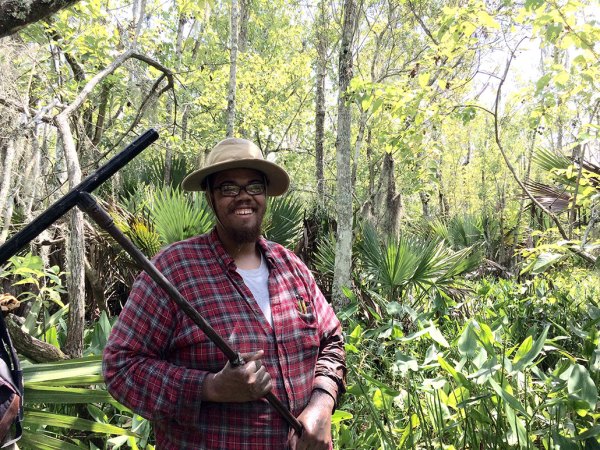 Elliott White Jr. had to leave Louisiana as a child after Hurricane Katrina devastated New Orleans, where his family had been living. In graduate school, he began to wonder if more intact wetlands (such as the one seen here) might have limited the storm’s damage.David KaplanHow do you get your best ideas?
 I get my best ideas doing field work. Going out and being in the environment, you get a chance to see things in a way that you can never really experience in the classroom. When you’re out there, you get a chance to see how these things actually interact in person, and you get to see variation.
What is one of your biggest successes?Graduating with a Ph.D. is a big success for me. I’m the first person in my family to do anything like that. Many people in my family have college degrees, but none of them did science. I’m also the only one in my family, as far as I know, that pursued science as a professional career.
Have you ever made a mistake in your career? How did you overcome it?I was placed on academic probation, and I had to meet with my advisor. It was the most beneficial meeting I probably had in my career. He was trying to build me back up, and he diagnosed the problem as imposter syndrome, which is people feeling like they don’t belong in a certain environment for many different reasons. Sometimes it’s made worse by the fear that if you ask for help, other people might also think that you don’t belong. And that was what was really holding me back.
The major lesson that came out of that experience is just learning how to ask for help. And not being afraid that people will think less of me or think I’m not smart enough because I have to ask for help. Even at this point in my career, I still ask people for help.
What piece of advice do you wish you had been given when you were younger?Some people may find themselves in places and spaces where they’re the only one that looks like them, and sometimes that can be challenging to deal with. But just because you’re the only one that looks like you in a certain place or space doesn’t mean that you don’t belong. You very much do belong there.
What would you say to kids who experience natural disasters like you did growing up?There’s always tomorrow. The place you live at may be experiencing climate change in a really drastic way, but that’s not the end all, be all for your life and what you can be. And sometimes when you are in those types of places where it seems like there’s no hope, you just have to look for those silver linings to keep you motivated and to keep you moving forward. Because sometimes when you get stuck, it’s hard to get out. And that’s true in wetlands, too. Sometimes you get stuck in the mud and it’s very hard to climb out.
academic: Relating to school, classes or things taught by teachers in formal institutes of learning (such as a college).
application: A particular use or function of something.
climate: The weather conditions that typically exist in one area, in general, or over a long period.
climate change: Long-term, significant change in the climate of Earth. It can happen naturally or in response to human activities, including the burning of fossil fuels and clearing of forests.
defense: (in biology) A natural protective action taken or chemical response that occurs when a species confronts predators or agents that might harm it.
ecosystem: A group of interacting living organisms — including microorganisms, plants and animals — and their physical environment within a particular climate. Examples include tropical reefs, rainforests, alpine meadows and polar tundra. The term can also be applied to elements that make up some artificial environment, such as a company, classroom or the internet.
environment: The sum of all of the things that exist around some organism or the process and the condition those things create. Environment may refer to the weather and ecosystem in which some animal lives, or, perhaps, the temperature and humidity (or even the placement of things in the vicinity of an item of interest).
environmental science: The study of ecosystems to help identify environmental problems and possible solutions. Environmental science can bring together many fields including physics, chemistry, biology and oceanography to understand how ecosystems function and how humans can coexist with them in harmony. People who work in this field are known as environmental scientists.
field: An area of study, as in: Her field of research is biology. Also a term to describe a real-world environment in which some research is conducted, such as at sea, in a forest, on a mountaintop or on a city street. It is the opposite of an artificial setting, such as a research laboratory.
football field: The field on which athletes play American football. Owing to its size and familiarity, many people use this field as a measure of how big something is. A regulation field (including its end zones) runs 360 feet (almost 110 meters) long and 160 feet (almost 49 meters) wide.
force: Some outside influence that can change the motion of an object, hold objects close to one another, or produce motion or stress in a stationary object.
forest: An area of land covered mostly with trees and other woody plants.
generation: A group of individuals (in any species) born at about the same time or that are regarded as a single group. Your parents belong to one generation of your family, for example, and your grandparents to another. Similarly, you and everyone within a few years of your age across the planet are referred to as belonging to a particular generation of humans. The term also is sometimes extended to year classes of other animals or to types of inanimate objects (such as electronics or automobiles).
graduate school: A university program that offers advanced degrees, such as a Master’s or PhD degree. It’s called graduate school because it is started only after someone has already graduated from college (usually with a four-year degree).
hurricane: A tropical cyclone that occurs in the Atlantic Ocean and has winds of 119 kilometers (74 miles) per hour or greater. When such a storm occurs in the Pacific Ocean, people refer to it as a typhoon.
imposter syndrome: A form of self-doubt that people sometimes experience. An inner voice seems to tell them they aren’t up to managing what others assume they can do. Affected people may think of themselves as a fraud who is faking it. Even well-trained and successful people may at times feel this way.
major: (in education) A subject that a student chooses as their area of focus in college, such as: chemistry, English literature, German, journalism, pre-medicine, electrical engineering or elementary education.
mangrove: A type of shrub or tree that lives mostly in coastal swamps and usually has long, tangled, above-ground roots.
Ph.D.: (also known as a doctorate) A type of advanced degree offered by universities — typically after five or six years of study — for work that creates new knowledge. People qualify to begin this type of graduate study only after having first completed a college degree (a program that typically takes four years of study).
population: (in biology) A group of individuals (belonging to the same species) that lives in a given area.
salt: A compound made by combining an acid with a base (in a reaction that also creates water). The ocean contains many different salts — collectively called “sea salt.” Common table salt is a made of sodium and chlorine.
sea: An ocean (or region that is part of an ocean). Unlike lakes and streams, seawater — or ocean water — is salty.
sea level: The overall level of the ocean over the entire globe when all tides and other short-term changes are averaged out.
social: (adj.) Relating to gatherings of people; a term for animals (or people) that prefer to exist in groups. (noun) A gathering of people, for instance those who belong to a club or other organization, for the purpose of enjoying each other’s company.
social science: A research field that deals with human society, with organizations and institutions that people join or work for, and with relationships between individuals and those organizations. Economics and political science are subsets of social science that deal with how groups of people organize and make important decisions for the good of society. People who work in all of these fields are known as social scientists.
species: A group of similar organisms capable of producing offspring that can survive and reproduce.
storm surge: A storm-generated rise in water above normal tidal level. In most cases, the largest cause of storm surge is strong onshore winds in a hurricane or tropical storm.
syndrome: Two or more symptoms that together characterize a particular disease, disorder or social condition.
system: A network of parts that together work to achieve some function. For instance, the blood, vessels and heart are primary components of the human body's circulatory system. Similarly, trains, platforms, tracks, roadway signals and overpasses are among the potential components of a nation's railway system. System can even be applied to the processes or ideas that are part of some method or ordered set of procedures for getting a task done.
undergrad: Short for undergraduate, which is a student at a two- or four-year college.
wetland: As the name implies, this is a low-lying area of land either soaked or covered with water much of the year. It hosts plants and animals adapted to live in, on or near water.
wood: A porous and fibrous structural tissue found in the stems and roots of trees, shrubs and other woody plants.