Просмотр новости
Найдите то, что Вас интересует
 Спутники
 РН
РН SpaceX
 Роскосмос
 NASA
NASA
СпутникиРНSpaceXРоскосмосNASALight pollution in North American cities seems to be tricking plants into releasing pollen for longer periods each year.
Nearly one in four U.S. adults have seasonal allergies. So do one in five kids. Most of those allergies are to mold spores or pollen from ragweed, grasses and trees. Now, a study finds, flashy billboards, streetlights and bright buildings are extending pollen season in cities.
Indeed, that season can now run two months longer there than in rural areas.
Why? Plants are sensitive to changes in day length — how many hours of sunlight they get. They also take cues from changes in temperature and rainfall. In spring, days gradually lengthen at the same time that soil and air temps rise. These cue tree buds to swell and break open. Likewise, longer and warmer summer days prompt plants to flower and release pollen.
Exposure to lights at night can “disrupt the natural day-length signal,” says Lin Meng. She’s an ecologist at Vanderbilt University in Nashville, Tenn. She’s also an author of the new study. Night lighting makes plants think days are longer than they really are.
Past studies had found that global warming has been extending and intensifying the pollen season in North America. Spring has also been coming six days earlier on average in the United States. Meng and her team wondered if light pollution affected pollen season, too.
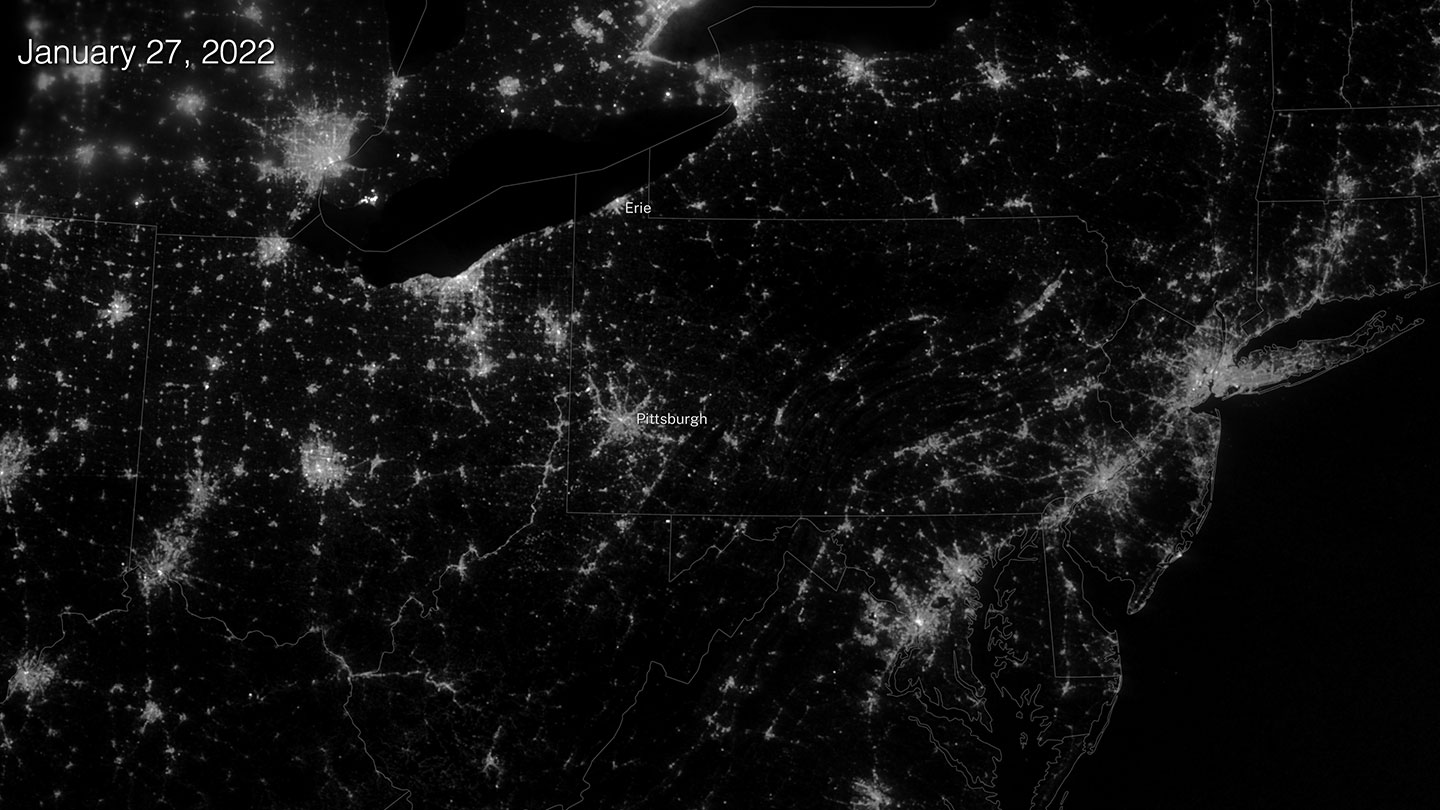 This satellite image of a clear January night in 2022 shows light at night over the northeastern United States. Light pollution could be strong enough to trick plants into extending their pollen seasons.NASA Scientific Visualization StudioFour seasons in bright cities
To find out, they studied daily pollen data from the U.S. Northeast between 2012 and 2023. The measurements came from 12 pollen-monitoring stations. All had been managed by the National Allergy Bureau. (It’s a resource of the American Academy of Allergy, Asthma and Immunology.) The researchers compared those pollen data with satellite measurements of light at night. The team also looked at temperature and rainfall data.
Why focus on the U.S. Northeast? It has several of the country’s biggest and most light-polluted cities, Meng notes. These include New York City, Boston and Philadelphia. It also has four distinct growing seasons and large populations affected by pollen allergies.
Pollen season starts around 20 days earlier in cities than in rural areas, Meng’s team now reports. It also ends 20 to 30 days later. This suggests light-polluted cities expose people to pollen nearly two months longer than rural areas will. Cities also experienced more high-pollen days than rural areas — and more severe pollen levels.
Higher temperatures also help extend pollen seasons, the study found. Pollen season began earlier in warmer places.
“Our study shows that artificial light actually plays a role in the risk of pollen allergies,” Meng concludes. “This is just one example of how light pollution can affect the environment.”
See how common light pollution is around the world and the effects it can have beyond extending the pollen season.Forecasting wheezy days“Right now, allergy forecasts are mostly based on temperature,” Meng says. She thinks her group’s light-at-night findings could help improve pollen forecasts. These advise allergy sufferers when it’s safe to exercise outside.
Theresa Crimmins describes the new study as novel and impactful. “It’s a relatively recent notion,” this plant ecologist says, “but it has been established that artificial light influences the timing of flowering.” Crimmins works at the University of Arizona in Tucson.
More than 106 million people in the United States suffer from asthma and allergies. Pollen triggers many of their allergies. “Wind-pollinated trees and grasses cause most pollen allergies in North America,” Crimmins points out. “They generate a whole lot of pollen.”
Catkins hang from a birch tree in spring. Many anemophilous — wind-pollinated — trees sprout these droopy flower clusters that produce light, tiny pollen. Birches, oaks, willows and cottonwoods produce catkins — and can trigger pollen allergies.ligora/Creatas Video+/Getty Images PlusThe pollen season typically runs from spring to early summer. Tree pollen shows up first, followed by grasses. Ragweed sheds pollen toward fall. Pollen allergies cause itchy and watery eyes, sneezing, a runny or stuffy nose and a scratchy throat or difficulty breathing.
Less well known: Seasonal allergies can mess with our thinking. One Norwegian study of high school students found that when compared to those without allergies, random increases in pollen counts reduced test scores for students with allergies.
More studies neededCrimmins is not sure how broadly the new findings might apply. The U.S. Northeast is “fairly compact,” she notes. “If you expanded [data collection] over a larger area, the story might get a little more complicated.” Areas with hills and valleys, different ecosystems and different climates might well turn up different results, she says.
Still, this study “is consistent with a lot of what we know experimentally,” says Jon Bennie. He’s a biogeographer at the University of Exeter in Cornwall, England. “We know that artificial light, at least locally, does alter the phenology of trees and grasses.” Phenology refers to the link between climate and biological events. Those events include things such as the budding of plants, emergence of animals from hibernation and migration of birds.
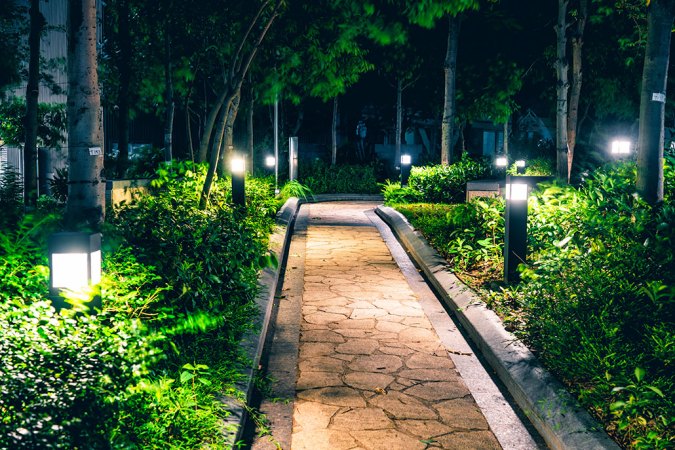 As attractive as these garden lights are at night, they can keep plants from resting their growth. Such illumination can cause some of those plants to extend their seed-making season — and our risk of exposure to the pollen responsible for seasonal allergies. CHUNYIP WONG/iStock/Getty Images Plus
Bennie found it interesting, for instance, that the study found light pollution extended the end of the growing season more than its beginning. The start of pollen season is usually driven by a mixture of day length and temperature, he says. The end of the season is more dependent just on day length. “So that’s consistent,” he says.
Yet he, too, thinks the study needs more “robust” data. For instance, he’d like to see studies look into possible effects of urban heat islands on pollen levels in these regions. This is where concrete and asphalt in cities absorb the sun’s heat. That trapped heat makes cities become warmer than surrounding areas. (This is different from climate change, but climate change can make it worse).
There will always be uncertainties in studies that rely on remote-sensing (satellite) data, Meng says. “We weren’t able to validate it with ground data,” she says. “But we will be building on this study [in] future work.”
In the meantime, kids can help reduce light pollution. “Just turn off the light,” Meng says. “Reduce unnecessary lights outside your homes. It’s a type of pollution for trees and a waste of energy.”
allergy: The inappropriate reaction by the body’s immune system to a normally harmless substance. Untreated, a particularly severe reaction can lead to death.
asthma: A disease affecting the body’s airways, which are the tubes through which animals breathe. Asthma obstructs these airways through swelling, the production of too much mucus or a tightening of the tubes. As a result, the body can expand to breathe in air, but loses the ability to exhale appropriately. The most common cause of asthma is an allergy. Asthma is a leading cause of hospitalization and the top chronic disease responsible for kids missing school.
average: (in science) A term for the arithmetic mean, which is the sum of a group of numbers that is then divided by the size of the group.
climate: The weather conditions that typically exist in one area, in general, or over a long period.
climate change: Long-term, significant change in the climate of Earth. It can happen naturally or in response to human activities, including the burning of fossil fuels and clearing of forests.
ecologist: A scientist who works in a branch of biology that deals with the relations of organisms to one another and to their physical surroundings.
ecosystem: A group of interacting living organisms — including microorganisms, plants and animals — and their physical environment within a particular climate. Examples include tropical reefs, rainforests, alpine meadows and polar tundra. The term can also be applied to elements that make up some artificial environment, such as a company, classroom or the internet.
global warming: The gradual increase in the overall temperature of Earth’s atmosphere due to the greenhouse effect. This effect is caused by increased levels of carbon dioxide, chlorofluorocarbons and other gases in the air, many of them released by human activity.
hibernation: A state of inactivity that some animals enter to save energy at certain times of year. Bears and bats, for example, may hibernate through the winter. During this time, the animal does not move very much, and the use of energy by its body slows down. This eliminates the need to feed for months at a time.
high school: A designation for grades nine through 12 in the U.S. system of compulsory public education. High-school graduates may apply to colleges for further, advanced education.
immunology: The field of biomedicine that deals with the immune system. A doctor or scientist who works in that field is known as an immunologist.
light pollution: The intrusion of unwanted light into areas that would naturally remain dark. Light pollution interferes with our ability to view the night sky. It also alters the circadian rhythms of plants, animals and people.
link: A connection between two people or things.
migration: (v. migrate) Movement from one region or habitat to another, especially regularly (and according to the seasons) or to cope with some driving force (such as climate or war). An individual that makes this move is known as a migrant.
novel: Something that is clever or unusual and new, as in never seen before. (in literature) A work of fiction.
phenology: The study of periodic and seasonal phenomena in wildlife (such as when birds migrate or flowers bloom). Some of these studies focus on how one type of event (such as bloom dates) line up with another phenomenon, such as the normal arrival in a location of a pollinator for those flowers.
pollen: Powdery grains released by the male parts of flowers that can fertilize the female tissue to make a seed. Pollinating insects, such as bees, often pick up pollen that will later be eaten.
population: (in biology) A group of individuals (belonging to the same species) that lives in a given area.
random: Something that occurs haphazardly or without reason, based on no intention or purpose. Or an adjective that describes some thing that found itself selected for no particular reason, or even chaotically.
risk: The chance or mathematical likelihood that some bad thing might happen. For instance, exposure to radiation poses a risk of cancer. Or the hazard — or peril — itself. (For instance: Among cancer risks that the people faced were radiation and drinking water tainted with arsenic.)
spore: A tiny, typically single-celled body that is formed by certain bacteria in response to bad conditions. Or it can be the single-celled reproductive stage of a fungus (functioning much like a seed) that is released and spread by wind or water. Most are protected against drying out or heat and can remain viable for long periods, until conditions are right for their growth.
Report: Asthma and Allergy Foundation of America. 2026 Allergy Capitals: The most challenging places to live with allergies. March 2026, 29 pp.
Journal: B. Geist et al. Artificial light at night extends pollen season and elevates allergen exposure. PNAS Nexus. Vol. 5, January 2026. doi: 10.1093/pnasnexus/pgaf405.
Journal: W.R.L. Anderegg et al. Anthropogenic climate change is worsening North American pollen seasons. Proceedings of the National Academy of Sciences. Vol. 118, February 8, 2021. doi: 10.1073/pnas.2013284118.
Journal: A. Sapkota et al. Associations between alteration in plant phenology and hay fever prevalence among US adults: Implication for changing climate. PLoS One. Vol. 14, March 28, 2019, p. e0212010. doi: 10.1371/journal.pone.0212010.
Journal: S.S. Bensnes. You sneeze, you lose: The impact of pollen exposure on cognitive performance during high-stakes high school exams. Journal of Health Economics. Vol. 49, September 2016, p. 1. doi: 10.1016/j.jhealeco.2016.05.005.
| # | Наименование новости | Тональность | Информативность | Дата публикации |
|---|---|---|---|---|
| 1 | Experts: Pollen and seasonal allergies | 0 | 6.05 | 24-04-2026 |
| 2 | Аллерголог Логина объяснила, как защититься от пыльцы в разгар цветения | 0 | 8.71 | 26-07-2026 |
| 3 | В Москве уровень пыльцы в воздухе снизился в 2 раза | 0 | 10.39 | 10-07-2026 |
| 4 | Аллергиков предупредили о пыльцевом дожде из-за цветения ольхи и орешника | 0 | 0 | 14-04-2021 |
| 5 | Malaga province records extreme pollen levels causing suffering for many allergic residents | 0 | 8.36 | 15-05-2026 |
| 6 | Pollution May Be Responsible for Thousands of Deaths a Year in This U.S. City | 0 | 8.4 | 26-03-2026 |
| 7 | Toxic air crisis grips US as three major cities rank as most dangerous to breathe worldwide | 0 | 5.62 | 17-07-2026 |
| 8 | Весеннее обострение: что такое поллиноз и как справиться с сезонной аллергией | 0 | 6.88 | 09-04-2026 |
| 9 | Зеленые легкие города неожиданно превратились в источник опасного газа | 0 | 9.11 | 21-08-2026 |