Просмотр новости
Найдите то, что Вас интересует
 Спутники
 РН
РН SpaceX
 Роскосмос
 NASA
NASA
СпутникиРНSpaceXРоскосмосNASALake Powell is the 2nd-largest reservoir in the U.S. But with climate and usage stresses, the lake is shrinking. It could reach dead pool by spring 2027.
The post Lake Powell is shrinking toward ‘dead pool’ levels first appeared on EarthSky.
 The Bullfrog Basin portion of Lake Powell in the Glen Canyon National Recreation Area of Utah. This pair of images from ESA’s Copernicus shows how low the water level has gotten in the past decade. Image via ESA/ Copernicus.Lake Powell is shrinking toward ‘dead pool’ levels
Lake Powell in the Glen Canyon National Recreation Area of Utah. This pair of images from ESA’s Copernicus shows how low the water level has gotten in the past decade. Lake Powell is a human-made reservoir on the Colorado River that runs from Arizona into Utah. The completion of Glen Canyon Dam on the Colorado River in 1963 created Lake Powell. When full, it’s the 2nd-largest reservoir in the United States, behind Lake Mead. But drought over the past decades has caused Lake Powell to shrink. As of midsummer 2026, it had reached its lowest summer level ever, at only about 23% capacity.
At full capacity, it holds more than 23 million acre-feet of water (28 billion cubic meters). Currently, Lake Powell is holding just 5 million acre-feet of water. As of July 29, 2026, the lake level is at 3,522.78 feet. The record for the lowest level on Lake Powell is 3,519.92 feet, which it reached on April 13, 2023.
Lake Powell now stands at 152.78 ft above dead pool. Dead pool is when water in a reservoir drops so low that it can’t flow downstream from the dam. It would have serious consequences for the people and farmland downstream. There is also a turbine at the base of Glen Canyon Dam. If the water level were to drop low enough, the turbine would lose capacity to produce power. A July report from the Bureau of Reclamation said this could happen as early as spring 2027.
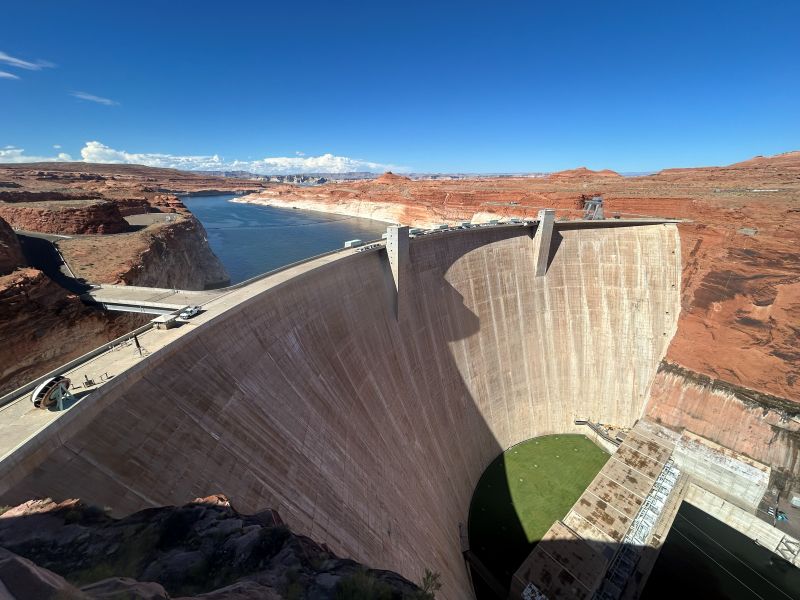 This was the view from the visitor center at Glen Canyon Dam in August of 2024. This dam created the reservoir known as Lake Powell, which extends from Arizona into Utah. Image via Lucy Whitt. Used with permission.Why are Lakes Powell and Mead and the Colorado River shrinking?
There are a number of factors putting stress on these bodies of water. One is the increased demand as our population grows. The water downstream is used for drinking, but the majority of it is used in farming. And climate change has also been another big factor, leading to hotter weather, more evaporation, less precipitation and smaller snowpack. Plus, one major factor for the low water level this year is the incredibly dry winter this region of the country experienced in 2025-2026.
A water supply crisisLake Mead and Lake Powell hold nearly 60% of the Colorado River Basin’s water. Some 40 million people rely on this water. But currently, those lakes are at their lowest level in about 70 years. As the July report said:
Is there hope for rain and snow?Lake Powell and Lake Mead essentially comprise one gigantic reservoir, separated into two parts by the Grand Canyon.
Every day going forward, until runoff from the 2026-2027 winter snowpack begins next spring, a new record low will likely be set. This is a significant moment in the evolving Colorado River water supply crisis.
We are entering not only an El Niño year, but very likely a supercharged one. Right now, the American Southwest is experiencing monsoon season, and there is some hope that rainfall could alleviate a small portion of the drought. And an El Niño year could lead to increased snowfall this winter. But at this point we still must wait to see how the seasons unfold.
Recreation continues on Lake PowellRight now, there is still plenty of water in Lake Powell that recreational activities continue. Even so, the surrounding communities have taken a hit. It’s unclear whether the drop in tourism is due to visitors choosing to go elsewhere because of news of low lake levels or if it’s related to high gas prices or other reasons.
Marina owners have been extending their boat ramps to continue to have access to the lake. The boat ramp at Bullfrog Marina has been extended so much that at this point, an observer noted, it’s long enough for a small plane to land on it.
At the Glen Canyon National Recreation Area” rel=”noopener” target=”_blank”>Glen Canyon National Recreation Area website, it says:
Lake levels are changing; your adventure isn’t. Open access and a wide range of recreation continue all season long. Since 2001, declining water levels due to climate change and 20 years of drought have reshaped Lake Powell’s shoreline. Today we are experiencing low lake levels and their effects on boat ramp access points, on-lake facilities, and the landscape.
If you want to visit and bring your own boat, visit this page for the latest on lake levels.
Bottom line: Lake Powell is the 2nd-largest reservoir in the United States. But with climate and usage stresses, the lake is shrinking. It could reach dead pool by spring 2027.
Source: A Significant Moment in the Colorado River Water Supply Crisis
Kelly Kizer Whitt writes and edits some of the most fascinating stories at EarthSky.org. She's been writing about science, with a focus on astronomy, for decades. She began her career at Astronomy Magazine and made regular contributions to other outlets, including AstronomyToday and the Sierra Club. She has nine published books, including a children's picture book, Solar System Forecast, and a young adult dystopian novel, A Different Sky.
| # | Наименование новости | Тональность | Информативность | Дата публикации |
|---|---|---|---|---|
| 1 | ‘Uncharted territory’: Second-largest reservoir in US plunges to a record low | 0 | 9.38 | 16-08-2026 |
| 2 | Lake Powell hits record low, threatening key water and electricity supply for millions | 0 | 7.1 | 16-08-2026 |
| 3 | Low Water Levels in Lake Powell and Lake Mead in August 2026 | 0 | 11.56 | 20-08-2026 |
| 4 | Lake Mead’s slow demise just sped up in latest federal study | -2 | 6 | 19-06-2026 |
| 5 | USA: Größter Stausee Lake Mead verzeichnet historisch niedrigen Wasserstand | 0 | 7.9 | 08-08-2026 |
| 6 | Lake Mead expected to drop nearly 33 feet by June 2028, and that’s not even the worst-case scenario | -3 | 6 | 18-07-2026 |
| 7 | СМИ: в США уровень воды в водохранилищах упал до рекордно низкой отметки | 0 | 4.32 | 17-08-2026 |
| 8 | Lake Mead expected to drop nearly 33 feet by June 2028, and that's not even the worst-case scenario | -2 | 7 | 15-07-2026 |
| 9 | Lake Mead’s outlook just went from bad to historically bad | 0 | 14.22 | 16-05-2026 |
| 10 | Sediment is shrinking reservoir storage in the West. Wildfires could make it worse | 0 | 8.1 | 22-09-2026 |