Просмотр новости
Найдите то, что Вас интересует
 Спутники
 РН
РН SpaceX
 Роскосмос
 NASA
NASA
СпутникиРНSpaceXРоскосмосNASAPhotographer Lorenzo Grifantini looks at how the Italian capital’s historic centre has gradually reorganised itself around the uninterrupted flow of visitors and the expectations projected on to itBy mid-morning, the area around the Trevi fountain is already difficult to cross. Visitors stop suddenly to take photographs while tour groups gather behind raised umbrellas, and security staff redirect the flow of people through temporary barriers placed around the monument. Nearby, souvenir kiosks sell rosaries, plastic gladiator helmets, bottled water and magnets in the summer heat.Tourists pose for photographs in front of the Trevi fountain Continue reading...
By mid-morning, the area around the Trevi fountain is already difficult to cross. Visitors stop suddenly to take photographs while tour groups gather behind raised umbrellas, and security staff redirect the flow of people through temporary barriers placed around the monument. Nearby, souvenir kiosks sell rosaries, plastic gladiator helmets, bottled water and magnets in the summer heat.
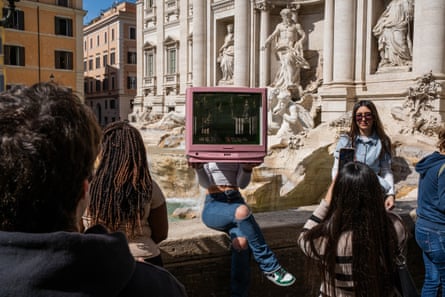
Tourists pose for photographs in front of the Trevi fountain
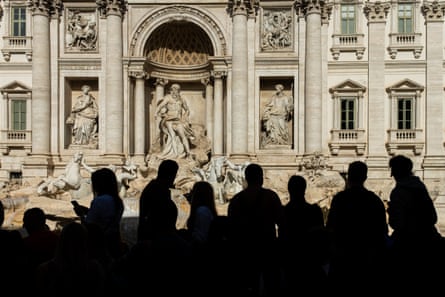
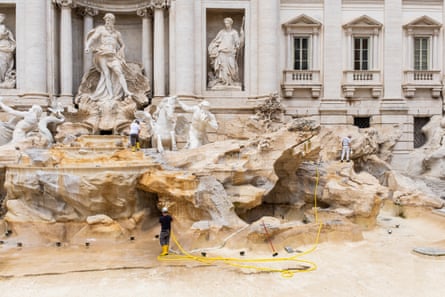
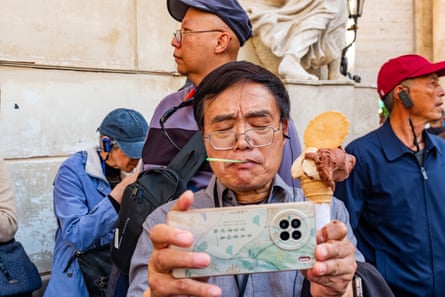
Top left: visitors gather in front of the Trevi fountain. Top right: the fountain during restoration works. Above: a tourist takes a selfie at the fountain while eating an ice-cream
Rome has always depended on the people passing through it. Pilgrims, tourists and travellers have crossed the city for centuries, following routes that were familiar long before they arrived. What feels different today is the scale of that movement, and the way the historic centre has gradually reorganised itself around it.
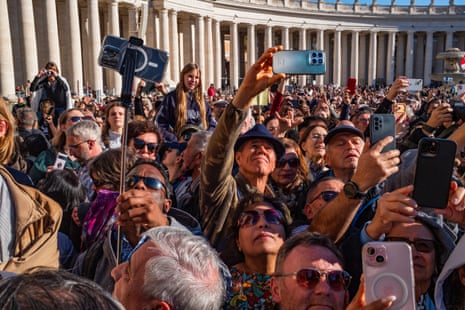
Crowds gather in St Peter’s Square during the Jubilee year in Rome
During the Jubilee year, the city can often feel structured almost entirely around the management of visitors. Barriers redirect pedestrian flows around monuments. Portable toilets sit beside churches and Renaissance walls. Pilgrims queue in the heat outside St Peter’s Square and Castel Sant’Angelo while crowds continue moving through temporary routes and checkpoints. Public space becomes a place of waiting, circulation and constant exposure.
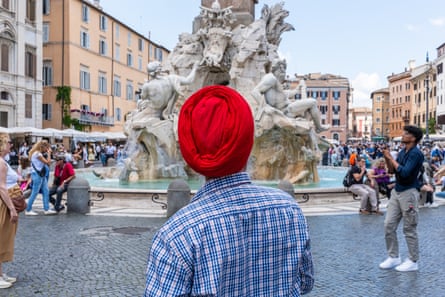
A visitor stands in front of the Fontana dei Quattro Fiumi (fountain of the Four Rivers) in Piazza Navona
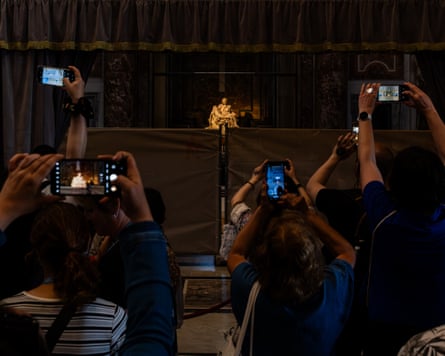
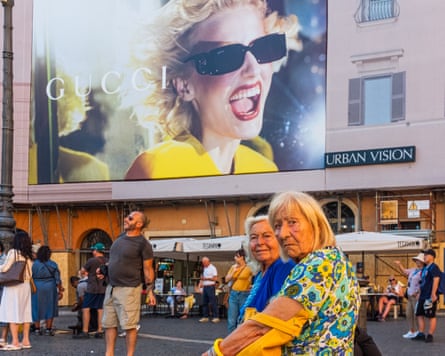
Above left: visitors raise smartphones towards Michelangelo’s Pietà inside St Peter’s Basilica. Above right: tourists gather beneath a luxury fashion advertisement in Piazza Navona
Around Rome’s most visited landmarks, the same gestures repeat themselves throughout the day. Visitors photograph monuments through their phones before looking at them directly. Crowds raise smartphones towards Michelangelo’s Pietà inside St Peter’s Basilica. Tourists sit exhausted around fountains and church steps looking for shade. Outside souvenir kiosks near the Vatican, postcards of the newly elected pope hang beside plastic gladiator helmets, Vatican keychains and novelty souvenirs. Near the Colosseum, inflatable toys and oversized plastic objects drift above the crowds in the afternoon heat. In Piazza Navona and Piazza di Spagna, luxury advertising occupies the same visual space as churches, fountains and temporary tourist infrastructure.
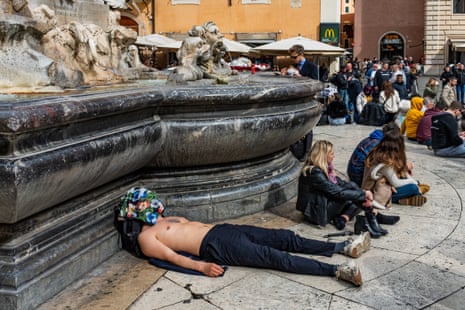
A man sleeps beside a fountain near the Pantheon while tourists rest nearby
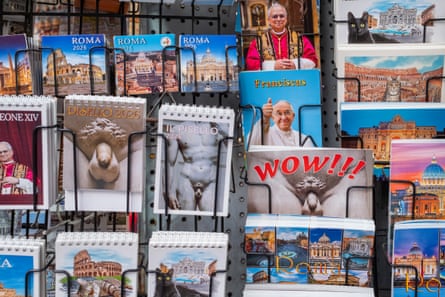
Souvenirs depicting religious figures and landmarks are displayed at a tourist kiosk in central Rome
None of this appears unusual any more. The barriers, queues, guided routes and temporary structures have become part of the normal visual language.
Rome has always been crowded. Tourism itself is not new. What feels more significant is the way the experience of the city is increasingly organised around movement, visibility and repetition. Visitors arrive already carrying familiar images of Rome in their minds – the Trevi fountain, the Pantheon, St Peter’s Square – and much of the city now operates around reproducing those images as efficiently as possible.
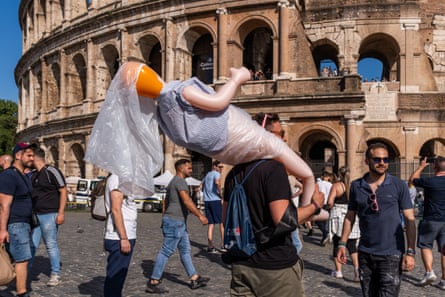
Visitors walk past the Colosseum carrying inflatable souvenirs during peak tourist season
In the summer heat, much of the historic centre becomes organised around waiting. People queue for churches, fountains, tickets, toilets, shade and photographs. Some stop briefly before moving on again a few minutes later. Others sit silently against barriers or sleep beside monuments while crowds continue to move around them. Around the city’s landmarks, exhaustion becomes part of the landscape.
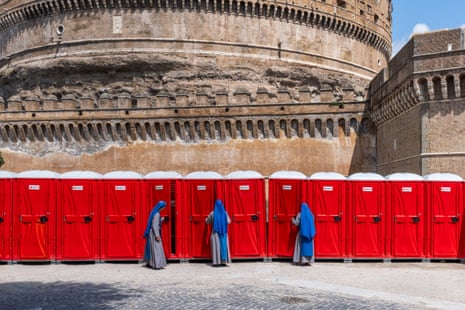
Nuns consider the temporary toilets installed outside Castel Sant’Angelo
At times, sacred space, tourism infrastructure and spectacle begin to collapse into one another. A pilgrim queueing beside temporary toilets outside Castel Sant’Angelo can seem absurd and completely ordinary at the same time.
Again and again, the same patterns emerge: waiting, photographing, resting, queueing, moving on.
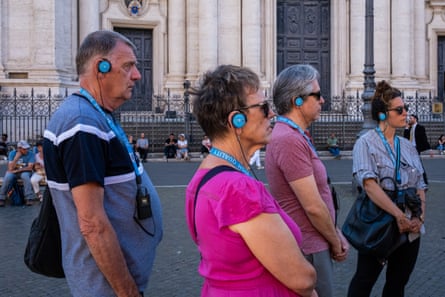
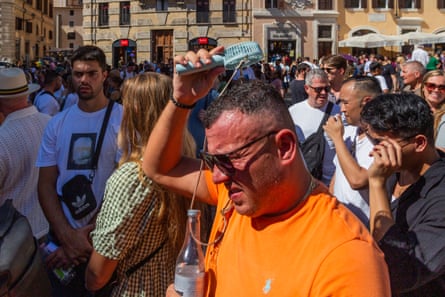
Above left: visitors wearing audio guides cross Piazza Navona. Above right: a tourist shields himself from the heat in Piazza Navona during peak visiting hours
Over time, the city itself begins to feel shaped less by permanence than by passage, by the uninterrupted flow of people moving through it each day.
Rome remains one of the most visited cities in the world, but it has also become a prototype for something larger: a historic city increasingly reorganised around the expectations, rhythms and behaviour of its visitors.
| # | Наименование новости | Тональность | Информативность | Дата публикации |
|---|---|---|---|---|
| 1 | 7 лучших бутик-отелей в Риме | 0 | 20.94 | 23-08-2020 |
| 2 | Motorbikes and mountains: photographing the 2026 Tour de France – photo essay | 0 | 8.14 | 28-07-2026 |
| 3 | 24 best Airbnbs in Rome, from apartments overlooking the Colosseum to designer villas | 2 | 3 | 10-07-2026 |
| 4 | Пустынные улицы, закрытые рестораны и музеи. Как изменился Рим из-за коронавируса | 0 | 0 | 12-03-2020 |
| 5 | 10 лучших отелей с видом на Рим | 0 | 7.62 | 26-08-2020 |
| 6 | Wildfire pollution and clowns on a pilgrimage: photos of the day – Thursday | 0 | 5 | 16-07-2026 |
| 7 | Reflecting Pool drained again as issues plague Trump-backed renovation | 0 | 6 | 11-07-2026 |
| 8 | How Istanbul’s smaller museums tell its bigger story | 0 | 8.95 | 07-07-2026 |
| 9 | Italy displays paintings from an ancient Etruscan tomb, its latest cultural acquisition | 0 | 7 | 01-07-2026 |