Просмотр новости
Найдите то, что Вас интересует
 Спутники
 РН
РН SpaceX
 Роскосмос
 NASA
NASA
СпутникиРНSpaceXРоскосмосNASANATIONAL HARBOR, Md.–The U.S. Air Force is discussing requirements for Increment 2 of the service’s Collaborative Combat Aircraft (CCA) program. “We’re going through some thought machinations about what should Inc […]
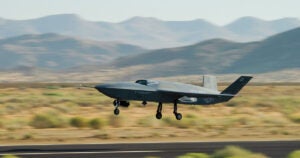 Pictured is a General Atomics YFQ-42A in flight testing last year (U.S. Air Force photo)
 NATIONAL HARBOR, Md.–The U.S. Air Force is discussing requirements for Increment 2 of the service’s Collaborative Combat Aircraft (CCA) program.
“We’re going through some thought machinations about what should Inc 2 be able to do,” Air Force Chief of Staff Kenneth Wilsbach told a Monday reporters roundtable at the Air & Space Forces Association’s annual conference here. “Inc 1 is air-to-air so do we want [Inc 2 to be] air-to-ground? Maybe, maybe not. Do we want it to have more sensors? Do we want it to be a lot cheaper? Do we want it to be maybe more attritable/expendable or more exquisite? Do we want it to be shorter range or longer range? Do we want it to be something that you drop off another platform, or does it take off and land by itself. These are all considerations.”
“It’s still a bit early to make any definitive decisions on that, especially before we really get our hands on the current Inc 1 ones and have some learning,” he said.
Air Force Secretary Troy Meink told the conference on Monday that the Air Force plans to have 500 CCAs by 2032.
In June, the Air Force chose the FQ-42A by General Atomics Aeronautical Systems, Inc. (GA-ASI) and the FQ-44A by Anduril Industries. to enter engineering and manufacturing development for Increment 1 (Defense Daily, June 17).
Anduril said on Monday that it is aiming to build 150 CCAs annually and that it has been testing its YFQ-44A prototype alongside the Lockheed Martin [LMT] F-35 fighter.
On Monday, Wilsbach fielded questions on a variety of topics, including replacements for the at least 45 MQ-9A Reapers by GA-ASI that the Air Force has lost in the Middle East, including operations against Iran, which began on Feb. 28.
An Air Force and Defense Innovation Unit solicitation in July pegged initial operational capability of 20 Massed Modular Aircraft (MMA) to begin replacing the MQ-9A in fiscal 2031, but that schedule has significantly accelerated, as Meink told the conference on Monday that the goal is to have 500 MMAs by 2032.
The Air Force is eyeing a force of at least 180 MMAs–the minimum objective for MQ-9As (Defense Daily, Sept. 3). The Air Force has said that losses in the Middle East have decreased the fleet to 135.
In terms of unit cost for the MMA air vehicle the Air Force is estimating a high-end of $10 million, compared to $20 million for the CCA air vehicle. Those unit costs would increase, depending on mission package.
The MQ-9A line closed last year, but GA-ASI still makes the MQ-9B SkyGuardian and SeaGuardian. GA-ASI has said that the unit cost of the MQ-9A is about $16 million, but the Air Force has said that missionized MQ-9As can cost up to $50 million and the MQ-9B even more.
Asked on Monday whether the MQ-9B could have a role in replacing the Reapers lost in the Middle East, Wilsbach replied, “It could.”
“The one concern I have about the MQ-9B is the cost,” he said. “It’s expensive. Given the MQ-9A and the increase in cost for the MQ-9B, it’s a significant loss if you get one shot down.”
Another platform the Air Force is considering for aiding in the replacement of the Reapers is DZYNE Technologies‘ Unmanned Long-endurance Tactical Reconnaissance Aircraft (ULTRA), which the Air Force Research Laboratory has funded.
“The thought process as we go forward on unmanned is there’s a few things we’re working on for the next generation of acquisitions,” he said. “It could include some additional MQ-9s, certainly MMA, ULTRA, and there are others too. Cost is gonna matter. Survivability is gonna matter, and certainly what can the platform do for me.”
In May, Wilsbach told the House Armed Services Committee that the MQ-9A had been the “most valuable player” in Operation Epic Fury and that strikes by the aircraft had far outnumbered those by any other platform (Defense Daily, May 20). “I don’t want to say how many because the number’s classified, but no other platform’s even close to the MQ-9,” he testified at the time. “We get a lot of utility out of them.”
On Monday, Wilsbach said that MQ-9As had hit more than 800 targets during the operation and that, if one accounts for other strikes in which Reapers had found targets and passed them to other platforms, “there’s a lot more than the 800 that they hit,” among the targets those in highly defended areas.