Просмотр новости
Найдите то, что Вас интересует
 Спутники
 РН
РН SpaceX
 Роскосмос
 NASA
NASA
СпутникиРНSpaceXРоскосмосNASATrump tends to make this mistake with authoritarians whose power he admires and envies.
By Fred Kaplan
Enter your email to receive alerts for this author.
Sign in or create an account to better manage your email preferences.
Unsubscribe from email alertsAre you sure you want to unsubscribe from email alerts for Fred Kaplan?
Sept 25, 20261:28 PM
Sign up for the Slatest to get the most insightful analysis, criticism, and advice out there, delivered to your inbox daily.
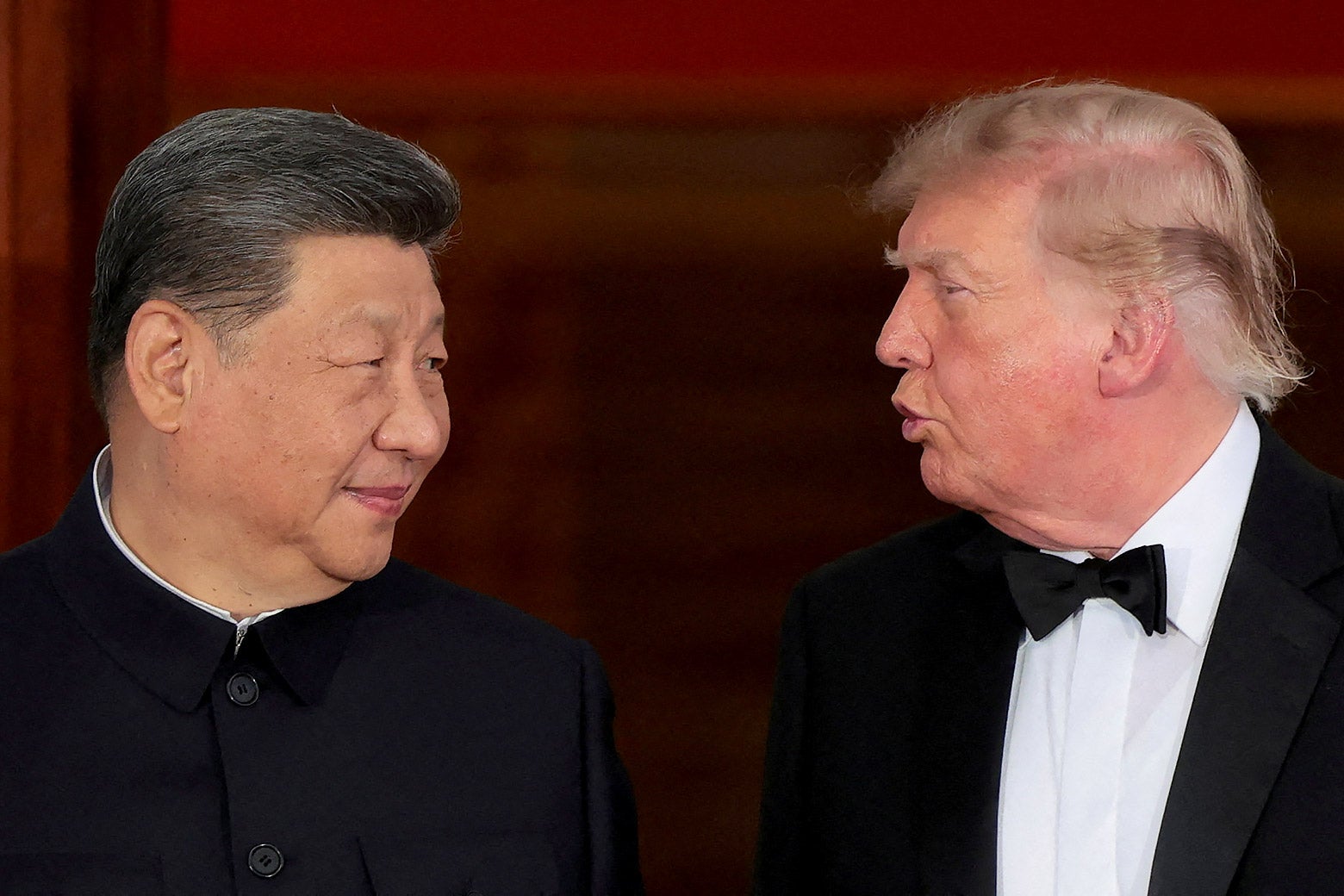
Little was expected of President Donald Trump’s summit with Chinese President Xi Jinping, and even less was actually accomplished.
Trump met the Communist Party chairman’s plane on a red carpet, which he also did for Vladimir Putin last year (and which no president had done for any other leader since John F. Kennedy greeted U.K. Prime Minister Harold Macmillan at Andrews Air Force Base in 1962). He staged a flyover with B-2 bombers and F-22 stealth fighters as a further sign of respect, then threw a state dinner, and gave Xi a tour of the White House’s new helipad and ballroom construction (which Trump, the self-described builder, must have seen as an offer of special honor).
In return, Xi announced he was giving the Atlanta Zoo two panda bears and extended the U.S.–China trade-war truce, which was about to expire, by two months.
Video from Slate
Many contentious issues face the two countries—the status of Taiwan, the war in Iran, nuclear weapons, space weapons, and, of course, A.I. The two leaders may have discussed these topics (they must have talked about something besides granite for three hours), but nothing—no resolutions, no agendas for the future, not even the creation of bilateral working groups—emerged from the meeting.
For most American presidents, summits, especially with powerful leaders, are carefully planned affairs. Senior aides on both sides meet well ahead of time to lay out issues to discuss, outline points of agreement and discord, draft announcements that would impart at least the illusion of progress (enough to justify having held the summit), and leave a few blank spaces that the leaders themselves might fill with some accord.
None of that seems to have been done in advance of this summit. So why was it held? Some commentaries noted it was less about substance than ceremony and symbolism, but what did it commemorate or symbolize?
For Xi, it seemed to be a reassertion of his own dominance in the relationship. In his public statements, both at this summit and the one in Beijing last May, Xi stressed the goal of “constructive strategic stability”—which is code, in his mind, for maintaining Chinese control of the area around its coasts, including the South China Sea, and assuring that Taiwan is not regarded as an independent state.
As long as those principles aren’t challenged, Xi would rather not make progress on some of the other issues—or even acknowledge that they are issues.
Trump’s goals are less clear. He would like to even out the two countries’ trade imbalance. He would like to export more American goods and regain access to China’s rare-earth minerals. The Wall Street Journal reported this week that U.S. and Chinese officials have been quietly discussing China’s possible violations of the nuclear test-ban treaty.
But Trump didn’t seem flummoxed that the summit produced nothing on these matters. Nor did he seem annoyed by reports that China has given Iran weapons and intelligence, which have helped the Iranian military fire drones and missiles at vital U.S. facilities in the region—and, in some cases, kill American servicemen and women. When a reporter asked about these reports before the summit, Trump shrugged and said, “We spy on them, too.”
The appalling thing here is that Trump has publicly condemned, and threatened to boycott trade with, the leaders of allied nations who declined to join his war on Iran. Yet he fawns over Xi and doesn’t even lightly criticize him for aiding Iran in that war.
At both of this year’s summits, Trump lauded Xi as a “friend”—at this week’s summit, he called the Communist Party chairman a “truly great friend.” Xi did not reply in kind but rather stressed their two countries’ overlapping “interests.”
That’s one of the many differences between the two leaders. Trump thinks he can gain favors by tapping personal friendships, then compounds the mistake by believing that certain leaders—especially authoritarians whose power he admires and envies—are his friends. (This is why Trump thought, at the start of his term, that ending the war in Ukraine would be easy; he thought Putin would end it as a personal favor.)
Xi, like most world leaders, calculates his moves on the basis of interests. He may like Trump, or merely pretend to like him; either way, it doesn’t affect what he does.
The summit’s most lamentable lapse was its failure to take even a small step toward putting guardrails on artificial intelligence. This would require some cooperation between the two countries, as they have taken the greatest strides, and are also the leading competitors, in the new technology. One problem is that neither Trump nor Xi is much interested in restricting A.I. Each of them sees it as vital to economic development.
It’s interesting that, in his dinner speech Thursday night, Xi said the two countries have “the capability and the responsibility” to keep A.I. “always under human control.” He may be driven in this view by his concern to keep A.I. under the control of the Communist Party of China. (His top spy recently expressed this concern explicitly.) Still, another American president might have taken that remark as an opening to pursue negotiations. Trump has no such inclinations. Not only does he see A.I. as vital to winning a broader geopolitical contest (Xi may, as well), he derides fears of A.I.’s dark side—which have been raised by some of the technology’s inventors—as a “hoax.”
Trump claimed that his meeting with Xi was “very productive” and that “tremendous things” were happening. But the one example he cited was, to say the least, bizarre. He noted that Xi agreed with his proposal—made in his speech at the U.N. General Assembly—to change the name of A.I. to “super intelligence.“ In a social media post about Xi’s endorsement, Trump wrote, “That would be ‘SUPER!’ ”
Trump’s glee probably struck Xi as another sign—one of many at this summit—of how easy it is to please this American president without making any real concessions.
| # | Наименование новости | Тональность | Информативность | Дата публикации |
|---|---|---|---|---|
| 1 | Trump and China's Xi discuss AI, trade and Iran war during state visit | 0 | 7.6 | 25-09-2026 |
| 2 | Takeaways from the Trump-Xi state visit: Pageantry and pandas | 0 | 12.71 | 25-09-2026 |
| 3 | What did we learn from the Trump-Xi summit? | 0 | 11.81 | 25-09-2026 |
| 4 | Trump and Melania host Xi for tea at the White House... as President is hit by brutal question | 0 | 5.52 | 26-09-2026 |
| 5 | Kommentar: Trump gefährdet mit seiner Außenpolitik die demokratische Welt | 0 | 12.86 | 26-09-2026 |
| 6 | Scott Bessent huddles with Chinese vice premier on trade ahead of Trump’s meeting with Xi Jinping | 0 | 6.82 | 20-09-2026 |
| 7 | Премьер Японии обсудила с Трампом его переговоры с Си Цзиньпином | 0 | 8.79 | 27-09-2026 |
| 8 | Trump acelera en su espiral autoritaria | 0 | 7.88 | 26-09-2026 |
| 9 | Китаист объяснил, зачем Си Цзиньпин принес термос на ужин с Трампом | 0 | 4.94 | 27-09-2026 |
| 10 | Why Italian Fascists Loved Samurai | 0 | 8.64 | 22-09-2026 |