Просмотр новости
Найдите то, что Вас интересует
 Спутники
 РН
РН SpaceX
 Роскосмос
 NASA
NASA
СпутникиРНSpaceXРоскосмосNASAThe phrase “love letter” is a tired one but so often an unavoidable one. People enjoy consonance so it rolls off the tongue more pleasantly, better than something terse like “homage”. “Tribute” tends to evoke imagery of golden statues or a more direct line to the thing being idolized. Simply put, “love letter” is in […]
The post SPRAWL zero Review appeared first on digitalchumps.
The phrase “love letter” is a tired one but so often an unavoidable one. People enjoy consonance so it rolls off the tongue more pleasantly, better than something terse like “homage”. “Tribute” tends to evoke imagery of golden statues or a more direct line to the thing being idolized.
Simply put, “love letter” is in the lexicon, especially when speaking about a piece of entertainment that feels inspired by a certain era or a specific thing.
SPRAWL zero hold obvious reverence for a period of gaming instantly identifiable to those who experienced it.
For me, SPRAWL zero is evocative of my first time playing Half-Life. Prior to Valve’s watershed title, most of my shooting experience was either from GoldenEye 007, the genre’s growing pains on console, or anything birthed in the wake of DOOM. Half-Life was different. It integrated NPCs into its world and story, making the world cohesive and alive. Guns were weird and strange, turning aliens and soldiers into polygonal gibs.
As the genre began evolving, Half-Life felt like a herald of change. Console shooters began to more closely align with the PC as players could wield a controller with two joysticks. Move and aim at the same time, just like with a mouse and keyboard. Better tech meant that games would play more fluidly, despite polygons still being muddy and blocky. Halo, F.E.A.R., Killzone, Black, even Call of Duty all nestled into a vibe. And developer MAETH mimics that vibe all across SPRAWL zero‘s digital footprint.
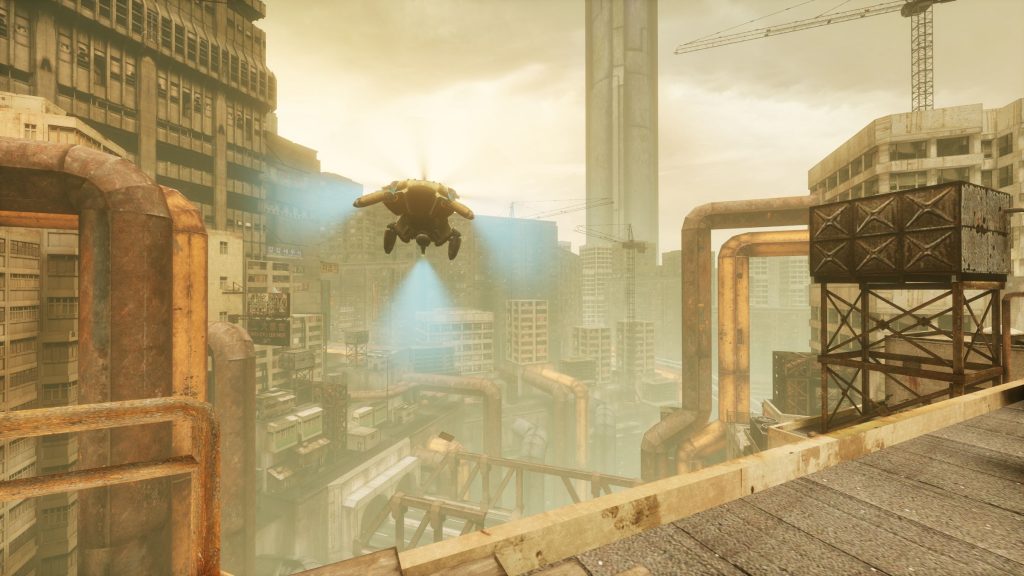
Much like SPRAWL zero‘s kinetic movement, I more or less sprinted past its story and the depths of trying to comprehend it. But maybe in the spirit of its brethren, that’s not a big deal as it certainly isn’t what makes the game most memorable. As FIVE, players control a super soldier enhanced by powerful cybernetics. Under the control of the militant Junta faction, FIVE is the standout hero amongst a legion of disposable grunts.
Set against the backdrop of the futuristic megalopolis called Sprawl, humanity is on the brink of desolation. Cities are blown-out and rusted to pieces. Enormous factories pump toxic gas into the streets and militant forces clash. FIVE’s mission is to eliminate Silas, the leader of the techno-religious group Imago-Dei who spouts propaganda over the loudspeakers, talking about humanity’s decline and ascension. As players blast through these warring factions, motivations become blurred and who the bad guys are seems hard to distinguish. But much of it can be considered background noise. Honestly, I had no idea that the game was a prequel to SPRAWL, a game I also did not play but am definitely interested in now.
SPRAWL zero gets the feeling right. Anyone who grew up in or lived through the era of late 90s and early 00s shooters is going to have that twinkle in their eye.
What’s interesting to me is that over the past few years, developers have leaned into the moniker of “Boomer Shooters” that, more or less, dovetail into DOOM-likes. As the first-person shooter has morphed into a genre hydra, games like Turbo Overkill, Warhammer 40,000: Boltgun, and Prodeus strive to go back to basics. While there is an effort to employ modern standards to those shooters, they very much are about running through levels and mass slaughtering whatever foe is in the way, all with destructive weapons.
As the PlayStation 2 and Xbox began to appear on the horizon and take center stage, there was a certain kind of maturity gestating across the shooter genre. Gone were the days of Duke Nukem. Shooters were kind of serious. Serious games for serious players. Graphics could be more detailed and we could shoot others online.
But how do you explain a feeling? That’s not so easy. Yet when playing a game like SPRAWL zero it truly does feel like a kind of time machine, or unearthing an unreleased title that was thought to be lost media.
SPRAWL zero has those kind of ugly graphics where textures were smeared and tessellated so as not to appear flat. Concrete walls aren’t just a flat color, they have flaws and cracks and distortions. And when you look from far away, it translates well. Move in close and you can practically see the coding. We didn’t care, though, it was the future.
MAETH understands that. That there is a beauty in these muddy, war-torn worlds. I’m always a proponent of visual and thematic cohesion where it matters. The world can lack color as long as it still has personality. SPRAWL zero‘s world, while futuristic, has all the signs of moral and physical decay. Plants and greenery are likely long-gone or found in the mansions of billionaires who control the strings of governments. All the game’s levels look like locations ripped straight out of other games in terms of how they replicate keystone story beats. Think of any dystopian setting and it’s probably here. The rugged streets where fighting is non-stop. Military installations, places where “science” happens, and awe-inspiring machinery all give off the impression that despite the advancements, everything got worse.
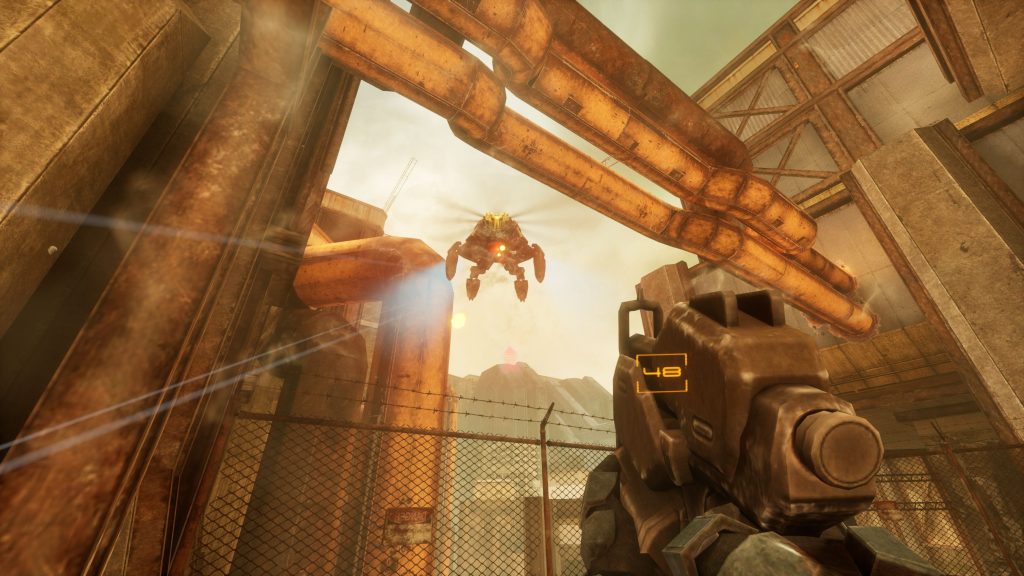
Despite this effortless work of recreation, I can’t help but knock SPRAWL zero‘s levels for being a bit too bloated and visually repetitive. A number of these levels embody the idea of sprawling, frequently tasking players with backtracking between places. An early one had me disabling anti-air installations and I found myself retracing steps and open-concept arenas to get from one to the other.
In these gargantuan stages I also found a lot of storage crates, metal fencing, yellow-brown concrete, and a general sense that a bit of editing could have been done. Ironically, many of the corridors and paths I went through–that also conveniently have a green gate that fully heals the player–feel like soft loading zones that would be right at home in past generations.
Size doesn’t always matter and first-person shooters can often contain massive levels that are constantly firing on all cylinders However, MAETH did construct a game with a lot of classic “go here, do thing” objectives that don’t always constitute the spiciest and most unique gameplay encounters.
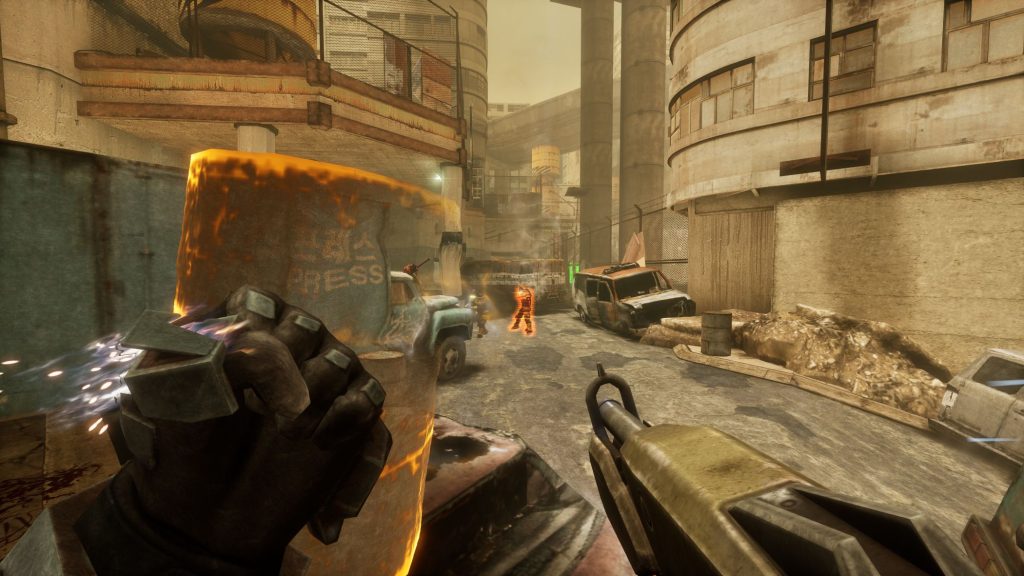
Gameplay is the most enthralling part of SPRAWL zero, to be quite honest. Immediately upon starting the game, players are granted gravity gauntlets which allow FIVE to grab most smaller objects that aren’t nailed down and hurl them around. Wood pallets, metal drums, enemy grenades, explosive containers, and chunks of scenery can all be weaponized. The best part is that there is no cooldown on the ability to snatch something from a relatively good distance and bludgeon someone with it.
More interesting, however, is how MAETH designed gun combat in the game. Rather than have a traditional weapon wheel where players permanently pick something up and collect ammo for it, each gun has a finite amount of bullets until it is rendered worthless. Players empty the clip, dispose of the gun, then pick up a new weapon.
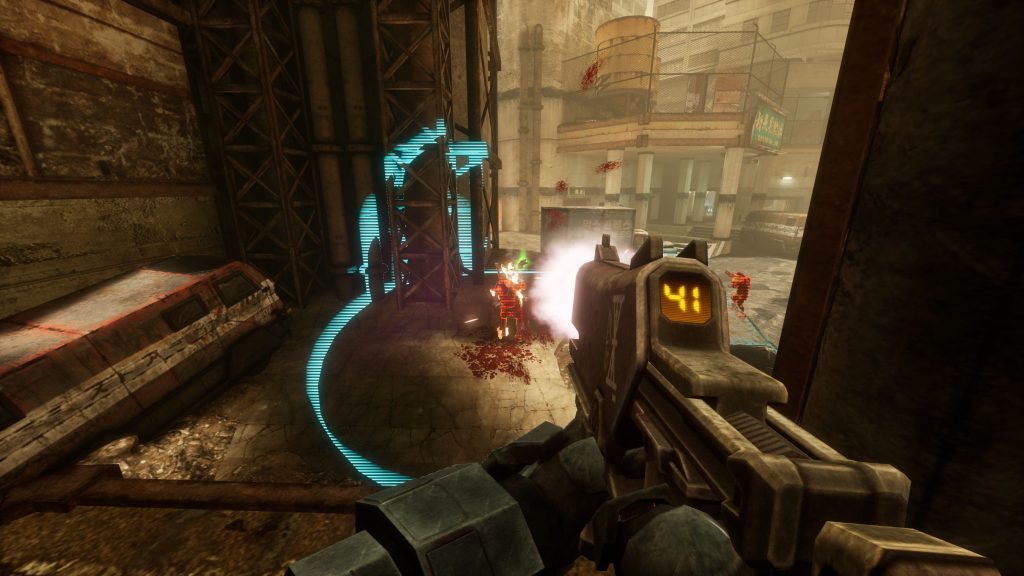
This creates a fascinating momentum throughout stages once players acclimate to this extremely untraditional method of gunplay. There are instances where the player may be up against a room of combatants and have only a few bullets in a basic pistol. The desperation of using the gravity gauntlet to pick up an object and launch it at an enemy in hopes of killing it to claim their weapon gets the bloop pumping. But on top of that players may want to use their empty or half-full gun as a projectile and rush around the area pulling off kills.
To keep weapons interesting, there are varying rarities that each weapon can have. This translates to how strong the weapon is, how many bullets it may have, and even how accurate it is. While the ability exists to aim with the left trigger and fire, I mostly chose to fire from the hip because enemies and bullets move fast.
SPRAWL zero also operates on a system where health doesn’t slowly recover. Instead, players need to heal through health drops. Passing through a healing gate usually acts as a kind of checkpoint but health containers are scattered around that, when broken open, contain neon green vials of health.
In the heat of combat, players need to focus on using their cybernetic powers to do the most chaos and guarantee enemy health drops. By activating a bullet time ability, the action slows down and every shot magnetizes to enemies near the crosshair. FIVE can still be injured and die because this is just a slow version of time and bullets are still flying, albeit at a significantly lower velocity. Another favorite ability was at the press of a button, a shield pops up over FIVE an absorbs bullets. When the shield glows purple, the player can release it and watch those bullets be returned to the ones that sent it.
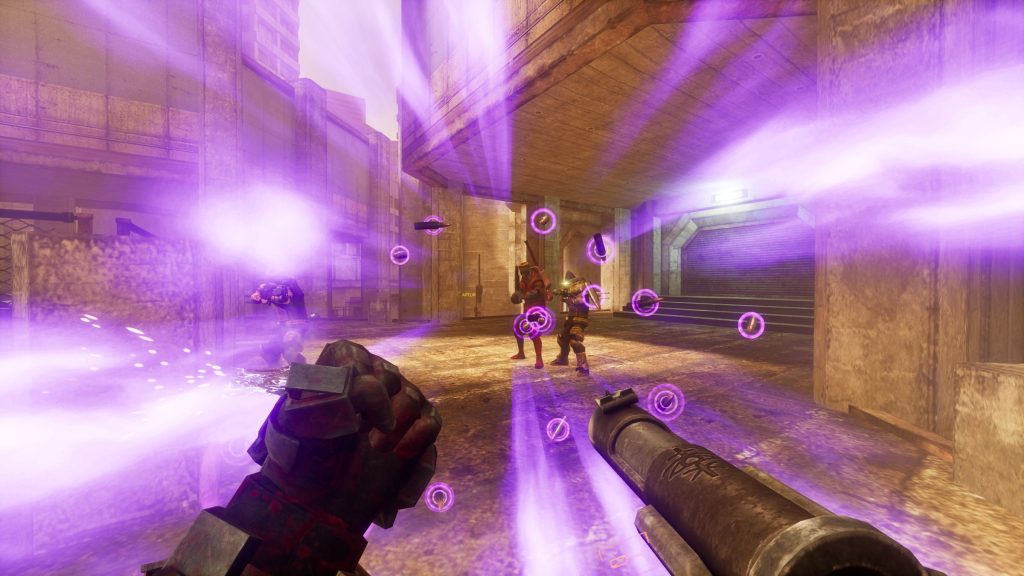
During my time with SPRAWL zero I played the game on Hard, which increased enemy damage and reduced the adrenaline charge time which dictates when cybernetic powers can be used. Honestly, I feel like this was my preferred way to play because it made most encounters fairly challenging, requiring a significant amount of movement between cover while constantly being aware of what guns were around the battlefield. All the while, crunchy, guitar-heavy riffs were playing, fueling the action. I felt like some sound designer who worked on Sega Genesis games was given new tools and instruments and put on SPRAWL zero. This soundtrack is truly incredible and does help longer moments go by just a bit quicker.
Despite my complaints of the game’s pacing that stem from level and objective design, SPRAWL zero absolutely knows what type of game it is. It is overall smartly designed and meant to be played fast. Players can seek out optional collectibles that can be used to modify New Game Plus runs and I feel like it will be beloved amongst the speedrunning community. But for a player like me who seeks unique and thrilling challenges, this one takes the cake merely because of the nostalgia it inspires. Currently, there aren’t a lot of games vying for this era of shooters and it’s wonderful to see this one nail so many parts of it in such a timeless way.
SPRAWL zero encapsulates the early 2000s era of first-person shooters. Hearkening back to a time where developers wanted to immerse players in more than just gunplay, MAETH gives players a crunchy, accurate time capsule.
| # | Наименование новости | Тональность | Информативность | Дата публикации |
|---|---|---|---|---|
| 1 | KEMOVE K94 Keyboard Review (PC/MAC) | 0 | 8.77 | 24-09-2026 |
| 2 | Well Dweller Review | 0 | 13.12 | 28-09-2026 |
| 3 | Keeper Review | 0 | 7.22 | 26-09-2026 |
| 4 | Welcome to Elderfield Review (PC) | 0 | 9.02 | 28-09-2026 |
| 5 | Garfield: Escape from Monday Review (PS5) | 0 | 10.39 | 23-09-2026 |
| 6 | DEKONI Audio Sheepskin Ear Pads (Audeze Maxwell 2) Review | 0 | 9.07 | 27-09-2026 |
| 7 | Parpuzio | 0 | 25.79 | 24-09-2026 |
| 8 | Star Wars Zero Company finds success in passing 1m sales, so can the furloughed development team be reinstated and paid now? | 0 | 14.42 | 23-09-2026 |
| 9 | groundcover Acquires Wand To Expand AI-Powered Kubernetes Optimization And Autonomous Infrastructure Capabilities | 0 | 7.57 | 25-09-2026 |
| 10 | women love to press A to jump | 0 | 3.91 | 24-09-2026 |