Просмотр новости
Найдите то, что Вас интересует
 Спутники
 РН
РН SpaceX
 Роскосмос
 NASA
NASA
СпутникиРНSpaceXРоскосмосNASAThe post I Think AI Is Sharing Wrong Information About My Business. What Do I Do? appeared first on SEO.com.
AI is answering questions about your business right now. Half of all searches happen through platforms like ChatGPT, Claude, and Google’s AI Overviews. When customers ask about your services, locations, or pricing, AI gives them an answer.
But AI makes mistakes.
40% of users flag AI answers as inaccurate. Therefore, it’s important to audit what AI is saying, correct the sources it’s synthesizing, and build a strategy that ensures AI gets it right going forward.
AI is a pattern-matching machine piecing together information from multiple sources, but this process can go wrong in three ways:
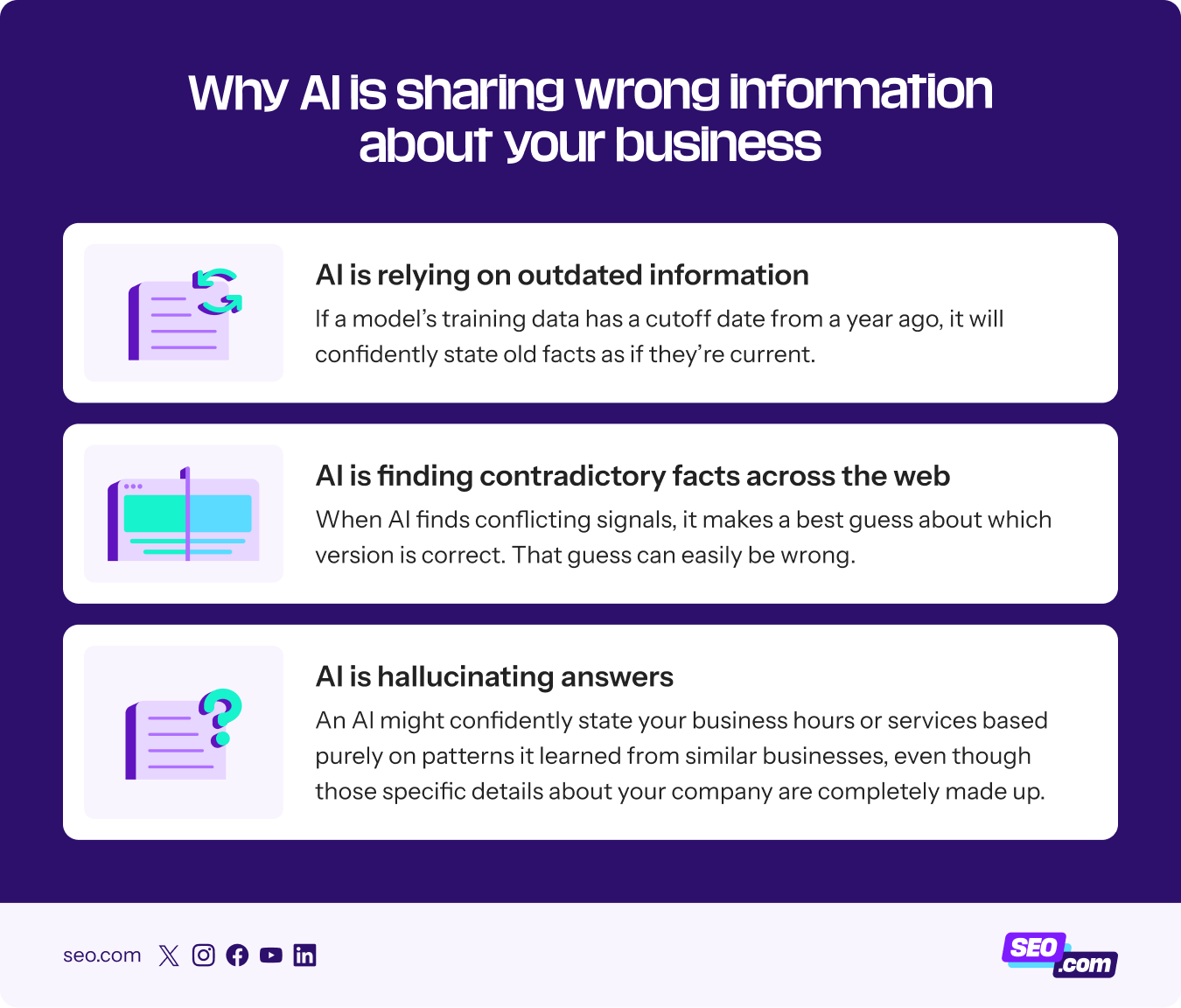
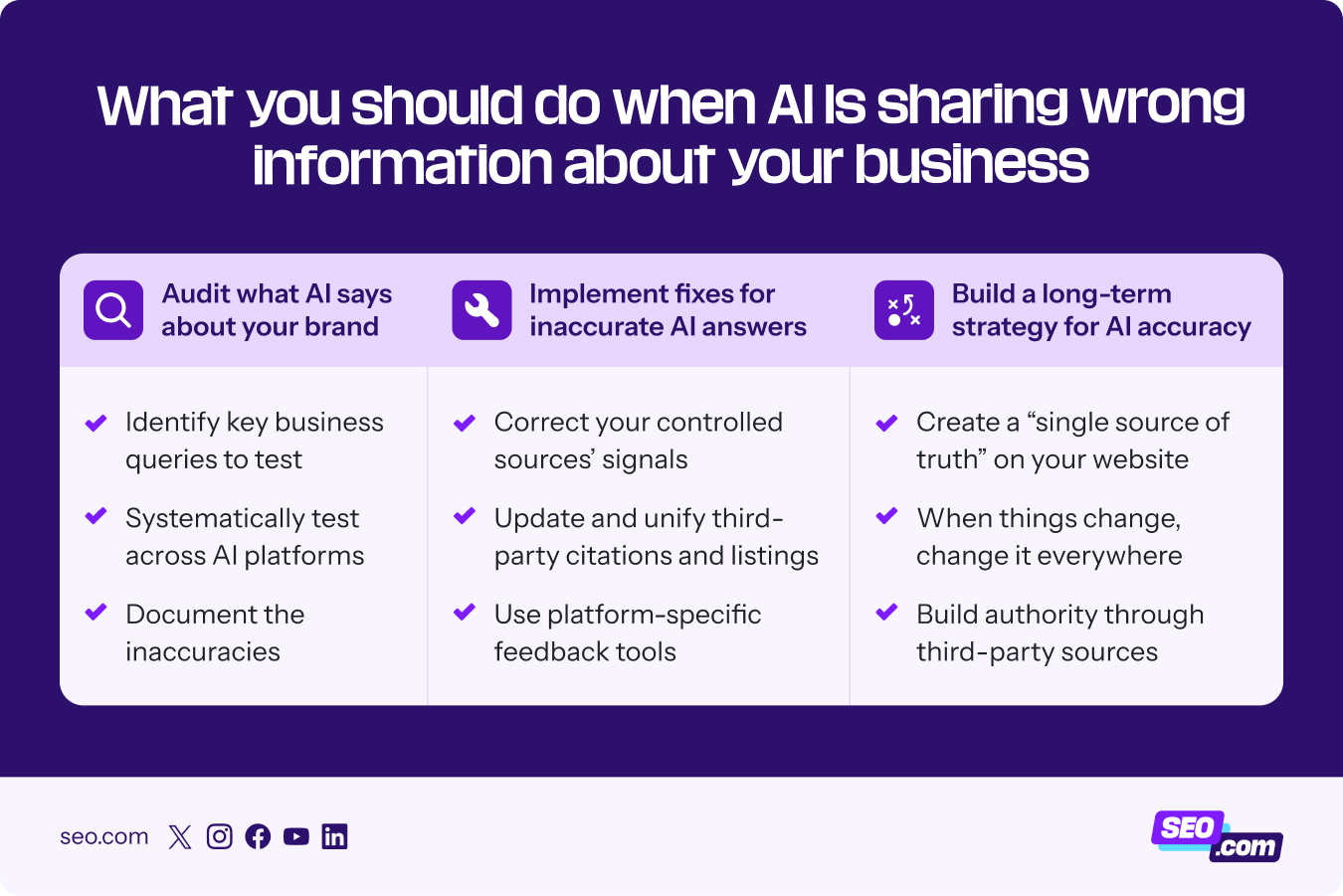
Fixing how AI talks about your business follows a three-part process:
This framework gives you both quick wins and sustainable solutions.
1. Audit what AI says about your brandAt this point, you have some idea that AI is saying wrong things about your brand. But, you need to conduct an audit to see exactly what it’s getting wrong.
Here’s how you can do it:
Identify key business queries to testStart by creating a list of terms people would use to search for information about your business, such as:
Think about queries like “What services does [Company] offer?” or “Where is [Company] located?” or “[Product name] pricing.” These show you exactly what customers are seeing when they ask AI about you.
By conducting these searches, you can get a sense of where AI is getting information wrong about your business.
Systematically test across AI platformsAI engines use different data sources and can produce wildly varying results for the same question. Google’s AI Overviews, ChatGPT, Claude, and Perplexity might all give different answers about your business.
So, test your key queries across multiple platforms to see the full range of what people might encounter. You should:
You can use a spreadsheet to document any responses that are delivering inaccurate information. Make sure you record:
This list becomes your action plan for the next step. You’ll be able to see patterns in where the misinformation is coming from and prioritize which issues to fix first.
2. Implement immediate fixes for inaccurate AI answersFixing the inaccuracies of AI’s output will take a lot of time and correction, but can ultimately help AI get a more accurate picture of your brand.
Here’s how you can do that:
Correct your controlled sources’ signalsWhatever entities you have for your brand that you control, make sure they’re accurate. This includes things like your website, Google Business Profile, and social media profiles. Any profiles you own should be 100% accurate, so make sure that’s the case.
Update and unify third-party citations and listingsAI cross-references your website with major third-party directories to verify information. Use your audit spreadsheet to find every listing site where your information appears incorrectly.
Update your business details on platforms like Yelp, industry-specific directories, review sites, and any other third-party platforms where you have a presence.
Use platform-specific feedback toolsMost AI platforms have “Feedback” or “Report a problem” features built into their answer interfaces. When you find wrong information, use these tools to flag the issue.
This is a secondary tactic, and results aren’t guaranteed, but it’s still worth doing. Some platforms review flagged content and may update their responses, especially if multiple users report the same problem.
3. Build a long-term strategy for AI accuracyIn addition to correcting current issues, it’s wise to build a long-term strategy that ensures accuracy of your brand for the future.
Create a “single source of truth” on your websiteCreate a dedicated page on your website with all your essential business facts in one place. Include:
Having a “single source of truth” can help create a reliable source for third-parties to get information.
Additionally, add schema markup to the page, so AI can easily extract the information. Schema tells search engines and AI exactly what each piece of data represents. You can use Schema types like Organization, LocalBusiness, or FAQPage, depending on your business type.
Link to this page from your homepage and other high-traffic pages so search engines can easily find it to get the right information.
When things change, change it everywhereA big mistake businesses make is only updating their information in one or two places, like their website or Google Business Profile. But those aren’t the only places that AI engines extract information — there are other third-party sites that provide information about your business, too.
So, if you make changes to your business, make sure you’re making updates across platforms where your information shows.
A tool like LocalFX (from WebFX) can help you keep track of all your local citations and sync the information across 100 directories. That means you keep your listings in popular directories accurate, so AI engines have a higher probability of pulling and serving the right information.
Build authority through third-party sourcesA recent analysis examined more than 11,000 links cited by ChatGPT in responses to business queries. Nearly half of those citations came from PR-influenced sources, such as analyst reports, industry forums, reviews, and social platforms.
When authoritative third-party sources validate your expertise and cite your business correctly, AI is more likely to include those citations in its own answers. If you’re consistently not cited in AI answers, building this kind of third-party validation is often the missing piece. So, you should:
Showing up accurately in search results is more important than ever. If you aren’t sure how you can take the first steps to changing what AI says about you, the team behind SEO.com (WebFX) can help.
We can help audit what AI is saying about your brand, implement fixes to help correct inaccuracies, and build long-term strategies that keep AI citing you correctly. Explore our AI search services and take control of how AI represents your business.
| # | Наименование новости | Тональность | Информативность | Дата публикации |
|---|---|---|---|---|
| 1 | Do AI Search Engines Respond the Same to the Same Query? An Exploration | 0 | 5.19 | 27-08-2026 |
| 2 | I’m Not Being Cited in AI Answers — Why? Here’s What Our Experts Say | 0 | 8.56 | 20-08-2026 |
| 3 | Local SEO in Today’s Climate: Why “Near Me” Still Matters and What’s Actually Changed | 0 | 13.96 | 15-09-2026 |
| 4 | AI Overviews Ranking Factors in 2026: How Do You Rank in AI Overviews? | 0 | 8.05 | 23-09-2026 |
| 5 | How To Track Brand Mentions Across AI Engines | 0 | 7.97 | 21-08-2026 |
| 6 | You Can’t Ignore Content Freshness in 2026 If You Want to Get In AI Engines | 0 | 10.03 | 19-08-2026 |
| 7 | How To Tell if Your SEO Company Is Working: Free Guide | 0 | 4.79 | 27-08-2026 |
| 8 | What is Content Decay and How Can You Fix It? | 0 | 7.03 | 20-08-2026 |
| 9 | What is an "AI swarm," and why is it giving tech experts nightmares? | 0 | 8.16 | 23-09-2026 |
| 10 | Los riesgos de la inteligencia artificial | 0 | 10 | 15-09-2026 |