Просмотр новости
Найдите то, что Вас интересует
 Спутники
 РН
РН SpaceX
 Роскосмос
 NASA
NASA
СпутникиРНSpaceXРоскосмосNASALearn how the transactional outbox pattern prevents dual writes and enables reliable event publishing for scalable event-driven architectures.
September 19, 2026 ∙ 5 minutes read
If your application updates a database and publishes events, keeping those operations in sync is a challenge. A service can commit a database transaction, then crash before the corresponding event ever gets published.
The transactional outbox pattern makes that specific failure impossible. It guarantees the event is delivered, not just attempted. It's become a foundational pattern in event-driven architecture, where services depend on reliable event delivery to stay in sync.
When events get lost in distributed systemsImagine a customer places an order. Your application saves the order to the database, then publishes an OrderCreated event so your inventory, billing, and shipping services can take over.
The problem is that those two actions don't happen simultaneously. If your application crashes after saving the order but before publishing the event, the order exists, but the rest of your system isn’t alerted. That's the dual-write problem: One part of the operation succeeds while the other fails, creating a delivery failure that can leave downstream services permanently out of sync.
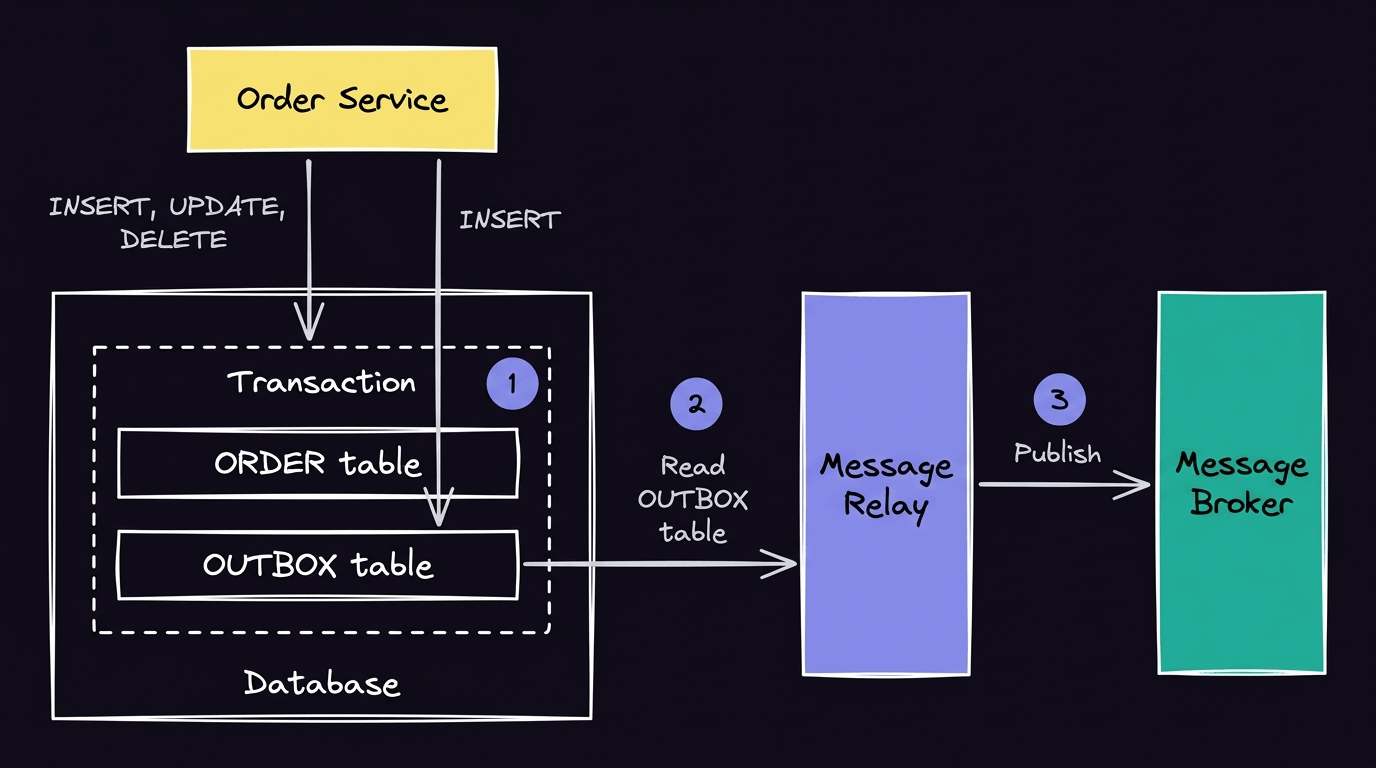 A schematic diagram of the transactional outbox pattern: (1) A service writes into 2 tables during a single transaction, (2) a separate message relay fetches new outbox messages and passes them to (3) the message broker.
 The fix is to write the database change and the event in the same transaction. If the transaction succeeds, both the business data and the event are saved. If it fails, neither is.
The application doesn't publish the event immediately. Instead, it stores the event in an outbox table alongside the business data. A separate message relay reads that table and publishes each event to the message broker. If the broker is unavailable or the publish fails, the relay simply retries. Because the event is already stored safely in the database, retrying doesn't risk losing data or creating inconsistencies; it just delays delivery until it succeeds.
Building the relay in an automation workflowThe outbox table guarantees an event gets recorded, but it doesn’t deliver that event on its own. That's the job of a message relay, which continuously checks for new events, publishes them to a message broker, and retries if something goes wrong. Without that relay, the event never leaves the database. In microservices, the outbox pattern is a common way to make sure every service receives the same committed events, even when individual services or message brokers experience temporary failures.
There are two common ways to detect new events. The simplest approach is polling, where the relay periodically queries the outbox table for unpublished rows. If you need lower latency, change data capture (CDC) reads the database's transaction log and streams new records as they're committed. Polling is easier to set up, while CDC reduces latency at the cost of additional infrastructure. For many teams, polling is the right place to start. As throughput and latency requirements grow, migrating to CDC can improve performance without changing the overall outbox pattern.
You could build that relay yourself, but most teams end up creating redundant, duplicate capabilities. n8n is a workflow automation platform that provides retries, execution history, failure handling, and monitoring right out of the box, making it faster to build a relay that's reliable and easier to operate in production.
In n8n, you can set up publishing from the outbox to a message broker. If you haven’t already set up the message outbound, you may face a dual-write program. Here’s how to solve it:
Once you've built your relay, publish workflows so your team can reuse and maintain the same implementation across projects.
Checklist for guaranteeing delivery in your outbox implementationThe transactional outbox pattern only works if every part of the delivery pipeline is designed to handle failure. A few small implementation mistakes (like marking events as processed before delivery succeeds or letting your outbox table grow indefinitely) can undermine the guarantees the pattern is meant to provide.
Before moving to production, make sure you've covered the following:
Building a reliable relay shouldn't mean maintaining a custom worker service. With n8n, you can automate event delivery, monitor every execution, and retry failed deliveries without writing the surrounding infrastructure yourself.
Reliable event delivery starts with the right relayThe transactional outbox pattern solves one of the most common failure modes in distributed systems by making sure database updates and events are committed together. But that guarantee only holds if a message relay reliably publishes every event, retries failed deliveries, and gives you visibility into what happened when something goes wrong. That's what turns an architectural pattern into a production-ready system.
Try n8n Cloud for free to build, run, and monitor your message relay in one place.
FAQCan the transactional outbox pattern publish to an Apache Kafka topic?Yes, a message relay can publish each committed event to an Apache Kafka topic after the database transaction succeeds. The transactional outbox pattern isn't tied to Kafka (it works with any message broker), but Kafka is a popular choice for building scalable, event-driven systems.
| # | Наименование новости | Тональность | Информативность | Дата публикации |
|---|---|---|---|---|
| 1 | Process Orchestration: Execution Models, Observability, and Production Challenges | 0 | 7.16 | 11-09-2026 |
| 2 | Reducing AI Workflow Latency: Patterns That Actually Work | 0 | 6.85 | 19-09-2026 |
| 3 | How To Build Reliable Workflows With API Idempotency | 0 | 8.23 | 03-09-2026 |
| 4 | Beyond Static Coexistence: Architecting Non-Stationary RFFE Systems for Multi-State Devices | 0 | 30 | 12-08-2026 |
| 5 | API Rate Limiting for More Reliable Workflows | 0 | 5.99 | 18-09-2026 |
| 6 | Digital Twins: Closing the Agility Gap for RF and Analog Design | 0 | 10 | 10-09-2026 |
| 7 | When is the right time to buy? | 0 | 6.78 | 25-09-2026 |
| 8 | Running OpenBao on Kubernetes with a CloudNativePG PostgreSQL backend | 0 | 10.75 | 16-09-2026 |
| 9 | Post-production workflow guide: Go from raw footage to final delivery | 0 | 12.91 | 21-08-2026 |
| 10 | How Certinia’s System of Action smoothens service experiences | 0 | 8.4 | 25-09-2026 |