Просмотр новости
Найдите то, что Вас интересует
 Спутники
 РН
РН SpaceX
 Роскосмос
 NASA
NASA
СпутникиРНSpaceXРоскосмосNASA When you start factory automation game Satisfactory you awake in a drop pod plunging towards the surface of an alien world. In its first expansion you'll be heading a little deeper. Set entirely in an underground biome, Core Values sees you trying to build a thriving mining operation in a world that is limited in space and light, where even navigating its tunnels can become a challenge.
Though, the team are keen to emphasise that Core Values isn't just Satisfactory with the lights turned off. It will be bringing a whole new set of logistics tools (and new challenges with them), so getting resources from mining point A to refining point B won't always be as straightforward as just sending them down a conveyor belt.
Read more
Buckle up
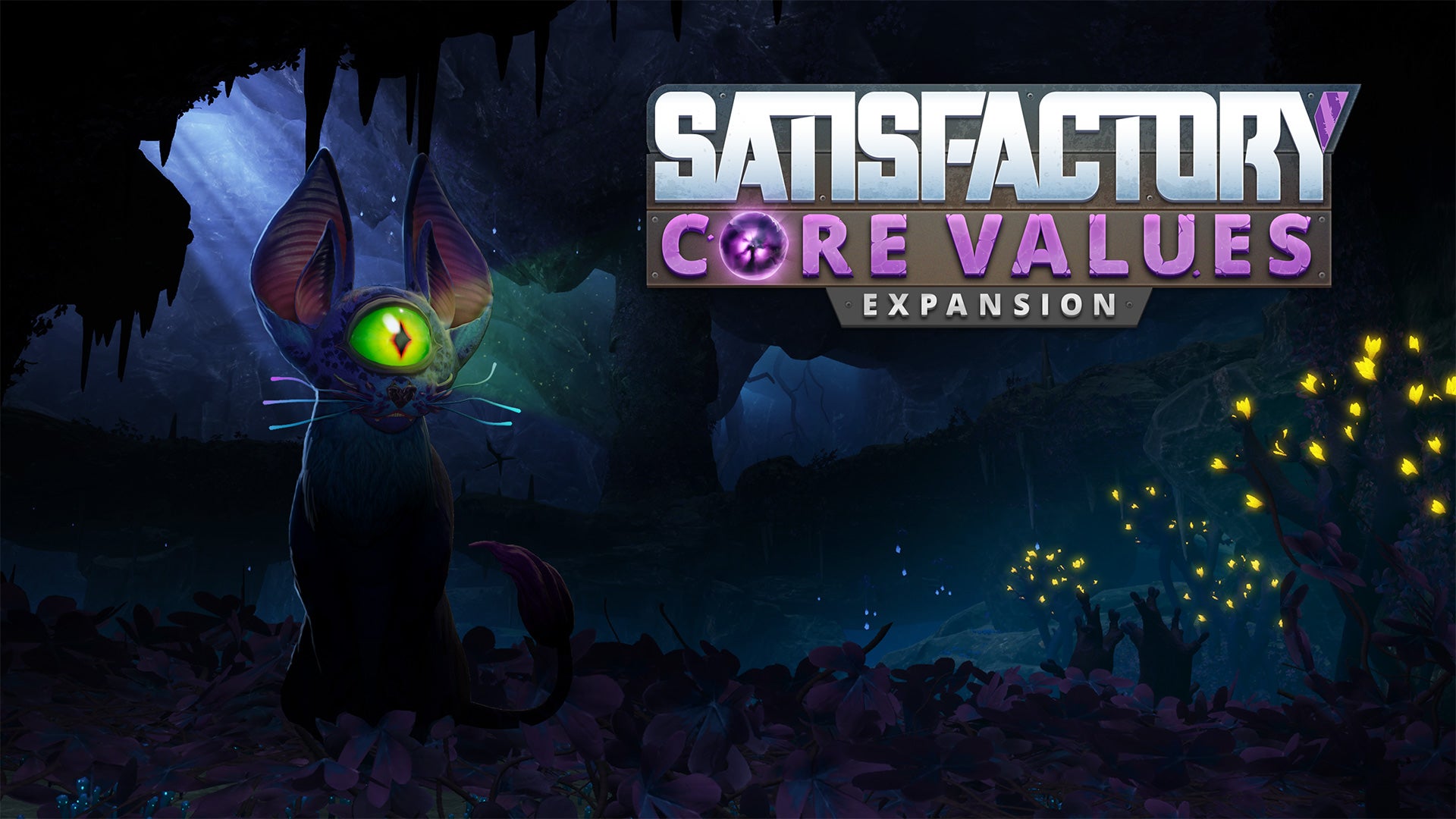 Image credit: Coffee Stain Publishing / Coffee Stain Studios
When you start factory automation game Satisfactory you awake in a drop pod plunging towards the surface of an alien world. In its first expansion you'll be heading a little deeper. Set entirely in an underground biome, Core Values sees you trying to build a thriving mining operation in a world that is limited in space and light, where even navigating its tunnels can become a challenge.
Though, the team are keen to emphasise that Core Values isn't just Satisfactory with the lights turned off. It will be bringing a whole new set of logistics tools (and new challenges with them), so getting resources from mining point A to refining point B won't always be as straightforward as just sending them down a conveyor belt.
When Coffee Stain first told me about Core Values, they explained that the challenge of making an expansion that connects to the base game and allows some connection of their economies is that there are players who are sitting on factories they've been optimising for years. Those factories are pumping out resources and components that, should they be able to funnel them down into the underground base, could let them blitz through all the challenges of the new expansion. This suggested to me that in Core Values they were simply going to say something like 'Oh no, the air in this cave erodes concrete. I guess I can't build the same conveyor belt I use on the surface. I will instead have to make a conveyor belt from this very similar – but, for gameplay purposes, distinct – concrete-like substance.' Thus forcing the player to go through the same research and development process of the base game all over again.
I checked with the developers and, thankfully, they didn't call me a blaggard for suggesting they might take such a scurrilous approach. "There will still be some of the logistics from the base game," game director Emmet Burke tells me. "And you'll still use the same ingredients to actually build those, but we've added enough extra logistics to connect your factory that are unique to Core Values that I think will avoid repetition. You will not be using belts. Belts would be there, but there's going to be other logistics."
Very kindly, art director Torsten Gunst refrained from pushing me up against a wall and calling me a snivelling wretch for suggesting they might force players through the same tech trees of the base game and instead said "We would feel if it [were] just 'Oh, you'll find that new underground resource. This is now what you need to make belts' would just not be very rewarding. You want new resources to get you new logistics that expand the game. We are not cheaping out on this expansion. There's a lot of new stuff coming."
While the developers wouldn't say exactly what those new forms of logistics are, I'll make some educated guesses from other comments they made. "The base game machines are quite precise, like refined super computers," Burke told me. Whereas in Core Values the machinery is "more rugged, heavy machines. Big grinding gears, hammers bashing against resources." To me, that brings to mind mine carts, cranes, and load, haul, dump machines (those low-profile trucks that push loose material through mining tunnels).
However, for those to behave differently to the conveyor belts and trucks already in the game, then the resources they transport would need to behave differently. Perhaps, and this is pure speculation, they will be loose materials rather more like those we see in Sandustry. In the original Satisfactory, your resources only ever existed outside of storage lockers in easily-transported boxes that you couldn't physically interact with. Changing to something that can be heaped, spilled, or toppled would be a radical change. However, that may be too significant a change for an expansion.
(Of course, I'm writing this on an embargo and it will go live after the reveal. Potentially everything I am speculating on will turn out to be true and, when this article is live, I will be proven a Nostradamus of video games. Or a fool.)
Returning to less speculative ground, the developers did explain how shifting the action from the alien world's ground floor to its basement has more significant implications for how you play. In the main game, you build your factories across large open fields. They can sprawl, they can be tall, they can be wasteful. That's not the case in a cave.
"We want to be very careful how much space we allow for different players, because you still want to have the cave feeling," Burke says. "You want to have little tunnels to explore, and you want to make sure there's always enough area that if people want to unleash their creativity, they have the space to do that, but then you don't want to just give them a big box [where they can] just build whatever they want."
Then, another aspect of caves is that they traditionally aren't well lit. And, as soon as you take natural light away, players will both struggle to see and orientate themselves. That navigation is made more complex than on the surface because, as Burke says, your HUD compass might say you're just 20 metres from your hub, but, if there's a cave wall between you, that arrow on your UI which is pointing directly at a barricade of granite isn't really helping you get home. "That's been a tricky point," he says.
A partial solution is that the caves have points of interest you can navigate by, such as waterfalls and crevasses. But Coffee Stain have left the rest of the solution in players' hands. "To some extent, it's up to the player to make sure they never get lost," Gunst says, saying they could place sign posts, or learn to follow their own pipe system, or mentally map out the caves by what machines they've placed. "Navigation and orienting yourself is part of the fun," he adds. "It's not going to be a hardcore challenge for the player because they still need to do their job of building factories."
I'll admit when Coffee Stain first told me that the new expansion would be set in a cave I wasn't immediately excited. After all, what is a cave but a large underground room. Big whoop, right? And I've still not actually seen anything that dispels that worry. However, the team seemed desperate to explain why I was wrong, even though they refused to share any details, that they have left me extremely curious to see how building factories in a cave is going to be dramatically different from building factories on the surface.
Happily, at least, Burke did say that after today's reveal the team are going to be "much more active again with community", providing posts detailing new features, releasing videos of the expansion in action, and returning to the relationship they had with players during early access. So hopefully I won't have long to wait to have my curiosity sated.
Travel and accommodation to Gamescom was provided by the conference organisers.