Просмотр новости
Найдите то, что Вас интересует
 Спутники
 РН
РН SpaceX
 Роскосмос
 NASA
NASA
СпутникиРНSpaceXРоскосмосNASAUtah state lawmakers seem poised to propose a number of housing bills in the hopes of combating the Beehive State’s ongoing housing crisis. Among the potential bills are updates to the local zoning parameters, changes to deeply affordable housing funding and initiatives to house people aging out of the state’s foster care program. Four Utah […]
Utah state lawmakers seem poised to propose a number of housing bills in the hopes of combating the Beehive State’s ongoing housing crisis.
Among the potential bills are updates to the local zoning parameters, changes to deeply affordable housing funding and initiatives to house people aging out of the state’s foster care program.
Four Utah state lawmakers — Rep. Calvin Roberts, Rep. Jill Koford, Rep. Ray Ward and Sen. Luz Escamilla — discussed their upcoming bills during a session of the Utah Housing Coalition’s 2026 Utah Housing Matters Conference in Midway. During the panel, each expressed the need to make reforms to how Utah can create or enable the building of new homes.
Rep. Ward, for example, was critical of what the state has done in previous years in the housing realm, saying the legislature has previously taken incremental steps that did little to ease the state’s housing issues.
“I believe that some of the small steps we’ve taken are really not ever going to be sufficient,” Ward said Monday. “My belief is that in the Legislature we’ve done a whole bunch of things that we did because they were easy but complicated on paper, and we did that to avoid facing the larger question.”
Ward has long been a housing reform advocate in the Utah Legislature. He presented bills in 2025 that sought to more widely permit ADUs across the state and sought to allow single-family homes to be built on smaller lots. Both bills failed to pass out of committee. He ran a bill during this past session that would’ve encouraged the building of starter homes on smaller lots, but that bill also failed.
Ward was also critical of local permitting processes Monday, saying the current systems slow down development and make the process more expensive. More often, he said, the type of developments that are negatively impacted by the current zoning process are the building of smaller, more affordable homes.
This is why he plans to introduce a bill that would allow homes to be built on residential lots as small as 5,000 square feet. The bill, he said, would give cities the option to either make such homes a permitted or conditional use. The bill would give cities the ability to set the rules for lots, adding, “You can make the conditions so that it’s easy, (or) you pass an ordinance that says ‘yes, this is conditionally permitted if you have 200 feet of frontage,’ so no one will ever be able to use it.”
“So (cities will) need to set the conditions, but they’ll need to think about those small lots in a way that says you either allow them or at least you lay out the conditions under which you would allow them,” Ward said. Ward’s bill seems in line with legislation outlined by Steve Waldrip, senior advisor for housing strategy to Utah Gov. Spencer Cox, earlier this year.
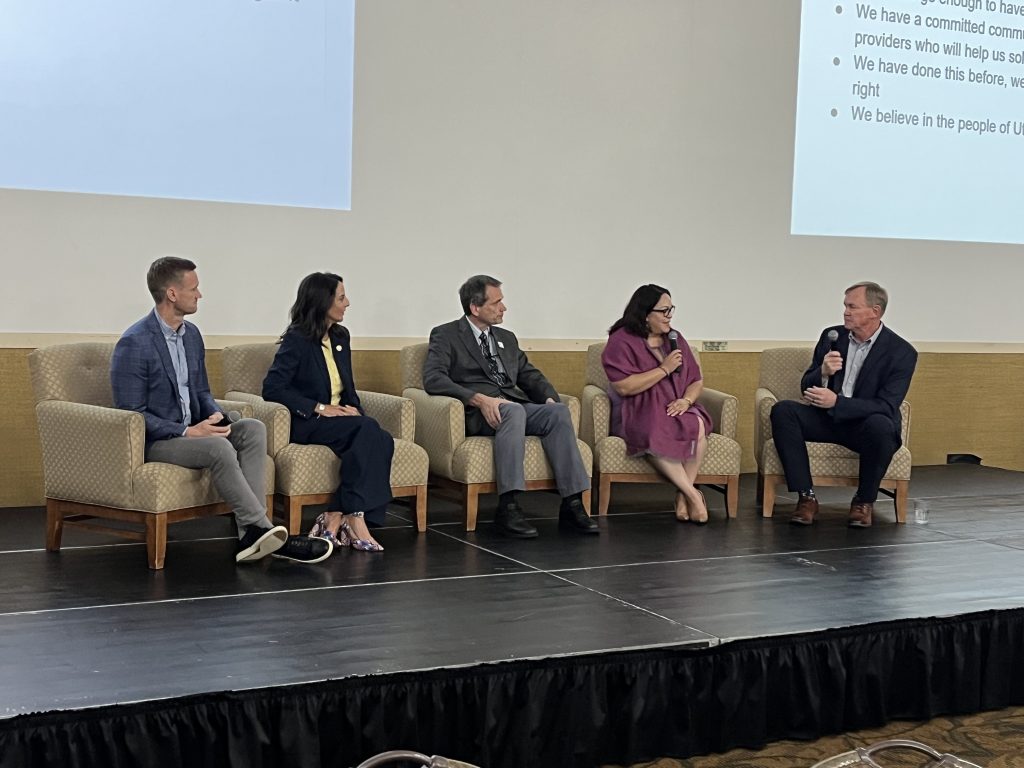
From left, Utah state Reps. Calvin Roberts, Jill Koford, Ray Ward, state Sen. Luz Escamilla and Steve Waldrip sit for a panel discussion during the Utah Housing Coalition’s 2026 Utah Housing Matters Conference in Midway. Photo by Jacob Scholl | Building Salt Lake
Another potential bill discussed Monday was a proposal from Escamilla to create housing for young people aging out of state foster care. Escamilla, the state’s Senate Minority Leader, said there’s a high correlation between foster care and homelessness. She said many young people graduate college and move back in with their parents or other family members, but those in foster care often are left with nowhere to go once they age out of the state system.
“We’re trying to start working into putting them into housing before they are exiting from foster care, so it’s a comprehensive piece of legislation,” Escamilla said. “It’s also addressing home ownership, education, and giving them a sense of family.”
Koford — who was the floor sponsor for Senate Bill 284, a bill approved earlier this year that allows for detached ADUs on lots larger than 11,000 square feet — said she plans on presenting a bill that would make further changes to state code on detached ADUs. She said a task force has also been working on changes to state HOA rules, adding, “so expect hopefully some good changes on HOAs.”
Roberts, who has also presented housing bills in recent years, said Monday he’s working on legislation to enable more deeply affordable housing to be built, and pair those funds with money set aside to address homelessness.
“We have a lot of different homeless funding streams, and I’m working on something that’s going to try to stack some of the homeless funding streams with more of our deeply affordable programs out there,” Roberts said. “I think there’s some opportunity to do better coordination with housing authorities and things like that.”
Waldrip, who was moderating the Monday panel, then asked if the lawmakers knew of other housing-related bills on the horizon. Three lawmakers said examining public funding methods like public infrastructure districts (PIDs) and tax increment financing would likely be on the horizon.
Roberts said it’s likely the state will examine public infrastructure districts and tax increment financing, adding, “I think there will be a lot of focus and energy around trying to make sure that those tools work for the benefit of Utahns.”
Ward echoed that notion, adding those types of financing tools, “don’t make housing one bit cheaper, all we do is move the upfront price tag into a monthly payment afterwards. So we’re not saving people anything with that.”
Koford said she hasn’t heard much about housing bills, but she’s heard of upcoming bills about water, data centers and tax increment financing. Escamilla said setting aside more public infrastructure funds for water, sewer and roads is another crucial piece for Utah’s future.
One of the final discussion points Monday was a fairly simple question from Waldrip — how do we get over the gridlock of building new housing?
Ward said one of the biggest hurdles is the idea the state is looking to take away zoning powers from cities. That fear has derailed state legislation in the past, and Ward added he understands city council members can be voted out of office for something as easy as allowing a duplex. Either way, Ward said we need to get past the idea that zoning is a zero sum game between the state and cities.
“To me, I look around the country and I see other states that do it different ways, and so I do hope we can get over the gridlock,” Ward said. “We’ve battled a long time, and the battle lines have not moved much. So I don’t know if we will, but we need to keep trying.”
| # | Наименование новости | Тональность | Информативность | Дата публикации |
|---|---|---|---|---|
| 1 | Utah lawmakers to consider allowing smaller homes in every city | 0 | 21.41 | 18-08-2026 |
| 2 | Salt Lake City small-lot zoning changes face first hurdle this week | 0 | 19.91 | 09-09-2026 |
| 3 | Planning Commission sends single-family zoning rewrite to council | 0 | 19.93 | 24-09-2026 |
| 4 | Salt Lake City single-family zone overhaul sees changes before Planning Commission | 0 | 19.99 | 11-06-2026 |
| 5 | How many units have been created by SLC’s Affordable Housing Incentives program? | 0 | 18.06 | 22-07-2026 |
| 6 | Salt Lake City votes to hike property taxes 12.5%, hints at another next year | 0 | 20.6 | 17-06-2026 |
| 7 | Salt Lake City ranked dead last in study for recent graduate job prospects. Here’s why. | 0 | 17.17 | 18-05-2026 |
| 8 | As Vermont lawmakers stare down adjournment, major bills are still in flux | 0 | 38.53 | 22-05-2026 |
| 9 | Vermont lawmakers grapple with giving farmers exemptions to local zoning | 0 | 42.39 | 06-05-2026 |
| 10 | The Rio Grande Plan is dead! Long live the Rio Grande Plan! [Opinion] | 0 | 16.8 | 06-07-2026 |