Просмотр новости
Найдите то, что Вас интересует
 Спутники
 РН
РН SpaceX
 Роскосмос
 NASA
NASA
СпутникиРНSpaceXРоскосмосNASAThis report explains how political weighting works, how Pew Research Center does it, and some of its limitations.
This report explains political weighting – adjusting a survey to reflect the political composition of the United States as accurately as possible.
Why did we do this?Pew Research Center does research to help the public, media and decision-makers understand important topics. In our surveys of the U.S. public, we regularly adjust, or “weight,” how much we emphasize certain groups’ responses depending on how likely they are to participate, among other factors.
This report examines best practices for weighting by political party affiliation and voting choice, particularly in the context of survey panels. It adds to the Center’s extensive body of work on survey research methods. Learn more about Pew Research Center.
How did we do this?We drew on results from Pew Research Center surveys, as well as studies conducted by other researchers.
A growing share of election polls in the United States – almost 70% of national polls in 2024 – are now weighted on political party affiliation or reported vote choice in a previous election. This kind of political weighting is controversial. But evidence shows that it has made polls modestly more accurate.
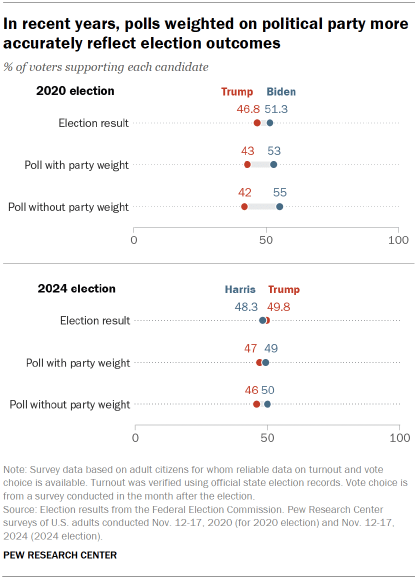
This report explains how political weighting works, how Pew Research Center does it, and some of its limitations.
It has become more necessary to weight on party or past vote because of growing evidence that Republicans have become slightly less likely than Democrats to take part in polls. Historically, neither party’s supporters were more likely than the other’s to participate in polling. Whether or not that change is permanent, it is true today and requires addressing.
Note: For a primer on survey weighting and how it’s used, read “What is weighting?” below.
Key takeawaysBecause there are long-standing questions about how this weighting works, which political outcomes or characteristics to use, and a variety of downsides to consider, this piece seeks to explain:
Surveys are still the best way to measure what the public is thinking. But they aren’t perfect. It’s hard to contact people for surveys and hard to get them to cooperate. We often don’t get enough people who have less than a high school education or who are younger than 30, groups that are often underrepresented compared with their share of the overall population.
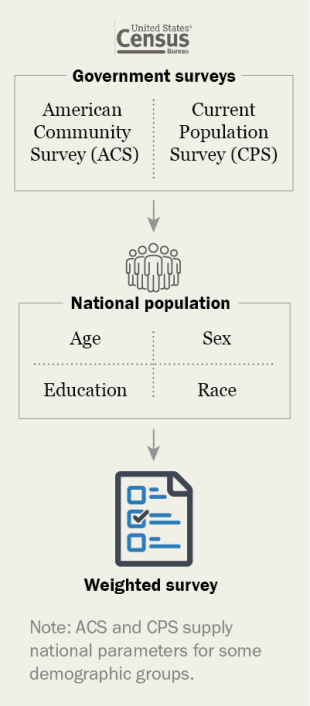
One of the best tools pollsters have for dealing with this is called weighting. To weight a survey, we need targets for the characteristics that are out of balance in our sample. (A target is a template for what a survey sample would look like if it was selected from the population in a way that was truly random.) Weighting is the process of adjusting the raw percentages of groups in our actual survey sample so they match these target shares as closely as possible.
For a few characteristics of the population, we can compare our survey with a trusted source like the U.S. Census Bureau and use that to make sure that our survey has the right percentages (matching the makeup of the actual population) of older and younger people; White, Black, Hispanic and other racial or ethnic groups; and people with a high school education.
Unfortunately, there is no trusted government estimate of party affiliation that we can use to correct a poll’s political balance. But pollsters, including Pew Research Center, have found ways to do this. We outline some of these approaches in the sections of this report that follow, and we address some common questions about political weighting and its limitations.
| # | Наименование новости | Тональность | Информативность | Дата публикации |
|---|---|---|---|---|
| 1 | FAQs about political weighting in polling and its limitations | 0 | 7.63 | 16-09-2026 |
| 2 | Survey panels can make political party affiliation weighting easier | 0 | 8 | 16-09-2026 |
| 3 | Why many polls need to weight on party affiliation or past vote | 0 | 10.42 | 16-09-2026 |
| 4 | 3 ways to correct a poll’s political balance: Party affiliation, past vote and voter file information | 0 | 8.47 | 16-09-2026 |
| 5 | How Pew Research Center is – and is not – using AI in our work | 0 | 7.2 | 28-09-2026 |
| 6 | Methodology | 0 | 13.96 | 30-09-2026 |
| 7 | Appendix B: Coding methodology | 0 | 16.2 | 15-09-2026 |
| 8 | Weekly: 9.19.26 | 0 | 9.78 | 18-09-2026 |
| 9 | How well synthetic polls capture the diversity of public opinion | 0 | 10 | 30-09-2026 |
| 10 | Can AI Stand In for Human Survey-Takers? Not Really | 0 | 14.39 | 30-09-2026 |