Просмотр новости
Найдите то, что Вас интересует
 Спутники
 РН
РН SpaceX
 Роскосмос
 NASA
NASA
СпутникиРНSpaceXРоскосмосNASAWASHINGTON, Sept. 8, 2026 — There are nearly 1 million pieces of debris larger than 1 centimeter in near-earth orbit. As we continue launching spacecraft and telescopes […]
The post Eggshells: Next-Generation Spacecraft Protection appeared first on AIP Publishing LLC.
From the Journal: Journal of Applied Physics
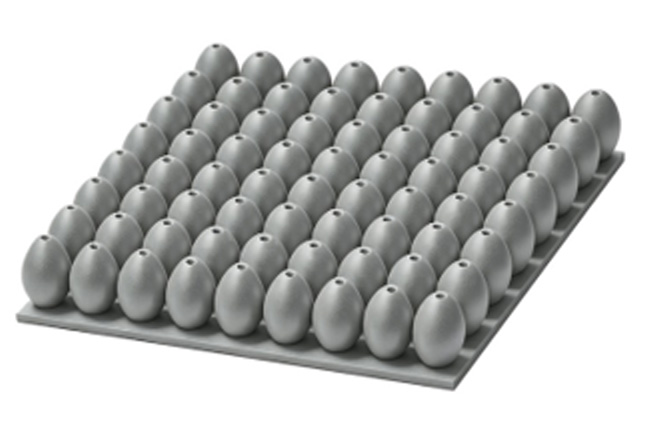 A 3D image of the water-filled aluminum eggshell array metastructure shows the eggshell pattern on an aluminum plate. The second aluminum plate — which goes on top of the eggs — is excluded from the image to help visualize the geometry. Credit: Wang et al.
WASHINGTON, Sept. 8, 2026 — There are nearly 1 million pieces of debris larger than 1 centimeter in near-earth orbit. As we continue launching spacecraft and telescopes to explore the universe, this debris poses a significant threat of high-speed impact damage.
In the Journal of Applied Physics, by AIP Publishing, researchers from Dalian University of Technology, in China, explored an eggshell-inspired design as a potential spacecraft protection material.
“Natural biological structures have evolved to demonstrate excellent energy absorption performance over long-term adaptation,” said author Yuxin Wang.
It may seem counterintuitive to use eggshells as a blueprint for strength. However, the researchers found that organizing water-filled aluminum eggshells into an array adds useful material properties when placed blunt side down between two aluminum impact plates. Rather than being concentrated within a single eggshell, the energy from an impact gradually dissipates through the material, allowing each shell to sequentially collapse and deform.
“A single eggshell breaks easily under local force, but the protection mechanism of the eggshell array is completely different,” Wang said. “The cooperative deformation of these eggshell units transforms the local impact load into distributed energy dissipation across the metastructure, thereby significantly enhancing the anti-impact performance of the target plates.”
Filling the eggs with water helps, too. Under high impact, the water sloshes about and suppresses the impact waves from being propagated. This interaction between the water and the aluminum eggshell significantly reduces and dissipates the energy from the impact.
Several 3D prints and simulations were compared: aluminum plates alone, water-filled aluminum spheres sandwiched between aluminum plates, and the eggshell structures.
The sandwiched, water-filled eggshell material performed best. It withstood high loads and reduced the velocity of an impact projectile by nearly 65%, compared to only a 51% reduction achieved by the aluminum plates on their own. Among the various possible eggshell orientations, metastructure patterns with the eggs placed upright and their small end contacting the top plate were the most effective.
Before being used for lightweight shielding on spacecraft, the material’s geometry and filling needs to be further optimized and impact-tested. The researchers are currently refining the thickness of the aluminum eggshells, their aspect ratio, and their layout to improve the material’s protective energy absorption.
“This work demonstrates that bionic, lightweight metastructures are a promising route for hypervelocity-impact protection,” Wang said. “We hope this research can attract more attention to bio-inspired protective structures.”
###
Article TitleAuthorsYuxin Wang, Yuqing Liu, and Hao Li
Author AffiliationsDalian University of Technology
Journal of Applied Physics is an influential international journal publishing significant new experimental and theoretical results of applied physics research.
| # | Наименование новости | Тональность | Информативность | Дата публикации |
|---|---|---|---|---|
| 1 | Как сообщается в очередном отчёте NASA Orbital Debris Quarterly News ... | 0 | 23.39 | 03-10-2026 |
| 2 | Космос и ОБЖ. 🔩Неработающий спутник, кусочек краски космического корабля, гайка, ... | 0 | 8.58 | 07-10-2026 |
| 3 | Космос поделили США, Россия и Китай: NASA раскрыла число объектов ... | 0 | 12.28 | 03-10-2026 |
| 4 | Делегация КЭП на 77-м Международном астронавтическом конгрессе (IAC 2026) ... | 0 | 7.85 | 06-10-2026 |
| 5 | Обломки ракет падают на Землю чаще двух раз в неделю: ... | 0 | 5.74 | 10-10-2026 |
| 6 | Космос поделили США, Россия и Китай: NASA раскрыла число объектов ... | 0 | 12.78 | 03-10-2026 |
| 7 | Кинематический ад на орбите: Как микроскопический мусор превращается в смертоносное ... | 0 | 5.95 | 28-09-2026 |
| 8 | 🌌 Мы уже рассказывали о световом загрязнении и о том, ... | 0 | 5.32 | 04-10-2026 |
| 9 | Падение космического мусора на Землю: масштабы и риски Каждую неделю ... | 0 | 7.36 | 02-10-2026 |
| 10 | Making Snoring a Bit More Palatable | 0 | 11.7 | 18-08-2026 |