Просмотр новости
Найдите то, что Вас интересует
 Спутники
 РН
РН SpaceX
 Роскосмос
 NASA
NASA
СпутникиРНSpaceXРоскосмосNASAA Russian plague lab worker died of "pneumonia of unknown origin," officials say, in response to initial reports that she was exposed to the deadly bacteria during a lab accident.
By

Ramy Inocencio is a CBS News foreign correspondent based in London, covering Europe and the Middle East. He joined the Network in 2019 as CBS News' Asia correspondent, based in Beijing and reporting across the Asia-Pacific, bringing two decades of experience working and traveling between Asia and the United States.
Updated on: October 5, 2026 / 7:42 PM EDT / CBS News
Russia's government played down concerns Monday sparked by media reports that a female scientist in Siberia might have died of exposure to the plague after a lab accident.
Kremlin spokesman Dmitry Peskov stressed that the state health watchdog known as Rospotrebnadzor was the "lead agency with expertise in this area," and he urged Russians to "listen to official information" from its "highly qualified professionals."
The researcher who died has been identified by Russian reports as Darya Shipilova, 28, who worked at the Irkutsk Anti-Plague Institute more than 2,500 miles east of Moscow.
Russian media initially reported that she broke a test tube containing plague bacteria in late September, came down with severe pneumonia and then died of her illness.
The World Health Organization said she died of severe pneumonia overnight into Oct. 2.
The plague bacterium referred to by the reports is yersinia pestis, the same one that caused the Black Death that swept across Europe in the mid-1300s, killing an estimated 25 million to 50 million people. That pandemic, often referred to as the bubonic plague, was spread by fleas living on rodents and other animals in close proximity to — and in the same grim sanitary conditions as — people.
The pathogen, if untreated, can cause swelling, fever and death.
 A microscopic image shows the yersinia pestis bacteria, which causes plague infections in humans.
RUSLANAS BARANAUSKAS/SCIENCE PHO/Getty Images
A microscopic image shows the yersinia pestis bacteria, which causes plague infections in humans.
RUSLANAS BARANAUSKAS/SCIENCE PHO/Getty Images
Shipilova, according to Russian media, died from the pneumonic plague, which is caused by the same bacteria but attacks the lungs and causes a fever and a cough that can turn bloody. Pneumonic plague can be transmitted from person to person, unlike bubonic plague, and can also be fatal.
The head of Russia's eastern Republic of Buryatia, Alexei Tsydenov, initially said Shipilova died of the plague in a post on the state-backed messaging app MAX. He later edited the post to add the word "possibly," according to an independent regional Russian media outlet that operates in exile, Lyudi Baikala (People of Baikal).
He was not the only Russian official to walk back their words on the story.
Local officials initially warned people not to visit the town of Shelekhov, where the scientist was hospitalized and later died, citing "unofficial information" about a human plague case.
The post was deleted less than two hours later, according to both Lyudi Baikala and Astra, another independent news website.
Since then, Russia's health watchdog, Rospotrebnadzor, has said it carried out "anti-epidemic measures" that included testing nearly 200 people who had come into contact with Shipilova.
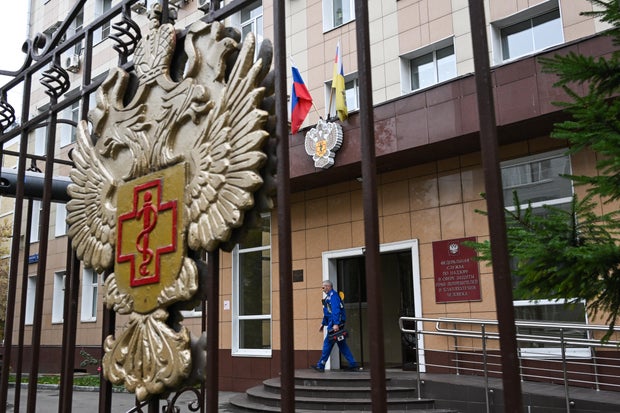 A maintenance worker walks out of the headquarters of Russia's consumer and health watchdog, Rospotrebnadzor, in Moscow on Oct. 5, 2026.
Igor IVANKO /AFP via Getty Images
A maintenance worker walks out of the headquarters of Russia's consumer and health watchdog, Rospotrebnadzor, in Moscow on Oct. 5, 2026.
Igor IVANKO /AFP via Getty Images
The agency said some people had tested positive for colds or COVID, but that no pathogens causing dangerous infections were found. It also said there had been no accident at the Irkutsk Anti-Plague Institute, and it attributed the scientist's death to "pneumonia of unknown origin."
A WHO spokesperson said that based on the unofficial information available, the public health risk to the general public appears to be low.
Speaking with reporters on Monday, U.S. Secretary of State Marco Rubio said the reports of a suspected plague case in Russia were not cause for alarm, but "for focus."
"We know what we know, obviously, about whatever the Russians have provided," he said. "It seems that there was a worker at the lab that was infected, and there's concern that that, you know, could have spread."
But Rubio said, given "very limited travel between the U.S. and Russia," he did not believe it was "cause for alarm, but it is cause for focus, and a cause to just keep an eye on it, and we're doing that."
Jennifer Jacobs contributed to this report.
In: