Просмотр новости
Найдите то, что Вас интересует
 Спутники
 РН
РН SpaceX
 Роскосмос
 NASA
NASA
СпутникиРНSpaceXРоскосмосNASAIndia's recently unveiled India Semiconductor Mission phase 2 or ISM 2.0 which focuses on design and Intellectual Property (IP) creation, helping complete the value chain and making the country Atmanirbhar (self-reliant). The new phase is focused on producing semiconductor equipment and materials in India as well as designing full-stack semiconductor intellectual property. The Union Cabinet had also approved the Research, Development and Innovation (RDI) Scheme, aiming to boost private sector investment.
Synopsis
India's recently unveiled India Semiconductor Mission phase 2 or ISM 2.0 which focuses on design and Intellectual Property (IP) creation, helping complete the value chain and making the country Atmanirbhar (self-reliant). The new phase is focused on producing semiconductor equipment and materials in India as well as designing full-stack semiconductor intellectual property. The Union Cabinet had also approved the Research, Development and Innovation (RDI) Scheme, aiming to boost private sector investment.
Listen to this article in summarized format
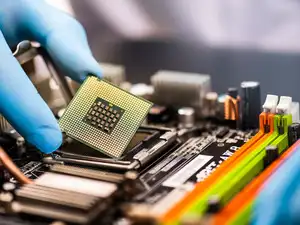 iStock
India Semiconductor Mission phase 2 or ISM 2.0 focuses on design and Intellectual Property (IP) creation, helping complete the value-chain and making the country Atmanirbhar (self-reliant).
NEW DELHI: The newly-unveiled India Semiconductor Mission phase 2 or ISM 2.0 will make India Atmanirbhar (self-reliant) in real terms as the scheme focuses on design and Intellectual Property (IP) creation, and can catalyse large investments, a top NITI Aayog official said.
Union Minister Ashwini Vaishnaw-headed Ministry of Electronics & IT (MeitY) is driving the ambitious India Semiconductor Mission (ISM) program.
"Now in phase 2 of the India Semiconductor Mission 2.0, the scheme's focus is on design and IP creations. This will complete the value chain. Companies will design and create the intellectual property, and also fabricate the chips here. So when we have technology for the end-to-end value chain, then India will become truly Atmanirbhar (self-reliant)," Abhay Karandikar, Member, NITI Aayog told ET.
Read more: Niti Aayog to review export SOPs amid evolving global trade order
Further, Karandikar said that ISM 2.0 will "definitely catalyse huge investment."
In the Union Budget 2026–27, the Centre launched India Semiconductor Mission 2.0 to deepen domestic semiconductor capabilities at a time when chipsets are becoming a critical piece of digital and industrial ecosystems.
The new phase is focussed on producing semiconductor equipment and materials in India, as well as designing full stack Indian semiconductor intellectual property (IP), and fortifying both domestic and global supply chains, with an initial outlay of Rs 1,000 crore for FY 2026–27.
"Now, any developed economy today rests on the foundations of science, technology and the innovation ecosystem. So, therefore, if the country is to become Viksit Bharat (Developed India), then we have to become technologically sovereign and achieve strategic autonomy in technologies," he added.
Atmanirbharta (self reliance) in technology, according to him, is one of the government's top focus areas which plays a critical role for the country and national priorities.
"The government has made certain institutional and sectoral interventions. So, institutional interventions led to the establishment of Anusandhan National Research Foundation (ANRF) and Rs 1 lakh crore Research, Development and Innovation (RDI) fund."
In July last year, the Union Cabinet approved the Research, Development and Innovation (RDI) Scheme that aims to catalyse private sector investment in R&D with a total outlay of ₹1 lakh crore over six years, including ₹20,000 crore in FY 2025-26.
In order to fully achieve technological sovernity, the Centre also created India Semiconductor Mission, National Quantum Mission, India AI Mission, National Green Hydrogen Mission, and the National Mission on Interdisciplinary Cyber-Physical Systems (NM-ICPS), as a national priority.
The roadmap under NM-ICPS focuses on strengthening research, innovation and technology commercialization through broader industry partnerships, promotion of translational research, and scaling up validated cyber-physical technologies for mass adoption.
Read More News on
...moreless
| # | Наименование новости | Тональность | Информативность | Дата публикации |
|---|---|---|---|---|
| 1 | India now has five semiconductor units in production, ISM 2.0 to build wider ecosystem: MeitY secretary | 0 | 10.37 | 17-09-2026 |
| 2 | Govt estimates 200 chip design companies to emerge from Rs 1.27 lakh cr Semicon 2.0 scheme | 0 | 11.14 | 18-09-2026 |
| 3 | Chip majors make beeline for Semicon to build wider ecosystem with Indian talent | 0 | 10.99 | 19-09-2026 |
| 4 | Semicon 2.0 lays foundation for India's long-term semiconductor ambitions: ELCINA | 0 | 11.83 | 16-07-2026 |
| 5 | What goals does Semicon 2.0 aim to achieve? | Explained | 0 | 8 | 20-07-2026 |
| 6 | India doubles down on strategic manufacturing--from semiconductors to hydrogen trains: Finmin Report | 0 | 9.92 | 31-07-2026 |
| 7 | Kishan Reddy pushes for indigenous manufacturing in EV sector, self sufficiency in critical minerals | 0 | 8.62 | 02-08-2026 |
| 8 | Homegrown firms enter budget smartphone market as memory chip prices rise | 0 | 8.1 | 15-10-2026 |
| 9 | India’s Eye in the Sky: The Rise of a State-Deep Tech Startup Space Partnership | 5 | 7 | 05-06-2026 |
