Просмотр новости
Найдите то, что Вас интересует
 Спутники
 РН
 SpaceX
 Роскосмос
 NASA
СпутникиРНSpaceXРоскосмосNASAOceanographer Lily Dove uses remote robots to study Antarctica’s perilous oceans.
While at Brown University in Providence, R.I., oceanographer Lily Dove studied the physics of Antarctica’s Southern Ocean with the help of some unusual, furry assistants: Antarctic seals. “They’re oceanographers,” she says. “They are regularly making dives in areas that we don’t often get to sample.”
Dove didn’t work with the seals directly. Instead, she interpreted data collected by the Marine Mammals Exploring the Oceans Pole to Pole program. This international group of scientists collects ocean data through sensors attached to the foreheads of southern elephant and Weddell seals. (Don’t worry. The animals don’t mind.) The seals dive more than 100 meters (330 feet) in search of food, allowing researchers to monitor temperature, salinity and pressure at depths inaccessible to human divers.
Dove used these data to study how climate change is impacting the Southern Ocean. That’s the vast ocean that circles Antarctica. In certain areas of the Southern Ocean, atmospheric heat moves from the surface to the deep ocean. This heat is typically trapped for hundreds of years once it reaches the depths, further increasing ocean temperatures.
Now at the Georgia Institute of Technology, Dove works with autonomous robots to study polar oceans. Some, such as floats, ride sea currents. Others, such as gliders, are pilotable underwater vehicles, meaning Dove can target specific locations. “And this is all remote,” she says. “I can sit here in Georgia and tell my glider in a whole different hemisphere where I want it to go.”
This tech is also more predictable than her past assistants. “Seals are very independent,” she says. Unlike a glider, “seals very much tell me where they want to go,” she says. In this interview, Dove shares her experience and advice with Science News Explores. (This interview has been edited for content and readability.)
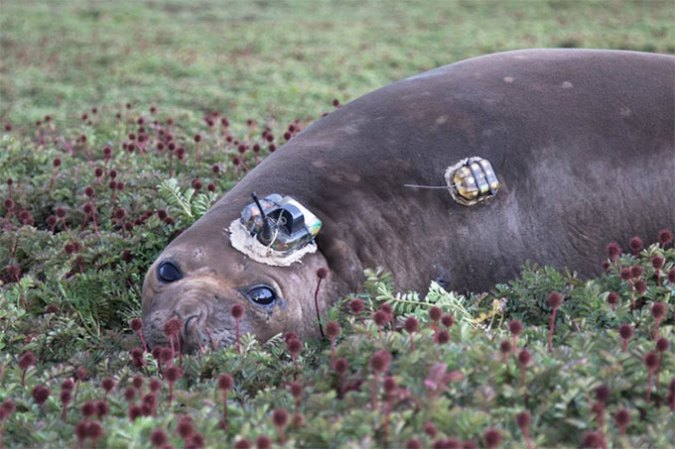 Part of Dove’s work has included analyzing data gathered by sensors placed on Antarctic seal species, such as Southern elephant seals. Etienne Pauthenet (EPFL, Switzerland)What inspired your career?
Growing up in Florida, the ocean interested me as this powerful system that we take for granted. But I didn’t really consider it as a career back then. I knew I loved science, like physics and chemistry. In college, I knew I wanted to do one of those things or some combination. I changed majors like five times.
Then I realized that I liked those topics because they could help explain what I cared about: the Earth and the environment. I learned that you need all different kinds of science to understand the Earth system. Biology, physics, chemistry, geology — all of them. I ended up researching atmospheric chemistry.
How did you get to where you are today?In graduate school, I took those skills from studying atmospheric chemistry and started doing oceanography instead. The atmosphere and ocean have the same physics. That made it feel like it was the perfect transition for me. I landed in a group that was investigating polar oceans, which wasn’t something I’d even considered before. I went to the Southern Ocean for the first time in 2020. The polar oceans are pretty remote and far away from where most people live. But they have massive impacts on our climate system, especially the Southern Ocean. It wasn’t until I was there that I realized that. That’s when I knew that this is exactly what I wanted to be doing.
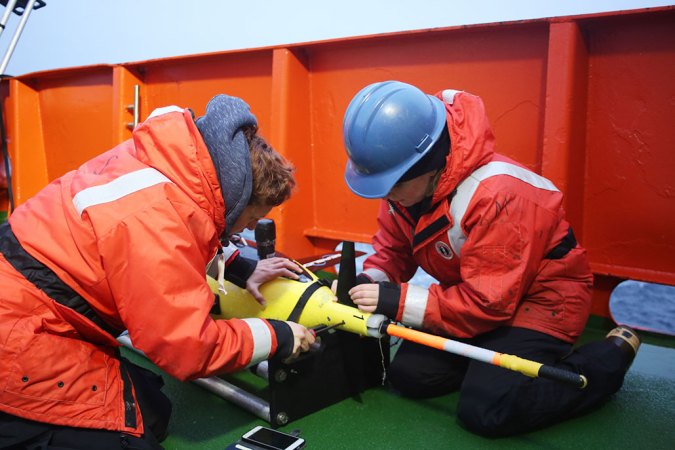 Dove now uses underwater autonomous vehicles, such as this glider being prepared for launch, to explore the ocean.Linnah NeidelWhat was your biggest challenge, and how did you overcome it?
I’ve experienced quite a bit of discrimination in this field as a woman. There are a lot of assumptions people have about who is welcome to do polar science. Historically, women have not been included on research cruises. Women used to stow away on ships to get data for their research theses. There’s a famous case at the Woods Hole Oceanographic Institution of a woman stowing away on a research vessel in the 1950s.
That stigma is still present to an extent, but it’s changing a lot. And it’s not just about women. People of color, queer people and disabled individuals are also experiencing this less-overt discrimination.
Throughout my time in the field and in academia, there have been times when people have assumed I can’t do something. That’s really frustrating, but it’s also given me the skill to really speak up and advocate for myself.
What advice would you give to your younger self?Say “yes” to as many opportunities as possible. That could be attending an event, talking with a scientist or taking a course. The worst-case scenario is that you learn something new that’s just not super interesting to you. The best-case scenario is that something grabs your attention, and you can’t let it go.
I am also glad that I didn’t hyperfixate on a particular area of study super early. I’m glad I got a strong basis in a lot of different scientific fields before I decided on a focus. It allowed me to be really flexible and open to new ideas.
If you already know that you’d want to do something specific, listen to your gut. But if you are not quite sure, lean into just learning a lot.
advocate: (n.) Someone who performs work to support some cause, idea or program. For instance, they might campaign for some change, speak up on behalf of someone or something in court (or other public forum), or write commentaries (opinion pieces) on a topic for some news outlet. (v.) The term for the act of doing such work. For instance, Sarah advocated for turning over the group's bake sale proceeds to buy a new park bench.
atmosphere: The envelope of gases surrounding Earth, another planet or a moon.
attention: The phenomenon of focusing mental resources on a specific object or event.
autonomous: Acting independently. Autonomous vehicles, for instance, pilot themselves based on instructions that have been programmed into their computer guidance system.
biology: The study of living things. The scientists who study them are known as biologists.
chemistry: The field of science that deals with the composition, structure and properties of substances and how they interact. Scientists use this knowledge to study unfamiliar substances, to reproduce large quantities of useful substances or to design and create new and useful substances. (about compounds) Chemistry also is used as a term to refer to the recipe of a compound, the way it’s produced or some of its properties. People who work in this field are known as chemists. (in social science) A term for the ability of people to cooperate, get along and enjoy each other’s company.
climate: The weather conditions that typically exist in one area, in general, or over a long period.
climate change: Long-term, significant change in the climate of Earth. It can happen naturally or in response to human activities, including the burning of fossil fuels and clearing of forests.
current: A fluid — such as of water or air — that moves in a recognizable direction. (in electricity) The flow of electricity or the amount of charge moving through some material over a particular period of time.
data: Facts and/or statistics collected together for analysis but not necessarily organized in a way that gives them meaning. For digital information (the type stored by computers), those data typically are numbers stored in a binary code, portrayed as strings of zeros and ones.
discrimination: (in social science) An attitude of prejudice again people or things based on a bias about one or more of their attributes (such as race, sex, religion or age). It is not based on the actions of an individual but instead based on yet-unfounded expectations that are being applied broadly to a whole group.
environment: The sum of all of the things that exist around some organism or the process and the condition those things create. Environment may refer to the weather and ecosystem in which some animal lives, or, perhaps, the temperature and humidity (or even the placement of things in the vicinity of an item of interest).
field: An area of study, as in: Her field of research is biology. Also a term to describe a real-world environment in which some research is conducted, such as at sea, in a forest, on a mountaintop or on a city street. It is the opposite of an artificial setting, such as a research laboratory. (in physics) A region in space where certain physical effects operate, such as magnetism (created by a magnetic field), gravity (by a gravitational field), mass (by a Higgs field) or electricity (by an electrical field).
glider: A vehicle (such as a plane in air or uninhabited submarine) that takes advantage of currents to travel long distances using little or no fuel. It also tends to move smoothly, creating few disruptions in the fluid or airstream through which it moves.
graduate school: A university program that offers advanced degrees, such as a Master’s or PhD degree. It’s called graduate school because it is started only after someone has already graduated from college (usually with a four-year degree).
mammal: An animal distinguished by possessing hair or fur, the secretion of milk by females for the feeding of their young, and (typically) the bearing of live young. They also are warm-blooded (or endothermic).
marine mammal: Any of many types of mammals that spend most of its life in the ocean environment. These include whales and dolphins, walruses and sea lions, seals and sea otters, manatees and dugongs — even polar bears.
oceanography: (adj. oceanographic) The branch of science that deals with the physical and biological properties and phenomena of the oceans. People who work in this field are known as oceanographers.
physics: The scientific study of the nature and properties of matter and energy. Classical physics is an explanation of the nature and properties of matter and energy that relies on descriptions such as Newton’s laws of motion. Quantum physics, a field of study that emerged later, is a more accurate way of explaining the tiny motions and behavior of matter about the size of electrons. A scientist who works in such areas is known as a physicist.
pressure: Force applied uniformly over a surface, measured as force per unit of area.
queer: A word that used to be an insult to describe people as strange or different. Some LGBTQ people now commonly use it as an inclusive and positive word to describe anyone who isn’t straight, who is transgender or who doesn’t identify as only male or female.
robot: A machine that can sense its environment, process information and respond with specific actions. Some robots can act without any human input, while others are guided by a human.
scenario: A possible (or likely) sequence of events and how they might play out.
sea: An ocean (or region that is part of an ocean). Unlike lakes and streams, seawater — or ocean water — is salty.
stigma: A disgrace, source of shame or a stain on one’s reputation — often not justifiably — due to something that one did, experienced or represents to others.
system: A network of parts that together work to achieve some function. For instance, the blood, vessels and heart are primary components of the human body's circulatory system. Similarly, trains, platforms, tracks, roadway signals and overpasses are among the potential components of a nation's railway system. System can even be applied to the processes or ideas that are part of some method or ordered set of procedures for getting a task done.
technology: The application of scientific knowledge for practical purposes, or the devices, processes and systems that result from those efforts.
transition: The boundary where one thing (paragraphs, ecosystems, life stage, state of matter) changes or converts into another. Some transitions are sharp or abrupt. Others slowly or gradually morph from one condition or environment to another. (in gender studies) A term used to describe the process of changing one’s outward gender in terms of name, behavior and/or expression to match one’s inner sense of their gender.
wood: A porous and fibrous structural tissue found in the stems and roots of trees, shrubs and other woody plants.
Aaron Tremper is the assistant editor for Science News Explores. He has a B.A. in English (with minors in creative writing and film production) from SUNY New Paltz and an M.A. in Journalism from the Craig Newmark Graduate School of Journalism’s Science and Health Reporting program. A former intern at Audubon magazine and Atlanta’s NPR station, WABE 90.1 FM, he has reported a wide range of science stories for radio, print, and digital media. His favorite reporting adventure? Tagging along with researchers studying bottlenose dolphins off of New York City and Long Island, NY.
| # | Наименование новости | Тональность | Информативность | Дата публикации |
|---|---|---|---|---|
| 1 | Spying on the secret lives of boobies | 0 | 14.1 | 10-09-2026 |
| 2 | Scientists collaborated with narwhals to study warming waters in the Arctic | 0 | 7.06 | 28-08-2026 |
| 3 | Шотландские ученые используют специального робота для изучения таяния ледников в Арктике | 0 | 0 | 07-08-2019 |
| 4 | A new kind of robot swims the seas and soars the skies | 0 | 7.01 | 09-07-2026 |
| 5 | What Antarctic Sled Expeditions Teach Us About the Human Body | 0 | 5.41 | 11-09-2025 |
| 6 | Пока лед не растаял. Как российский ученый исследует ледниковые пещеры на краю мира | 0 | 0 | 15-05-2025 |
| 7 | Some of the most pristine coral reefs have a secret weapon: birds | 0 | 6.81 | 13-10-2026 |
| 8 | Antarctic storms are becoming more frequent and intense, affecting sea ice | 0 | 10.37 | 29-07-2026 |
| 9 | Antarctic Tourism Is a Climate Farce. Its Environmental Cost Is Getting Harder to Ignore | 0 | 15.2 | 22-07-2026 |
| 10 | Seals’ amphibious hearing developed a long, long time ago | 0 | 8.16 | 27-07-2026 |