Просмотр новости
Найдите то, что Вас интересует
 Спутники
 РН
 SpaceX
 Роскосмос
 NASA
СпутникиРНSpaceXРоскосмосNASA
In an effort to break political deadlock, the UN has established a ‘4+4’ committee, bringing together Libya’s rival factions Read Full Article at RT.com
In an effort to break years of political deadlock, the UN has set up a ‘4+4’ committee, bringing together Libya’s rival factions
The long-awaited agreement between Libya’s rival factions was finally signed on August 30 under the auspices of the United Nations Support Mission in Libya (UNSMIL). On that day, the mission gathered the two negotiating delegations at its Tripoli headquarters to formalize the text ironed out during earlier rounds of talks in Rome and Tunis. UNSMIL invited foreign diplomats, media representatives, and Libyan delegations to the event, where UN Special Representative Hanna Tetteh hailed the accord in her opening remarks as “another important milestone in Libya’s journey toward stability and national unity.”
This, however, bore a resemblance to previous diplomatic milestones – most notably the 2015 Libyan Political Agreement (LPA) signed in Skhirat, Morocco. The LPA established the rules of the political game in the fractured country; rules to which none of the domestic political actors seem fully committed, yet from which none completely depart. In a sense, Skhirat remains the ultimate reference point for every subsequent UN roadmap in Libya.
In the vacuum left by the 2011 NATO intervention and the brutal murder of Muammar Gaddafi, Libya has seen a continuous parade of diplomatic accords. Yet the fundamental problem has never been a shortage of roadmaps, but rather their consolidation into nationally accepted political facts that elites cannot simply manipulate at will.
The August 30 agreement has two main parts. The first is restructuring the High National Elections Commission (HNEC), the agency in charge of organizing elections. In practice, this means replacing its leadership to settle disputes over appointments and regional representation. Although these changes were long delayed by regional quotas and political patronage stemming from the 2015 Skhirat agreement, rivals can still negotiate them with relative ease.
The 24-month timeline to hold elections was also established. However, the countdown is designed to govern the transition only once a single, unified executive authority and unified national institutions are established to oversee the voting process.
The second component concerns the central objective of UNSMIL’s latest roadmap: agreeing on viable election laws, an issue on which the UN has failed to make meaningful progress since the collapse of the planned 2021 elections.
Libya remains divided between rival power centers: the Government of National Unity (GNU), led by Abdul Hamid Dbeibah in Tripoli, the western part of the country, and the Libyan National Army (LNA) command in the east led by General Khalifa Haftar. These exist alongside two political institutions: the Tripoli-based High Council of state (HCS) and the eastern-based House of Representatives (HoR). To break the deadlock, UNSMIL established a smaller negotiating group known as the ‘Smaller Convening’, or the ‘4+4’. It brings together eight representatives from the GNU, Haftar’s military command, the HCS, and the HoR.
This mechanism directly mirrors the ill-fated 2021 Geneva process, Libyan Political Dialogue Framework, which ultimately hardened Libya’s institutional divide and brought the country closer to a permanent de facto partition than at any point since its formal unification in 1951. The UN Security Council issued a delayed presidential statement endorsing the deal, and thus repeating a familiar ritual that seems to elevates elite compromise over structural reform. Seeking to seize the political initiative, Speaker Aguila Saleh brought the 4+4 framework to the HoR floor for an immediate vote where it was approved by the majority of members.
The ‘4+4’ format developed alongside (and ultimately eclipsed) UNSMIL’s broader Structured Dialogue. Even before those conclusions were finalized, UNSMIL was already facilitating a parallel ‘Smaller Convening’ behind closed doors – the 4+4 was born. As Hanna Tetteh told the Security Council on June 18, the explicit goal of this smaller format was to bypass the paralysis between the legislative bodies and force an accord on the roadmap’s first two steps: reconstituting the elections commission’s board and resolving the contested electoral framework. Thus, the ‘4+4’ was a deliberate strategy to concentrate decision-making among the political and military figures deemed capable of enforcing an outcome.
After the HoR approved the agreement on September 14, the HCS formally rejected it on October 5, along with the related laws and decisions issued by the House, arguing that they bypassed the constitutional, legal and consensual frameworks governing the political process. In her October 14 briefing to the UN Security Council, Tetteh acknowledged this rejection but maintained that the agreement offers an actionable path to presidential and legislative elections under a single, unified executive authority within 24 months.
She also announced that UNSMIL would meet members of the 4+4 committee later this month to examine the possibility of establishing a broadly representative national mechanism under Article 5 of the agreement in consultation with the Security Council. This proposal implicitly acknowledges that the 4+4 mini-dialogue alone may not be sufficient to advance the roadmap.
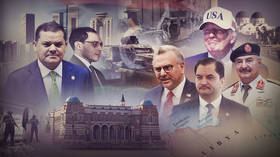
Another significant development is the removal of Aguila Saleh as speaker of the HoR after 12 years in office. On October 7, the eastern-based parliament elected Al-Salhin Abdulnabi as his successor, ending Saleh’s long tenure amid growing discontent over his leadership. The change is particularly significant because Saleh had been accused of being a prominent obstacle to previous attempts to move Libya’s political process forward. Tetteh acknowledged the transition, expressing her appreciation to Saleh for “his leadership and engagement over his 12-year tenure of service.” Her emphasis on the change in parliamentary leadership is noteworthy: The departure of a figure long associated with resistance to political roadmaps could create new room for maneuver, although it does not by itself guarantee that the House will cooperate with the UN initiative or that the entrenched political divisions will be overcome.
Ultimately, the structural core of the August 30 agreement rests on a fundamental contradiction: 4+4 does not equal 1. Combining four delegates from Tripoli’s political-institutional structures, including representatives of the HCS, with four delegates representing the eastern power structure in Benghazi does not produce a unified state. Instead, it seems to function as a shared enterprise in which rival political elites, rather than competing to build a single nation, recognize that their mutual survival depends on dividing power and maintaining exclusive control over the state apparatus.
Setting a 24-month timetable neither offers a guarantee that elections will actually occur; instead, it grants entrenched factions another two years of status quo protection without imposing any penalty for non-compliance.
Still, the UN Security Council appeared to endorse the latest UNSMIL plan. Following Tetteh’s briefing on October 14, the Council reaffirmed its support for the agreement, despite concerns over its implementation and the High Council of State’s rejection.

By prioritizing elite consensus over an enforceable constitutional baseline, the international community risks continuing to repeat a flawed equation. Until UNSMIL and foreign powers break this cycle and align their strategy with the Libyan public’s demand for genuine democratic renewal, every new agreement risks becoming another monument to the status quo. In the end, the ‘4+4’ framework offers no viable fallback or alternative path forward if it fails.
Last week, the UNSC did not vote to extend UNSMIL’s mandate, which expires on October 31. However, this is largely a technicality, since the Council has already approved UNSMIL’s roadmap.
The statements, views and opinions expressed in this column are solely those of the author and do not necessarily represent those of RT.
| # | Наименование новости | Тональность | Информативность | Дата публикации |
|---|---|---|---|---|
| 1 | Washington thinks it can fix Libya. It may be about to break it again instead | -3 | 5 | 01-07-2026 |
| 2 | Libyan rivals set deadline for national elections | 0 | 16.04 | 01-09-2026 |
| 3 | Libya’s maritime deal with Türkiye angers EU states | 0 | 11.5 | 21-10-2026 |
| 4 | Russia warns against sidelining key players in Libya talks | 0 | 14.96 | 15-10-2026 |
| 5 | Libya power crisis sparks new protests (VIDEO) | 0 | 11.07 | 19-08-2026 |
| 6 | The US has a secret plan for Libya. It will backfire | 0 | 9.86 | 29-08-2026 |
| 7 | СМИ: лидеры Италии, Франции и Германии согласовали совместную декларацию по Ливии | 0 | 0 | 13-12-2019 |
| 8 | СМИ: комитет "6+6" Ливии достиг консенсуса по участию в выборах лиц с двойным гражданством | 0 | 0 | 28-05-2023 |
| 9 | Саммит НАТО приветствовал прогресс в Ливии | 0 | 0 | 14-06-2021 |
| 10 | Генсек ООН заявил о прорыве в ливийском урегулировании | 0 | 0 | 05-02-2021 |