Просмотр новости
Найдите то, что Вас интересует
 Спутники
 РН
 SpaceX
 Роскосмос
 NASA
СпутникиРНSpaceXРоскосмосNASAThe changes were announced to little fanfare this week, but have set off alarm bells in the housing sector.
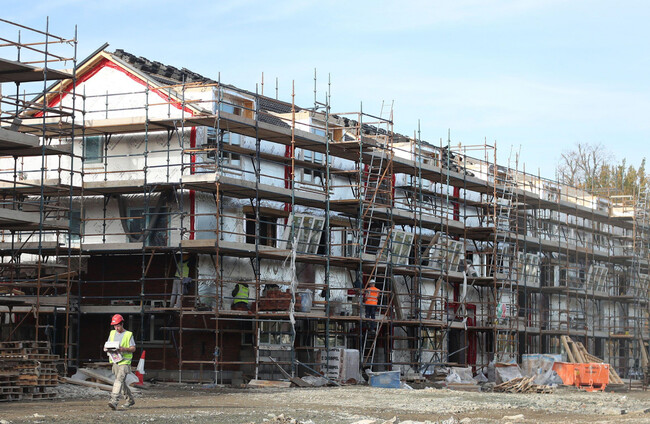
Housing insiders warn that this week's changes could lead to a fall in not just social housing, but it may have a knock-on impact to private home building. Alamy Stock Photo
Must ReadThe Morning Lead
The changes were announced to little fanfare this week, but have set off alarm bells in the housing sector.
THE ROLLOUT OF new homes may slow or even plunge into reverse as a result of a change introduced by the government this week, according to a number of insiders in the Irish housing sector.
Housing Minister James Browne intends to bring plans to cabinet to end funding applications for what is known as ‘turnkey’ social housing purchases from December 2027.
Turnkey acquisitions involve buying newly built and completely finished homes from developers, so-called because you simply need to ‘turn the key’ in the door of the home and occupy immediately.
While the tweaks were rolled out to relatively little fanfare, they have set off alarm bells across large swathes of the Irish housing sector, with multiple builders and housing sources expressing disquiet to The Journal.
The majority of these sources, across both private and state-backed sectors, believe the changes will cause at least a dip in housing completion numbers from 2028 onwards unless significant work is undertaken to resource alternatives to the current housing model.
It would also further jeopardise the government’s target of 60,000 homes per year, according to a number of those who spoke to The Journal.
They were of the view the announcement “leaves a lot up in the air”, as they noted that private developers big and small are currently reliant on turnkey housing being agreed before they build.
This is because these ‘guaranteed sales’ can secure financing from banks to proceed with a full development.
“It’s causing uncertainty among a lot of the sector,” one private developer warned.
Approved Housing BodiesThe Oireachtas Housing Committee heard this week from local council chief executives, who said they believed that one of the most impacted parts of Ireland’s housing networks will be Approved Housing Bodies (AHB).
These not-for-profit organisations work with private developers and councils to provide social and affordable housing, separate from the private market.
As the government’s changes will mean that the homes have to be developed at an earlier stage, housing sources believe it will cast doubt on plans for specific projects that be applied for after December next year.
One builder explained: “The problem is a developer might have planning for a site over the next year and it might look ideal for an AHB.”
But developers may find themselves questioning “how to do the site if you won’t have the option of an AHB, as you’ll have no outlet”, meaning no homes may be built on specific sites as the industry transitions to the new system.
The December 2027 deadline concerns applications for funding approval, rather than a requirement for all purchases to be completed by then.
A number of developers also told The Journal that the change poses a difficulty for apartment building, which has been a focus of the government coalition since taking office.
The private sector’s longstanding complaint regarding apartments is that it finds them hard to make profitable and struggles to sell them on the open market when complete. This has meant that many builders rely on AHBs to sell the apartments to, as a way of completing the project.
A number of AHBs declined to comment when contacted by The Journal.
One AHB, Co-operative Housing Ireland, told us that they are waiting to see further information on the changes before providing any response.
“We share the minister’s goal of increasing the supply of social and affordable homes and await the publication of full details on the recently announced approach,” Co-operative Housing Ireland said.
‘Already stretched’ local councilsSeveral sources, including developers, pointed to how significant investment would be needed in “already stretched” local councils, the Land Development Agency or AHBs to build up the internal teams required to deal with the new work they may be now expected to take on after next year.
“They haven’t got enough planners to manage the files in front of them never mind building thousands of homes,” one developer said. “This just adds to uncertainty.”
But these sources noted that such a build-out of capacity may fly in the face of public expenditure minister Jack Chambers’s stated aims to rein in state spending.
Senior council officials who spoke to The Journal said it would mean more work for them, but were more positive about the changes.
They noted that they would need to get involved at the design stage for new housing developments, but that this would mean they would have more input into the type of housing that could be provided, including for larger families and housing appropriate for disabled people.
‘Misguided’Michelle Norris, professor of social policy at UCD, had backed the turnkey housing proposal when she was a member of the Housing Commission, but said on social media this week that the government was “misguided” in how it planned to phase out the current system.
She added that she believes social housing output will “decline significantly” under the plan proposed.
“None of the large AHBs have any in-house capacity to manage large direct construction projects, this capacity is also severely limited in the local authority sector,” Norris said.
“Moving to increase direct construction requires time to invest in increasing land banks and construction capacity in the social housing sector. Unless this is done, social housing output will decline significantly if turnkey acquisition is stopped.”
Sinn Féin housing spokesperson Eoin Ó Bróin told The Journal that what the government is proposing needs a “five-year transition period”, and risks “upending” the housing sector on the shorter timeline.
“Sinn Féin is not, in principle, against the government announcement,” Ó Bróin added, “However, if government makes a mess of this it could actually result in fewer social and private homes being delivered.”
| # | Наименование новости | Тональность | Информативность | Дата публикации |
|---|---|---|---|---|
| 1 | Biggest bank bullish on home loans despite budget hit | 0 | 8.75 | 12-08-2026 |
| 2 | Якушев: требования к застройщикам жилья будут снижаться после перехода на счета эскроу | 0 | 0 | 07-06-2019 |
| 3 | New-builds coming to housing market at near 10-year low – Rightmove | 0 | 5 | 09-07-2026 |
| 4 | Voices: ‘This country struggles to build anything’: Readers clash over Andy Burnham’s £10bn housing plan | 0 | 7.83 | 25-08-2026 |
| 5 | Замглавы Минстроя призвал не снижать темпы жилищного строительства | 0 | 10 | 18-09-2026 |
| 6 | Housebuilder Bellway urges Burnham to cut stamp duty as it flags weak demand and higher costs | 0 | 6.14 | 11-08-2026 |
| 7 | Российским новостройкам предсказали спад интереса | 0 | 10 | 25-09-2026 |
| 8 | Jim O’Callaghan is proving to be a Teflon justice minister | 0 | 9.78 | 24-10-2026 |
| 9 | Burnham hails council house comeback with £10bn for 70,000 new homes | 0 | 12.34 | 25-08-2026 |
| 10 | Vistry shares slide as it warns of first-half loss and finance chief quits | -3 | 7 | 08-07-2026 |