Просмотр новости
Найдите то, что Вас интересует
 Спутники
 РН
РН SpaceX
 Роскосмос
 NASA
NASA
СпутникиРНSpaceXРоскосмосNASAFrench prime minister beaten to the presidency by his former ally Jacques Chirac at the 1995 electionFor many months before the 1995 French presidential election, Édouard Balladur, the incumbent prime minister, seemed certain of victory. Opinion polls consistently gave him a lead over his conservative rival Jacques Chirac, and the main leftwing candidate. But, as other politicians have discovered, polls can be misleading and voters change their minds. When the ballot papers were counted it was Chirac who won and succeeded François Mitterrand as president.The defeat of Balladur, who has died aged 97, was due partly to his lack of appeal to young voters, a consequence of his public image which, somewhat unfairly, was that of an aloof aristocrat. When he first became a minister, the satirical weekly newspaper Le Canard Enchaîné dubbed him “his courteous self-importance” and Le Monde’s cartoonist Plantu depicted him as a bewigged 18th-century nobleman being carried around in a sedan chair. His manner and style – three-piece English tailored suits, dislike (figuratively and literally) of getting his hands dirty and obvious distaste for close personal contact – did not play well in the context of a presidential contest. Continue reading...
For many months before the 1995 French presidential election, Édouard Balladur, the incumbent prime minister, seemed certain of victory. Opinion polls consistently gave him a lead over his conservative rival Jacques Chirac, and the main leftwing candidate. But, as other politicians have discovered, polls can be misleading and voters change their minds. When the ballot papers were counted it was Chirac who won and succeeded François Mitterrand as president.
The defeat of Balladur, who has died aged 97, was due partly to his lack of appeal to young voters, a consequence of his public image which, somewhat unfairly, was that of an aloof aristocrat. When he first became a minister, the satirical weekly newspaper Le Canard Enchaîné dubbed him “his courteous self-importance” and Le Monde’s cartoonist Plantu depicted him as a bewigged 18th-century nobleman being carried around in a sedan chair. His manner and style – three-piece English tailored suits, dislike (figuratively and literally) of getting his hands dirty and obvious distaste for close personal contact – did not play well in the context of a presidential contest.
There was nothing aristocratic in Balladur’s background, however, about which he maintained a certain mystery. He was born in Smyrna, now Izmir, in Turkey, the youngest of the six children of Pierre Balladur, the manager of a local branch of an Ottoman bank, and Émilie (nee Latour). His parents became naturalised French citizens in 1932 and the family moved to France when Édouard was six, settling in Marseille, where he went to school at the Lycée Thiers.
Balladur began studies in law at Aix-Marseille University, then continued them at the Institute of Political Sciences (Sciences-Po) in Paris, living for a while in the Roman Catholic hostel where years earlier Mitterrand had resided.
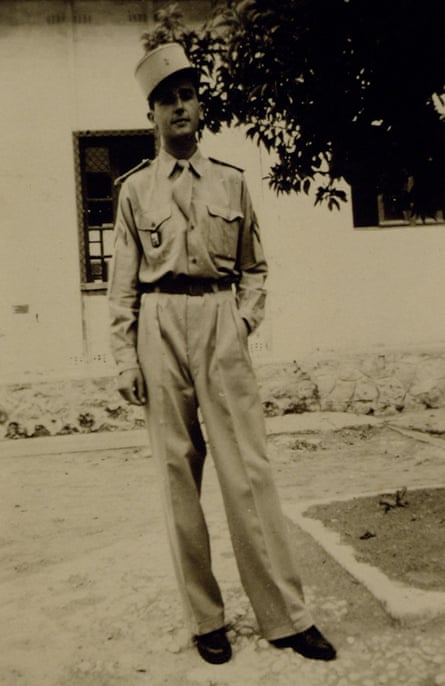
A bout of tuberculosis temporarily interrupted his studies; once cured he completed his military service in Algeria, which was then a French colony, two years before the war of independence, when tensions were high.
On his return to Paris, he was accepted into the École Nationale d’Administration (ENA), then the nursery of France’s political, business and technocratic elite.
He began his career with the Conseil d’État and the former state broadcasting organisation ORTF but caught the eye of Georges Pompidou, Charles de Gaulle’s prime minister, and became his adviser in 1964. This gave him a ringside seat during the student riots and civil unrest of 1968, and the negotiations that eventually got the country back to work after a national strike.
In 1969, Pompidou succeeded De Gaulle at the Élysée, and Balladur went with him, becoming secretary general of the presidency. After Pompidou’s death in 1974, a leading industrialist took Balladur under his wing, and he ran two subsidiaries of a major company, making useful contacts in business. For many years he enjoyed a plum sinecure as president of the company operating the Mont Blanc tunnel.
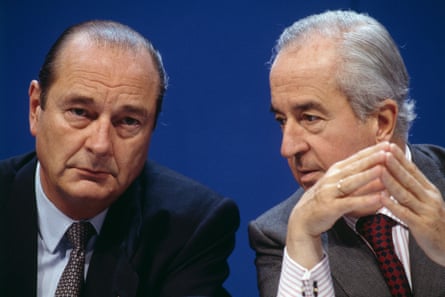
In 1980, he returned to politics. Chirac, who had walked out of his job as President Valéry Giscard d’Estaing’s prime minister in 1976 to found the conservative RPR party and pursue his own presidential ambitions, sacked two of his closest advisers and invited Balladur to replace them. Chirac’s first presidential bid the following year failed (though it sank Giscard), but five years later the conservative right recaptured the Assemblée Nationale, and Chirac was appointed prime minister after negotiations with the socialist Mitterrand in which Balladur played a key role.
In this, the first “cohabitation” (in which the president and the government are of different political families), Balladur was appointed minister of finance, economy and privatisation. He was a powerful minister, but was in office for only two years. In 1988, Chirac made a second presidential bid and lost again.
The re-elected Mitterrand called a general election, and the Socialists were able to form a minority government. Balladur returned to the world of business, where he now cut a more substantial figure after his experience in government, and set about establishing networks of friends and contacts.
It was clear that the Socialist-led government was heading for defeat in the 1993 general election. Chirac, as the leader of the right, was the obvious choice as prime minister after a conservative victory. But he had been so bruised by his experience as prime minister under Mitterrand’s presidency during the first cohabitation that he was not eager to repeat the experience.
Balladur emerged as the clear favourite for the role, acceptable to both Mitterrand and the right. It was evident at the time that Chirac saw Balladur as a proxy for himself. One of his closest allies even suggested Balladur might make weekly visits to Chirac in the Paris city hall, where he reigned as mayor, to brief him on government business. But Balladur established himself as his own man.
The second cohabitation, unlike the first, was a courteous affair. The public took to the new prime minister, and seemed to appreciate the absence of confrontation between Mitterrand and Balladur.
Balladur had never been one of the barons of Gaullism or Chirac’s version of neo-Gaullism, and his instincts appeared to favour Christian democracy on the German model more than the national populism of the likes of Charles Pasqua or Philippe Séguin.
There was no shortage of crises – over reform of immigration laws, a strike at Air France that saw clashes between workers and police, the minimum wage for young school leavers, funding for church schools and the plight of French fishermen.
Abroad, there were some serious questions over France’s role in the genocide in Rwanda. But Balladur avoided taking on protesters, preferring discreet withdrawal when it appeared there was strong opposition. He was credited with a success in the talks on the General Agreement on Tariffs and Trade (Gatt) in 1993.
It rapidly emerged that, far from being a surrogate for Chirac, Balladur was a man with views and, more importantly, ambitions of his own. Month after month, polls showed strong public support for him. Relations with Chirac and his allies deteriorated in spite of occasional public and unconvincing displays of unity. It is not clear when he decided to stand for the presidency, but he formally declared his intention in early 1995.
Much of the centre-right and two significant RPR figures – Pasqua and the future president Nicolas Sarkozy – rallied to him. But Chirac had found an issue on which to campaign: the “social fracture” in French society. In the slightly improbable role of the outsider castigating the technocratic elites, Chirac struck a chord, particularly with the young. Balladur’s efforts to reach out to the people, including climbing on tables at public meetings, to much general derision, were less successful.
His opinion-poll lead melted, and in the first round of voting Lionel Jospin, the socialist candidate, came top with 23% of the vote, followed by Chirac with a little under 21% and Balladur at 18.5%. Chirac won the run-off.
The new president was not the man to forgive what he regarded as treason, and in the new government there was no place for Balladur, who, however, retained political ambitions. When it became clear that Jean Tiberi, Chirac’s successor as mayor of Paris, was tainted beyond political redemption by scandal, Balladur, after some hesitation, declared his candidacy. If he had hoped for help from Chirac, he was disappointed.
Tiberi and Balladur split the centre right vote, allowing Bertrand Delanoé to become in 2001 the first leftwing mayor of the city since the Paris Commune 130 years earlier. Balladur continued to serve as an MP until 2007.
In later years, questions began to be asked about the financing of his 1995 presidential campaign. The allegations centred on the sale of submarines to Pakistan and possible bribes, commissions and kickbacks. In 2002, a bomb in Karachi killed 14 people, 11 of them French employees of the national shipbuilders. Al-Qaida was initially suspected, but later it was suggested that on taking office Chirac had stopped the payment of kickbacks to middlemen and the bombing had been an act of revenge or intimidation.
There were reports that some of the money had found its way into Balladur’s campaign funds. Certainly, claims that the huge sums of cash in large-denomination notes paid into campaign accounts were the product of the sale of T-shirts did not convince everyone.
Several members of his entourage were investigated and charged by magistrates looking into alleged misappropriation of public funds in what became known as the “Karachi affair”.
In 2017, Balladur himself was charged with funnelling kickbacks on state arms deals with Pakistan and Saudi Arabia, alongside the former defence minister François Léotard. In 2021, the court of justice of the Republic ruled that there was no evidence that Balladur had personally ordered payments linked to the contract, nor sufficient proof to establish the origins of his campaign financing, and he was acquitted of all charges. Léotard was found guilty, and given a suspended prison sentence and a fine.
Balladur’s wife, Marie-Josèphe (nee Delacour), whom he married in 1957, died last year. They had four sons, Pierre, Jerome, Henry and Romain.
Édouard Balladur, politician, born 2 May 1929; died 31 August 2026
| # | Наименование новости | Тональность | Информативность | Дата публикации |
|---|---|---|---|---|
| 1 | Биография экс-президента Франции Жискара д'Эстена | 0 | 0 | 02-12-2020 |
| 2 | Humiliation for Michel Barnier as his French presidential election bid ends in failure | 0 | 10.96 | 02-12-2021 |
| 3 | Правительство Франции назначило первый тур выборов на 18 апреля 2027 года | 0 | 5 | 01-07-2026 |
| 4 | "Изменения и преемственность". Каким запомнят президента Жискар д'Эстена | 0 | 0 | 03-12-2020 |
| 5 | Reuters: экс-президент Кот-д'Ивуара Анри Конан Бедье умер в возрасте 89 лет | 0 | 0 | 01-08-2023 |
| 6 | СМИ: умер экс-президент Франции Жискар д'Эстен | 0 | 0 | 02-12-2020 |
| 7 | Ле Пен по опросам с отрывом опередила конкурентов на пост президента Франции | 0 | 11.48 | 24-08-2026 |
| 8 | Кандидат в президенты Франции: только мусульманам под силу построить социализм | 0 | 8.2 | 20-08-2026 |
| 9 | Умер премьер-министр Кот-д'Ивуара | 0 | 0 | 10-03-2021 |