Просмотр новости
Найдите то, что Вас интересует
 Спутники
 РН
РН SpaceX
 Роскосмос
 NASA
NASA
СпутникиРНSpaceXРоскосмосNASA
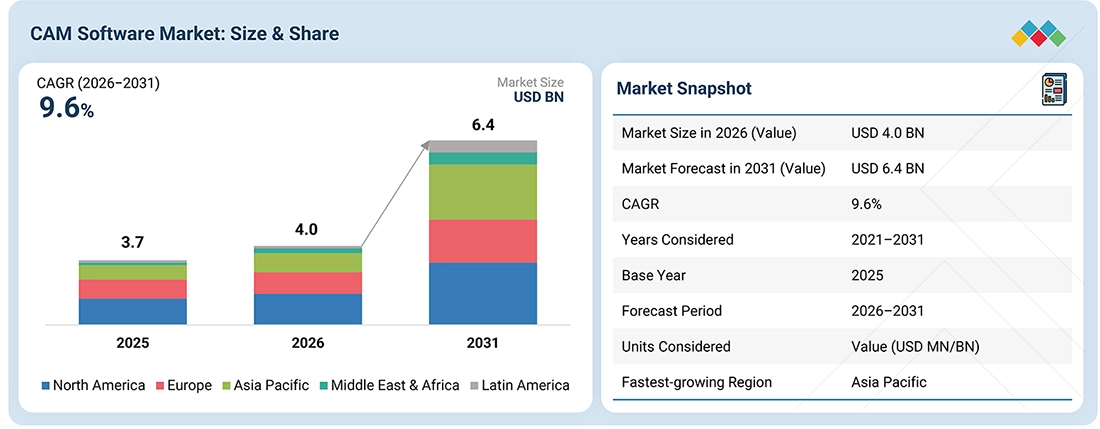
USD 6.4 BN
MARKET SIZE, 2031

CAGR 9.6%
(2026-2031)

300
REPORT PAGES

200
MARKET TABLES
Source: Secondary Research, Interviews with Experts, MarketsandMarkets Analysis
The global CAM software market is projected to grow from USD 4.0 billion in 2026 to USD 6.4 billion by 2031, at a CAGR of 9.6%, driven by increasing demand for manufacturing automation, precision machining, and improved production efficiency. CAM software is evolving beyond traditional CNC programming and toolpath generation toward integrated capabilities such as multi-axis machining, additive manufacturing, simulation, digital twins, and AI-enabled toolpath optimization. Rising adoption of smart manufacturing is encouraging manufacturers to connect CAM with CAD, MES, and other production systems, enabling more efficient and data-driven manufacturing workflows. The increasing complexity of components across automotive, aerospace & defense, and industrial machinery is further driving demand for advanced machining, simulation, and automated programming capabilities. Cloud-based deployment is supporting adoption by improving collaboration, accessibility, and scalability while reducing infrastructure requirements. At the same time, growing pressure to reduce machining time, material waste, production costs, and manufacturing errors is increasing demand for automated programming, real-time optimization, and integrated CAM solutions across discrete manufacturing industries
BY REGION
The North America is expcted to hold largest market value of USD 1.4 billion in 2026.
BY OFFERING
The software segment is expected to hold the largest market value in 2025
BY APPLICATION
The machining & production segment is expected to hold the largest market share in the 2025
BY DELIVERY MODE
The on-presmises deployment is expected to hold largest market share in the market in 2025.
BY CAPABILITY
The multi-axis segment is expected to grow at the highest CAGR over the forecast period
BY ORGANIZATION SIZE
Large Enterprise segment is expected to hold largest share in the 2025.
BY VERTICAL
The automotive segment is expected to hold largest market value in 2025.
COMPETITIVE LANDSCAPE
The CAM software market is highly competitive, with leaders like Autodesk, Siemens, Dassault Systèmes, Sandvik (Mastercam), and Hexagon positioned as top players offering comprehensive CAM and manufacturing solutions. These vendors distinguish themselves with advanced multi-axis machining, integrated CAD/CAM platforms, simulation, automation, cloud capabilities, and AI-enabled manufacturing technologies supporting complex production environments
COMPETITIVE LANDSCAPE
CloudNC, Toolpath, Productive Machines, Manukai, and Podium Automation are emerging and SME-focused players in the CAM software market, offering specialized solutions for AI-driven CNC programming, automated toolpath generation, machining optimization, and digital manufacturing workflows. These vendors focus on reducing programming effort, improving machining efficiency, and enabling scalable automation for manufacturers.
The CAM software market is expanding as manufacturers prioritize advanced machining capabilities to address growing production complexity, precision requirements, and operational efficiency. Adoption is rising as modern CAM platforms enable automated toolpath generation, multi-axis machining, simulation, and improved manufacturing accuracy. Cloud-based, AI-enabled, and integrated CAM solutions are accelerating this shift by making machining workflows more automated, connected, and scalable.
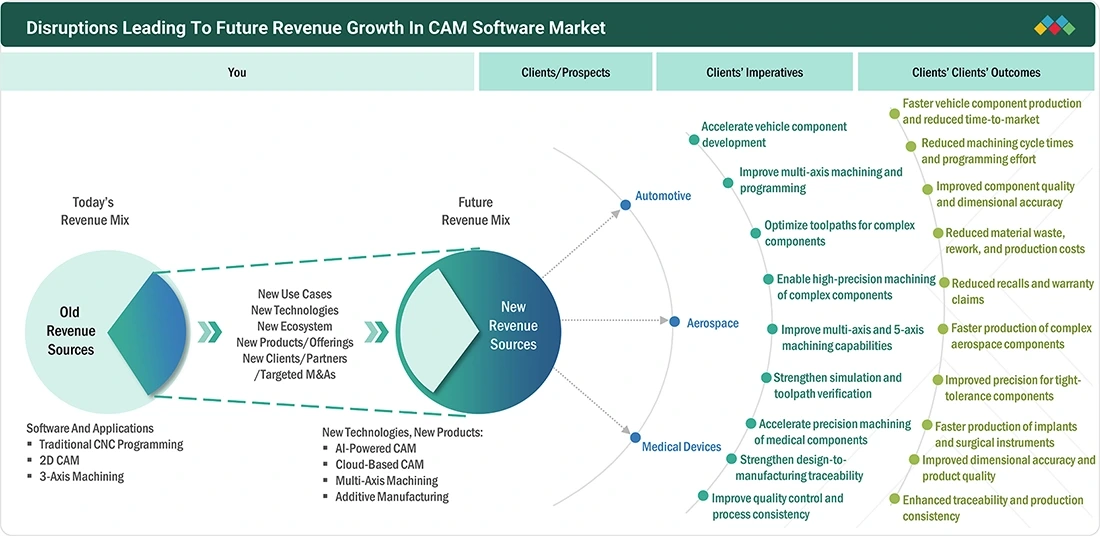
The CAM software market is witnessing significant trends and disruptions driven by the adoption of Industry 4.0, automation, and AI-powered manufacturing technologies. The shift towards multi-axis machining, cloud-based CAM solutions, and real-time data analytics is transforming traditional production processes. Emerging trends such as additive manufacturing integration and predictive maintenance are enhancing efficiency, reducing errors, and enabling customized, high-precision production. These developments are reshaping manufacturing workflows and creating new opportunities for growth and innovation in the CAM software market.
Source: Secondary Research, Interviews with Experts, MarketsandMarkets Analysis

Drivers
Impact
Level



RESTRAINTS
Impact
Level


OPPORTUNITIES
Impact
Level



CHALLENGES
Impact
Level


Source: Secondary Research, Interviews with Experts, MarketsandMarkets Analysis
The growing adoption of cloud-based and SaaS solutions is transforming the CAM software market by offering manufacturers scalable, cost-efficient, and high-performance tools that boost productivity and efficiency. Cloud-based CAM platforms enable real-time collaboration, data sharing, and streamlined project management, improving decision-making across operations. The SaaS model lowers upfront costs, making advanced CAM solutions more accessible to small and medium-sized enterprises (SMEs) while allowing flexible scalability based on demand. Solutions such as Creo+ and PowerMill demonstrate these benefits, with Creo+ providing integrated 3D CAD and collaboration features, and PowerMill offering advanced multi-axis machining and toolpath optimization. These technologies are driving innovation, flexibility, and competitiveness in modern manufacturing.
The integration of CAM software with legacy systems remains a key challenge in the CAM market, as many manufacturers continue to rely on outdated hardware and software that are incompatible with modern technologies. These limitations make it costly and complex to implement advanced CAM solutions, often leading to operational disruptions and integration delays. Additionally, the shortage of skilled professionals capable of managing both legacy and new systems further restricts adoption. Consequently, many organizations postpone upgrades or adopt limited solutions, which impacts overall productivity and efficiency. Addressing this challenge requires strategic modernization efforts and improved system compatibility to support smooth technology integration and market growth.
The growing focus on precision manufacturing of high-performance specialized components offers major growth opportunities for the CAM software market. Industries such as aerospace, automotive, and medical devices increasingly rely on CAM software to produce complex, high-tolerance parts with superior accuracy and consistency. By integrating with CAD systems, CAM enhances CNC programming efficiency, minimizes material waste, and supports rapid prototyping. Companies like Innovative Technology Manufacturing (ITM) use advanced tools such as Mastercam to achieve high precision in titanium component production and manage complex aerospace projects. Additionally, CAM’s role in additive and hybrid manufacturing strengthens innovation across sectors. Combined with Industry 4.0 technologies like IoT and AI, CAM enables smart, automated, and efficient production, making it essential for modern precision-driven manufacturing.
The CAM industry is facing a severe shortage of skilled professionals, particularly in CNC machining, programming, and robotics. According to a 2024 Deloitte and The Manufacturing Institute report, the U.S. manufacturing sector will require 3.8 million new workers by 2033, with 1.9 million positions likely to remain unfilled due to skill gaps. This shortage is driven by the retirement of experienced machinists, limited vocational training programs, and declining interest in manufacturing careers. To overcome these challenges, companies need to strengthen partnerships with educational institutions, promote technical training, and invest in workforce development. Furthermore, adopting AI-driven and Industry 4.0 technologies can help bridge skill gaps, enhance workforce capabilities, and ensure sustainable growth and competitiveness in the CAM market.
| COMPANY | USE CASE DESCRIPTION | BENEFITS |
|---|---|---|
|
|
Western Saw developed the WSX-1 using SolidWorks and CAMWorks to enable precise, safe, and efficient corner cuts, while streamlining design and prototyping to cut development time. | Achieve high-precision cuts while preserving structural integrity | Reduce manual handling, improving worker safety | Cut development timelines significantly (e.g., prototype in 6 months) | Deliver cost-effective alternatives to specialized tools | Improve installation speed and operational throughput |
|
|
Edwards implemented the 3DEXPERIENCE platform to centralize data, streamline product development, and improve collaboration, enabling secure sharing and customized vacuum pump solutions for the life sciences industry. | Centralize engineering data and streamline cross-functional collaboration | Accelerate design iterations and enable virtual testing | Improve project visibility and resource planning | Reduce delays and enhance team communication | Support sustainable innovation in high-performance components |
|
|
Decathlon utilized Autodesk’s generative design technology to develop a lighter, more sustainable diving fin, reducing material usage and environmental impact while ensuring superior performance and durability. | Reduced material usage and carbon footprint by 50% | Created lighter, recyclable products with high durability | Maintained performance standards while enhancing user comfort | Used single-material recycled plastic for easier end-of-life processing |
|
|
Brasseler, a leading German medical technology company, implemented PTC’s Creo NC to enhance the design and manufacturing of precision dental tools through advanced 3D modeling, automation, and integrated workflows. | Cut design time from hours to minutes | Improved machine utilization and shop floor productivity | Accelerated product launch cycles | Increased design precision and manufacturing quality |
Logos and trademarks shown above are the property of their respective owners. Their use here is for informational and illustrative purposes only.
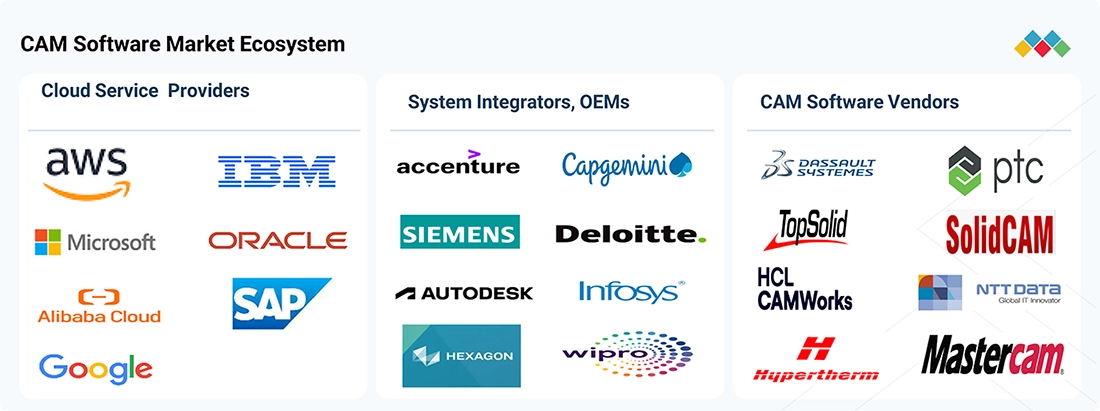
The CAM software market ecosystem comprises software providers, machinery manufacturers, system integrators, and end-user manufacturers working in tandem to enable digitalized production. Key software vendors offer AI-driven CAM solutions, simulation tools, and generative design platforms, while machinery providers supply CNC machines, robotics, and additive manufacturing systems. End-users, including OEMs and contract manufacturers, leverage these solutions to enhance efficiency, precision, and scalability. Training institutes and R&D centers further strengthen the ecosystem by supporting workforce upskilling and innovation in advanced manufacturing technologies.
Logos and trademarks shown above are the property of their respective owners. Their use here is for informational and illustrative purposes only.
Source: Secondary Research, Interviews with Experts, MarketsandMarkets Analysis
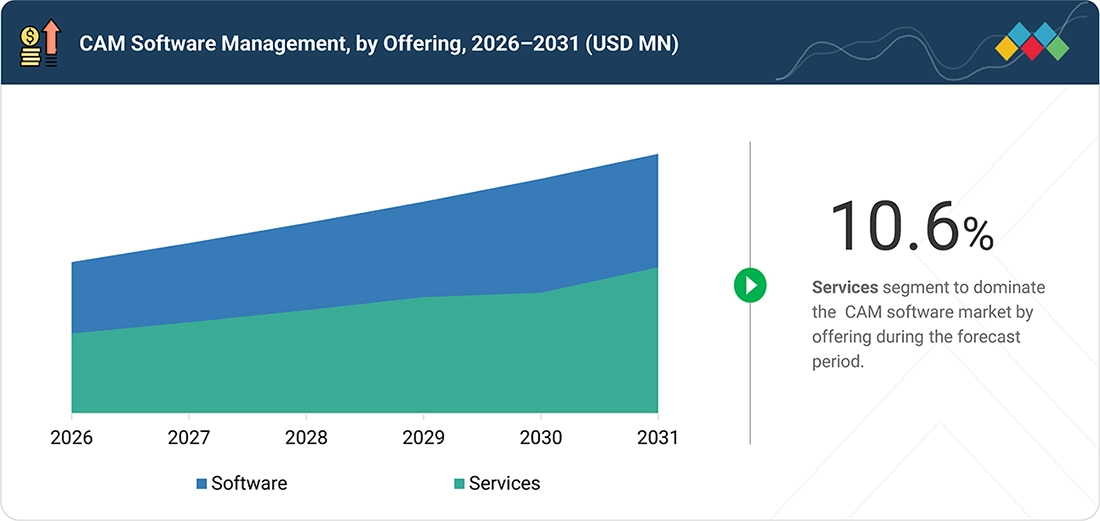
The software segment dominates the CAM market, driven by the adoption of integrated platforms that support automation, simulation, and precision machining. Manufacturers are investing in CAM software to streamline design-to-production workflows, minimize manual errors and downtime, optimize resource utilization and production efficiency. Integration with CAD and PLM systems is becoming standard, enabling seamless operations and data continuity across engineering and manufacturing teams.
The quality control & inspection segment is growing at the fastest pace, reflecting manufacturers’ focus on compliance, accuracy, and cost control. CAM-enabled inspection tools help reduce scrap and rework, ensure regulatory compliance, integrate with CNC and metrology systems for real-time validation. This segment is critical for industries with tight tolerances and high-quality standards, such as aerospace, automotive, and medical devices.
The 2D CAM segment continues to hold the largest share due to its widespread use in milling, drilling, and cutting applications. Key advantages include cost-effectiveness for small and mid-sized operations, ease of integration with legacy systems, operational simplicity for basic geometries and prototyping. While advanced 3D and multi-axis capabilities are growing, 2D CAM remains essential for high-throughput, low-complexity manufacturing environments.
The cloud deployment segment is projected to grow at the highest CAGR, driven by the shift toward remote operations, real-time collaboration, and scalable production environments. Cloud-based CAM platforms offer subscription-based access to advanced tools, AI-driven optimization and analytics, seamless data sharing across distributed teams. This model supports global manufacturing workflows, enabling faster decision-making and improved agility.
Large enterprises dominate the CAM software market due to their ability to invest in automation, smart manufacturing, and digital transformation at scale. These organizations are deploying advanced CAM systems to enhance operational efficiency across global facilities, standardize production quality and process control, integrate CNC machining, robotics, and multi-axis capabilities for precision manufacturing. Their focus on scalable, interoperable, and data-driven CAM platforms supports enterprise-wide optimization and ROI.
The medical devices and pharmaceutical segment is projected to grow at the highest CAGR, driven by the need for precision machining, customized components, and regulatory compliance. CAM software enables rapid prototyping of complex, biocompatible parts, traceable manufacturing workflows for quality assurance, integration with digital validation tools to meet strict standards. This vertical demands high accuracy, material integrity, and design flexibility, making CAM essential for innovation and patient safety.
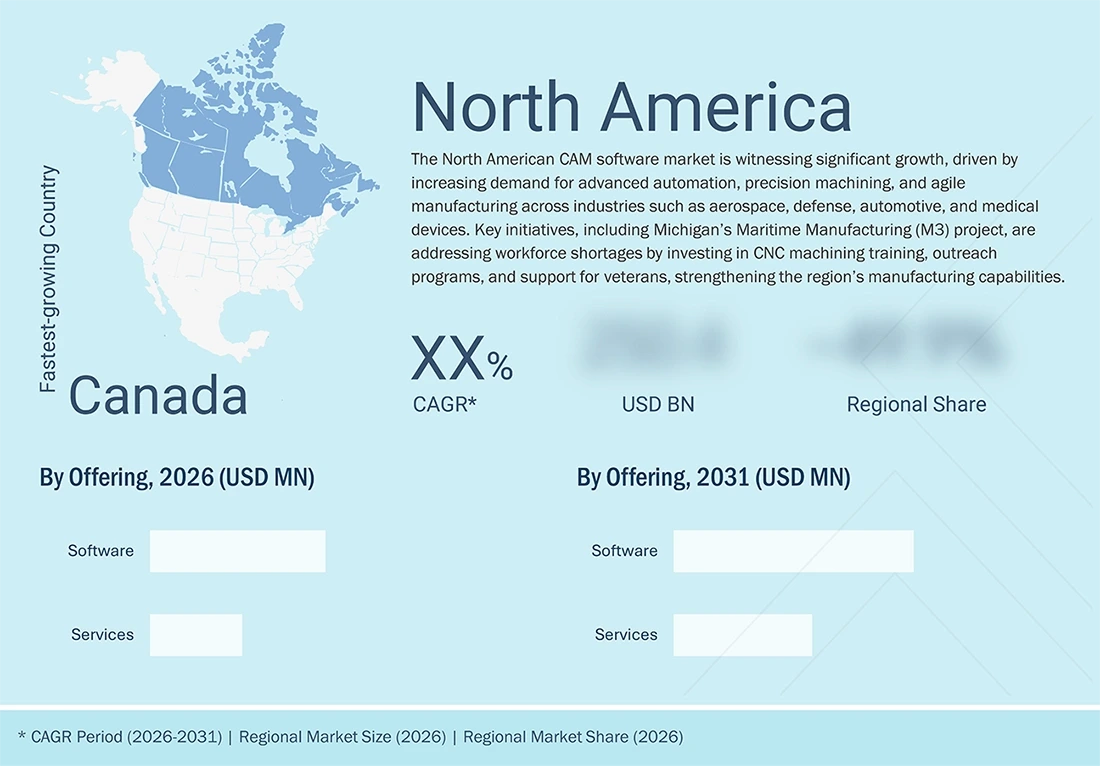
North America continues to represent an important market for CAM software, supported by its strong base of precision manufacturing and computer-integrated production. The US drives regional adoption through continued use of advanced machining across automotive, aerospace, medical devices, and industrial equipment manufacturing. In Canada, demand is supported by the modernization of machining operations and the increasing use of digital tools to improve production planning and manufacturing precision. Manufacturers are adopting CAM capabilities such as automated programming, multi-axis machining, simulation, and toolpath optimization to handle increasingly complex components and shorten production cycles. The growing integration of CAM with CAD, CNC equipment, and broader manufacturing systems is also creating opportunities for more connected and automated production environments across the region.
Autodesk (Star) continues to lead the CAM software market with its advanced, integrated software solutions that streamline design-to-production workflows, enhance precision, and support complex manufacturing processes. Its robust portfolio, including Fusion 360, offers scalable, cloud-enabled, and AI-driven tools, enabling high efficiency, reduced cycle times, and improved productivity across industries. NTT Data Engineering Systems (Emerging Leader) is gaining recognition for its innovative approach to digital manufacturing and CAM integration, delivering tailored solutions for smart machining, automation, and process optimization. The company focuses on bridging gaps between design, simulation, and production, helping enterprises enhance operational efficiency and adopt flexible, technology-driven manufacturing practices. Both companies are shaping the CAM landscape, with Autodesk driving established market leadership and NTT Data Engineering Systems emerging as a key innovator for specialized, next-generation manufacturing solutions.
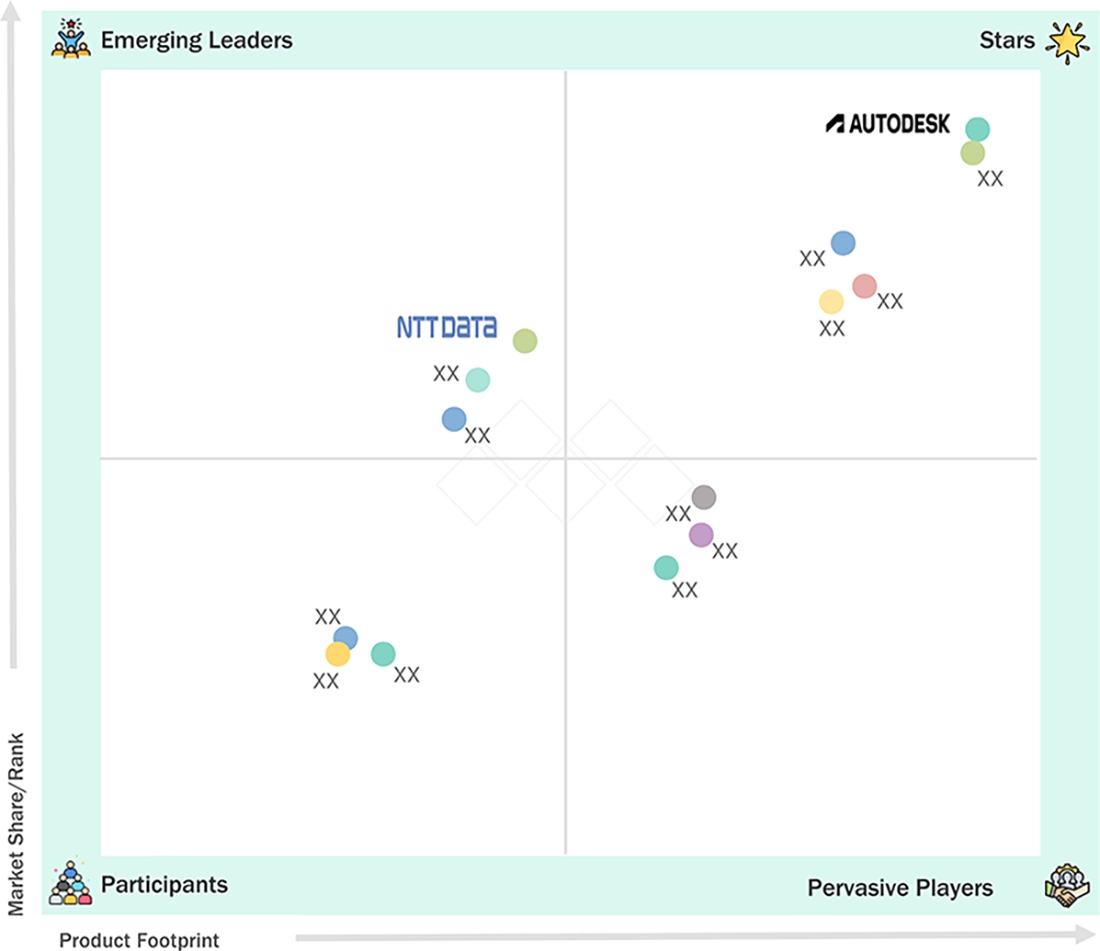
Source: Secondary Research, Interviews with Experts, MarketsandMarkets Analysis
| REPORT METRIC | DETAILS |
|---|---|
| Market Size in 2025 (Base Value) | USD 3.7 Billion |
| Market Forecast in 2026 (Value) | USD 4.0 Billion |
| Market Forecast in 2031 (value) | USD 6.4 Billion |
| Growth Rate | CAGR of 9.6% from 2026-2031 |
| Years Considered | 2021-2031 |
| Base Year | 2025 |
| Forecast Period | 2026-2031 |
| Report Coverage | Revenue forecast, company ranking, competitive landscape, vendor positioning, segment-wise analysis, regional trends, technological developments, key commercial use cases, and growth factors. |
| Segments Covered |
|
| Regional Scope | North America, Asia Pacific, Europe, the Middle East & Africa, and Latin America |
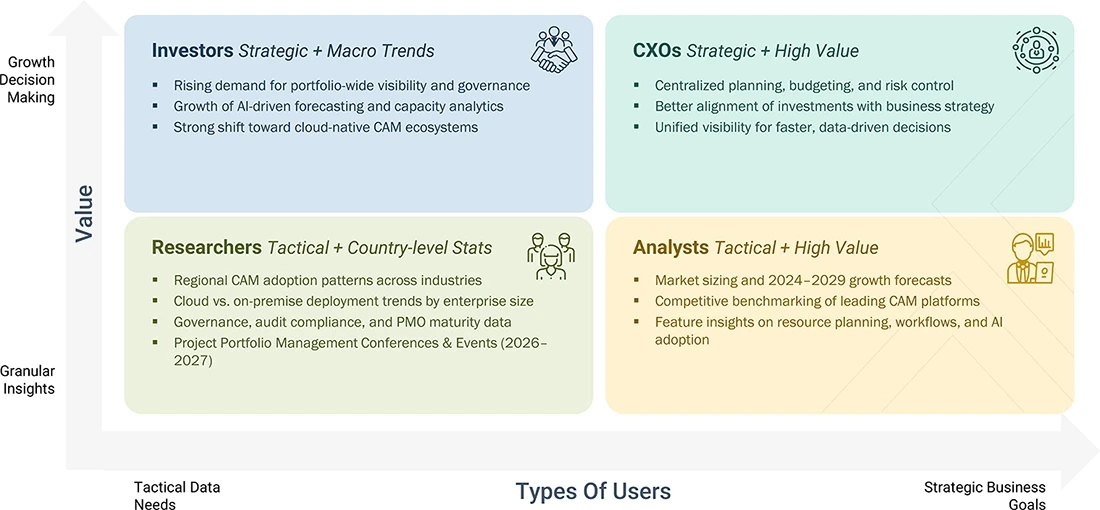
We have successfully delivered the following deep-dive customizations:
| CLIENT REQUEST | CUSTOMIZATION DELIVERED | VALUE ADDS |
|---|---|---|
| Leading Solution Provider (US) | In-depth segmentation of the North America CAM software market Extended regional breakdowns for: Europe Asia Pacific Middle East & Africa Latin America |
|
| Leading Solution Provider (EU) | Detailed profiling of additional CAM software market players (up to 5 vendors), including product portfolios, strategic initiatives, technology capabilities, and regional presence |
|
 Exclusive indicates content/data unique to MarketsandMarkets and not available with any competitors.
TITLE
PAGE NO
1
INTRODUCTION
15
2
EXECUTIVE SUMMARY
3
PREMIUM INSIGHTS
4
MARKET OVERVIEW
Explains the evolving landscape through demand-side drivers, supply-side constraints, and opportunity hotspots.4.1
INTRODUCTION
4.2
MARKET DYNAMICS
4.2.1
DRIVERS
4.2.2
RESTRAINTS
4.2.3
OPPORTUNITIES
4.2.4
CHALLENGES
4.3
UNMET NEEDS AND WHITE SPACES
4.4
INTERCONNECTED MARKETS AND CROSS-SECTOR OPPORTUNITIES
4.5
STRATEGIC MOVES BY TIER-1/2/3 PLAYERS
5
INDUSTRY TRENDS
Covers the key developments, trend analysis, and actionable insights to support strategic planning and positioning.5.1
PORTER'S FIVE FORCES ANALYSIS
5.2
MACROECONOMIC OUTLOOK
5.2.1
INTRODUCTION
5.2.2
GDP TRENDS AND FORECAST
5.2.3
TRENDS IN GLOBAL PRODUCT LIFECYCLE MANAGEMENT INDUSTRY
5.2.4
TRENDS IN GLOBAL SIMULATION SOFTWARE INDUSTRY
5.3
SUPPLY CHAIN ANALYSIS
5.4
ECOSYSTEM ANALYSIS
5.5
PRICING ANALYSIS
5.5.1
AVERAGE SELLING PRICE OF SOLUTIONS, BY KEY PLAYERS, 2025–2026
5.5.2
AVERAGE SELLING PRICE, BY REGION, 2025–2026
5.5.3
INDICATIVE PRICING ANALYSIS, BY KEY PLAYER (2025)
5.6
KEY CONFERENCES AND EVENTS, 2026–2027
5.7
TRENDS/DISRUPTIONS IMPACTING CUSTOMER BUSINESS
5.8
INVESTMENT AND FUNDING SCENARIO
5.9
CASE STUDY ANALYSIS
5.9.1
CASE STUDY
5.9.2
CASE STUDY
5.9.3
CASE STUDY
5.9.4
CASE STUDY
5.10
IMPACT OF 2025 US TARIFF - CAM SOFTWARE MARKET
5.10.1
INTRODUCTION
5.10.2
KEY TARIFF RATES
5.10.3
PRICE IMPACT ANALYSIS
5.10.4
IMPACT ON COUNTRY/REGION
5.10.4.1
US
5.10.4.2
EUROPE
5.10.4.3
ASIA PACIFIC
5.10.5
IMPACT ON VERTICALS
6
TECHNOLOGICAL ADVANCEMENTS, AI-DRIVEN IMPACT, PATENTS, INNOVATIONS, AND FUTURE APPLICATIONS
6.1
KEY EMERGING TECHNOLOGIES
6.2
COMPLEMENTARY TECHNOLOGIES
6.3
ADJACENT TECHNOLOGIES
6.4
TECHNOLOGY/PRODUCT ROADMAP
6.5
PATENT ANALYSIS
6.6
FUTURE APPLICATIONS
6.7
IMPACT OF AI/GEN AI ON CAM SOFTWARE MARKET
6.7.1
TOP USE CASES AND MARKET POTENTIAL
6.7.2
BEST PRACTICES FOLLOWED BY MANUFACTURERS/OEMS IN CAM SOFTWARE
6.7.3
CASE STUDIES RELATED TO AI IMPLEMENTATION IN CAM SOFTWARE MARKET
6.7.4
INTERCONNECTED ECOSYSTEM AND IMPACT ON MARKET PLAYERS
6.7.5
CLIENTS’ READINESS TO ADOPT AI-INTEGRATED CAM SOFTWARE
7
REGULATORY LANDSCAPE
7.1
REGIONAL REGULATION & COMPLIANCE
7.1.1
REGULATORY BODIES, GOVERNMENT AGENCIES, AND OTHER ORGANIZATIONS
7.1.2
INDUSTRY STANDARDS
8
CUSTOMER LANDSCAPE & BUYER BEHAVIOR
8.1
INTRODUCTION
8.2
DECISION-MAKING PROCESS
8.3
KEY STAKEHOLDERS INVOLVED IN BUYING PROCESS AND EVALUATION CRITERIA
8.3.1
KEY STAKEHOLDERS IN THE BUYING PROCESS
8.3.2
BUYING CRITERIA
8.4
ADOPTION BARRIERS & INTERNAL CHALLENGES
8.5
UNMET NEEDS OF VARIOUS END-USE INDUSTRIES
9
CAM SOFTWARE MARKET, BY OFFERING (MARKET SIZE & FORECAST TO 2031-IN VALUE, USD MILLIONS)(COMPARATIVE ASSESSMENT OF KEY CAM SOFTWARE OFFERINGS, THEIR MARKET POTENTIAL, AND DEMAND PATTERNS BY VARIOUS SUPPLIER COMPANIES)
9.1
INTRODUCTION
9.1
SOFTWARE
9.1.1
CAD-EMBEDDED CAM SOFTWARE
9.1.2
INDEPENDENT CAM SOFTWARE
9.2
SERVICES
9.2.1
CONSULTING
9.2.2
IMPLEMENTATION & INTEGRATION
9.2.3
TRAINING, SUPPORT & MAINTENANCE
10
CAM SOFTWARE MARKET, BY APPLICATION (MARKET SIZE & FORECAST TO 2031-IN VALUE, USD MILLIONS) (APPLICATION-WISE DEMAND POTENTIAL AND GROWTH PATHWAYS SHAPING CAM SOFTWARE ADOPTION IN DIVERSE INDUSTRIES)
10.1
INTRODUCTION
10.1
PRODUCT DESIGN & PROTOTYPING
10.1.1
SIMULATION
10.1.2
3D PRINTING/ADDITIVE MANUFACTURING
10.1.3
TOOL & DIE MANUFACTURING
10.2
MACHINING & PRODUCTION
10.2.1
CNC MACHINING
10.2.2
SHEET METAL FABRICATION
10.3
QUALITY CONTROL & INSPECTION
11
CAM SOFTWARE MARKET, BY CAPABILITY (MARKET SIZE & FORECAST TO 2031-IN VALUE, USD MILLIONS) (CAPABILITY-WISE DEMAND POTENTIAL, AND GROWTH PATHWAYS SHAPING CAM SOFTWARE ADOPTION IN DIVERSE INDUSTRIES)
11.1
INTRODUCTION
11.2
2D
11.3
3D
11.4
MULTI-AXIS
12
CAM SOFTWARE MARKET, BY DEPLOYMENT MODE (MARKET SIZE & FORECAST TO 2031-IN VALUE, USD MILLIONS) (DEPLOYMENT MODE-WISE DEMAND POTENTIAL, AND GROWTH PATHWAYS SHAPING CAM SOFTWARE ADOPTION IN DIVERSE INDUSTRIES)
12.1
INTRODUCTION
12.2
ON-PREMISES
12.3
CLOUD
13
CAM SOFTWARE MARKET, BY ORGANIZATION SIZE (MARKET SIZE & FORECAST TO 2031-IN VALUE, USD MILLIONS) ((ORGANIZATION SIZE-WISE DEMAND POTENTIAL, ADOPTION, AND GROWTH PATHWAYS SHAPING THE CAM SOFTWARE MARKET)
13.1
INTRODUCTION
13.2
LARGE ENTERPRISES
13.3
SMES
14
CAM SOFTWARE MARKET, BY VERTICAL(MARKET SIZE & FORECAST TO 2031-IN VALUE ,USD MILLIONS)( (SECTOR-SPECIFIC ADOPTION DRIVERS, DEMAND DYNAMICS, AND MARKET POTENTIAL ACROSS EACH VERTICAL )
14.1
INTRODUCTION
14.2
AUTOMOTIVE
14.3
AEROSPACE
14.4
SEMICONDUCTOR & ELECTRONICS
14.5
MEDICAL DEVICES & PHARMACEUTICALS
14.6
OIL & GAS
14.7
ENERGY & POWER
14.8
CHEMICAL
14.9
FOOD & BEVERAGES
14.10
METAL & MINING
14.11
HEAVY MACHINERY
14.12
PULP & PAPER
14.13
OTHER VERTICALS
15
CAM SOFTWARE MARKET, BY REGION(MARKET SIZE & FORECAST TO 2031-IN VALUE ,USD MILLIONS)( (ASSESSING GROWTH PATTERNS, INDUSTRY FORCES, REGULATORY LANDSCAPE, AND MARKET POTENTIAL ACROSS KEY GEOGRAPHIES AND COUNTRIES)
15.1
INTRODUCTION
15.2
NORTH AMERICA
15.2.1
US
15.2.2
CANADA
15.3
EUROPE
15.3.1
UK
15.3.2
GERMANY
15.3.3
FRANCE
15.3.4
ITALY
15.3.5
REST OF EUROPE
15.4
ASIA PACIFIC
15.4.1
CHINA
15.4.2
JAPAN
15.4.3
INDIA
15.4.4
ANZ
15.4.5
REST OF ASIA PACIFIC
15.5
MIDDLE EAST & AFRICA
15.5.1
GULF COOPERATION COUNCIL (GCC)
15.5.1.1
UAE
15.5.1.2
SAUDI ARABIA
15.5.1.3
REST OF GCC COUNTRIES (QATAR, BAHRAIN, OMAN, AND KUWAIT)
15.5.2
SOUTH AFRICA
15.5.3
REST OF MIDDLE EAST & AFRICA
15.6
LATIN AMERICA
15.6.1
BRAZIL
15.6.2
MEXICO
15.6.3
REST OF LATIN AMERICA
16
COMPETITIVE LANDSCAPE(STRATEGIC ASSESSMENT OF LEADING PLAYERS, MARKET SHARE, REVENUE ANALYSIS, COMPANY POSITIONING, AND COMPETITIVE BENCHMARKS INFLUENCING MARKET POTENTIAL
OVERVIEW)
16.1
KEY PLAYER COMPETITIVE STRATEGIES/RIGHT TO WIN (JANUARY 2024- SEPTEMBER 2026)
16.2
REVENUE ANALYSIS (2021-2025)
16.3
MARKET SHARE ANALYSIS,
16.4
PRODUCT COMPARISON
16.5
COMPANY EVALUATION MATRIX: KEY PLAYERS
16.5.1
STARS
16.5.2
EMERGING LEADERS
16.5.3
PERVASIVE PLAYERS
16.5.4
PARTICIPANTS
16.5.5
COMPANY FOOTPRINT: KEY PLAYERS,
16.5.5.1
COMPANY FOOTPRINT
16.5.5.2
REGION FOOTPRINT
16.5.5.3
OFFERING FOOTPRINT
16.5.5.4
ORGANIZATION SIZE FOOTPRINT
16.5.5.5
VERTICAL FOOTPRINT
16.6
COMPANY EVALUATION MATRIX: STARTUPS/SMES,
16.6.1
PROGRESSIVE COMPANIES
16.6.2
RESPONSIVE COMPANIES
16.6.3
DYNAMIC COMPANIES
16.6.4
STARTING BLOCKS
16.6.5
COMPETITIVE BENCHMARKING: STARTUPS/SMES,
16.6.5.1
DETAILED LIST OF KEY STARTUPS/SMES
16.6.5.2
COMPETITIVE BENCHMARKING OF KEY STARTUPS/SMES
16.7
COMPANY VALUATION & FINANCIAL METRICS
16.8
COMPETITIVE SCENARIO
16.8.1
NEW LAUNCHES
16.8.2
DEALS
16.8.3
OTHERS
17
COMPANY PROFILES (IN-DEPTH REVIEW OF COMPANIES, PRODUCTS, SERVICES, RECENT INITIATIVES, AND POSITIONING STRATEGIES IN THE CAM SOFTWARE MARKET LANDSCAPE
17.1
KEY PLAYERS
17.1.1
AUTODESK
17.1.2
HEXAGON
17.1.3
SIEMENS
17.1.4
SOLIDWORKS
17.1.5
PTC
17.1.6
ALIBRE
17.1.7
HYPERTHERM
17.1.8
MASTERCAM
17.1.9
OPEN MIND TECHNOLOGIES
17.1.10
DASSAULT SYSTEMS
17.1.11
3D SYSTEMS
17.1.12
CAMWORKS
17.1.13
BOB-CAD CAM
17.1.14
CIMATRON
17.1.15
SOLIDCAM
17.1.16
NTT DATA ENGINEERING SYSTEMS
17.1.17
SMARTCAM CNC
17.1.18
MECSOFT CORPORATION
17.1.19
SPRUTCAM
17.1.20
TOPSOLID
17.1.21
LANTEK
17.1.22
EZCAM
17.1.23
TEBIS
17.1.24
NCG CAM SOLUTIONS
17.1.25
ESTLCAM
17.1.26
SAI
17.1.27
SIGMANEST
17.1.28
ENCY SOFTWARE
18
RESEARCH METHODOLOGY
18.1
RESEARCH DATA
18.1.1
SECONDARY DATA
18.1.1.1
KEY DATA FROM SECONDARY SOURCES
18.1.1.2
LIST OF KEY SECONDARY SOURCES
18.1.2
PRIMARY DATA
18.1.2.1
KEY DATA FROM PRIMARY SOURCES
18.1.2.2
KEY PRIMARY PARTICIPANTS
18.1.2.3
BREAKDOWN OF PRIMARY INTERVIEWS
18.1.2.4
KEY INDUSTRY INSIGHTS
18.2
MARKET SIZE ESTIMATION
18.2.1
BOTTOM-UP APPROACH
18.2.2
TOP-DOWN APPROACH
18.2.3
MARKET SIZE CALCULATION FOR BASE YEAR
18.3
MARKET FORECAST APPROACH
18.3.1
SUPPLY SIDE
18.3.2
DEMAND SIDE
18.4
DATA TRIANGULATION
18.5
FACTOR ANALYSIS
18.6
RESEARCH ASSUMPTIONS AND LIMITATIONS
18.7
RISK ASSESSMENT
19
APPENDIX
19.1
DISCUSSION GUIDE
19.2
KNOWLEDGE STORE: MARKETSANDMARKETS’ SUBSCRIPTION PORTAL
19.3
CUSTOMIZATION OPTIONS
19.4
RELATED REPORTS
19.5
AUTHOR DETAILS
This research study involved the use of extensive secondary sources, directories, and databases, such as D&B Hoovers, Bloomberg Businessweek, and Factiva, to identify and collect information for a technical, market-oriented, and commercial study of the global CAM software market. A few other market-related reports and analyses published by various industry associations and consortiums, such as the National Security Agency (NSA) and SC Magazine, were considered while doing the extensive secondary research. The primary sources were mainly industry experts from the core and related industries and preferred suppliers, manufacturers, distributors, service providers, technology developers, and technologists from companies and organizations related to all segments of this industry’s value chain. In-depth interviews were conducted with various primary respondents, including key industry participants, subject-matter experts, C-level executives of key market players, and industry consultants to obtain and verify critical qualitative and quantitative information and assess the prospects. The market has been estimated by analyzing various driving factors, such as the need to improve compliance requirements within an organization, enhance operational efficiency, and the requirement of simplified workflows to eliminate bottlenecks.
Secondary ResearchThe market size of companies offering CAM software was determined based on the secondary data available through paid and unpaid sources and by analyzing the product portfolios of major companies in the ecosystem and rating the companies based on their product capabilities and business strategies.
In the secondary research process, various sources were referred to for identifying and collecting information for the study. The secondary sources included annual reports, press releases, investor presentations of companies, and product data sheets, white papers, journals, certified publications, and articles from recognized authors, government websites, directories, and databases.
Secondary research was mainly used to obtain key information about the industry’s supply chain, the total pool of key players, market classification and segmentation according to industry trends to the bottom-most level, regional markets, and key developments from both market- and technology-oriented perspectives, all of which were further validated by primary sources.
Primary ResearchIn the primary research process, various primary sources from the supply and demand sides were interviewed to obtain qualitative and quantitative information for this report. The primary sources from the supply side included industry experts, such as chief executive officers (CEOs), vice presidents (VPs), marketing directors, technology and innovation directors, and related key executives from various key companies and organizations operating in the CAM software market.
Primary interviews were conducted to gather insights, such as market statistics, the latest trends disrupting the market, new use cases implemented, data on revenue collected from products and services, market breakups, market size estimations, market forecasts, and data triangulation. Primary research also helped in understanding various trends related to technologies, segmentation types, industry trends, and regions. Demand-side stakeholders, such as Chief Information Officers (CIOs), Chief Technology Officers (CTOs), Chief Security Officers (CSOs), the installation teams of governments/end users using CAM software platforms, and digital initiatives project teams, were interviewed to understand the buyer’s perspective on suppliers, products, service providers, and their current use of services, which would affect the overall CAM software market.
The Breakdown of Primary Profiles

Note 1: Tier 1 companies have revenues greater than USD 10 billion; tier 2 companies’ revenues range between USD 1 and USD 10 billion; and tier 3 companies’ revenues range between USD 500 million and USD 1 billion.
Note 2: Others include sales, marketing, and product managers.
Source: Secondary Literature, Interviews with Experts, and MarketsandMarkets Analysis
To know about the assumptions considered for the study, download the pdf brochure
Multiple approaches were adopted to estimate and forecast the CAM software market. The first approach estimated market size by summing the companies’ revenue generated through services sales.
The research methodology used to estimate the market size included the following.

Once the overall market size was determined, we divided the market into segments and subsegments using the previously described market size estimation procedures. When required, market breakdown and data triangulation procedures were employed to complete the market engineering process and specify the exact figures for every market segment and subsegment. The data was triangulated by examining several variables and patterns from the government entities’ supply and demand sides.
Considering the views of various sources and associations, MarketsandMarkets defines “CAM software” as computer software used to automate the generation of machine tool instructions for manufacturing parts. CAM software typically produces precise, detailed instructions—commonly in the form of G-code—that direct computer numerical control (CNC) machines, such as lathes, mills, and routers, to produce components with high accuracy and efficiency. CAM supports end-to-end product design & prototyping, machining & production, and quality control & inspection.”
MarketsandMarkets provides customizations based on the company’s unique requirements using market data. The following customization options are available for the report.
Computer Aided Manufacturing (CAM) uses software and hardware to direct and improve manufacturing operations. It connects design and production by converting CAD files into programming languages to direct equipment such as lathes, three-dimensional printers, and robots. CAM improves accuracy, eliminates manual work in the production lines, organizes production processes, and, most importantly, maintains quality in manufacturing processes. This technology is extensively used in automotive, aerospace, and medical devices. Also, integrating with enterprise systems such as ERP and PLM, CAM allows monitoring, estimating costs, and managing resources. It will enable the manufacturers to be more flexible by allowing them to create more intricate designs and be more responsive to market changes, thus encouraging productivity and efficiency.
The US was one of the earliest adopters of computer-aided manufacturing.
Some of the significant vendors offering computer-aided manufacturing worldwide include Autodesk (US), Siemens (Germany), Hexagon (Sweden), Dassault Systemes (France), Hypertherm (US), PTC (US), SolidCAM (US), TopSolid (France), CAMWorks (US) and MasterCAM (US).
The computer-aided manufacturing market is expected to achieve a CAGR of 9.0% from 2024 to 2030.
Key clients adopting the computer-aided manufacturing software include: -

The research and discussions with the MarketsandMarkets team were insightful and influential towards driving our team's strategic direction. After engaging with the analyst team, we were able to have focused use cases, a targeted market segment, and strategic partners to consider as part of our GTM. The insights shared by MarketsandMarkets captured some useful information that we could leverage to develop our point of view for the next steps. The market reports were a great start for the project, but the analyst hours made a rough diamond turn into a polished gem of a project