Просмотр новости
Найдите то, что Вас интересует
 Спутники
 РН
РН SpaceX
 Роскосмос
 NASA
NASA
СпутникиРНSpaceXРоскосмосNASA
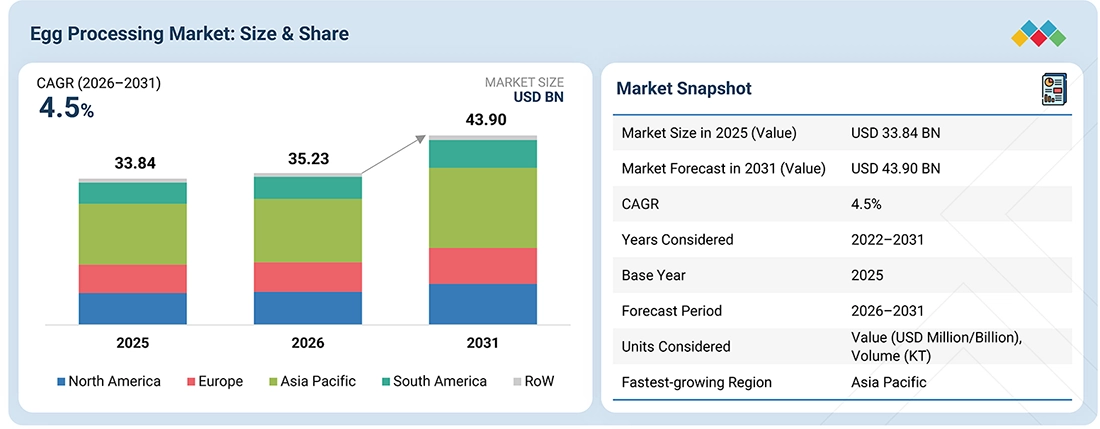
USD 43.90 BN
MARKET SIZE, 2031

CAGR 4.5%
(2026-2031)

330
REPORT PAGES

250
MARKET TABLES
Source: Secondary Research, Interviews with Experts, MarketsandMarkets Analysis
The egg processing market size is projected to grow from USD 35.23 billion in 2026 to USD 43.90 billion in 2031, at a CAGR of 4.5%. The market is driven by increasing demand for processed egg products that offer convenience, extended shelf life, consistent functionality, and ease of incorporation across food manufacturing, foodservice, and retail applications. Processed egg products are widely utilized in bakery and confectionery products, processed foods and ready meals, dietary supplements, and other food formulations due to their emulsification, foaming, binding, and coagulation properties. Growing consumption of convenience foods, increasing emphasis on food safety and quality standards, and rising demand for standardized ingredients in commercial food production are creating growth opportunities across the market. Additionally, manufacturers are expanding production capacities and investing in advanced processing technologies to improve product quality, operational efficiency, and product stability. Product innovation and advancements in egg breaking, pasteurization, drying, freezing, and packaging technologies are expected to support continued market development across diverse end-use applications.
By Product Type
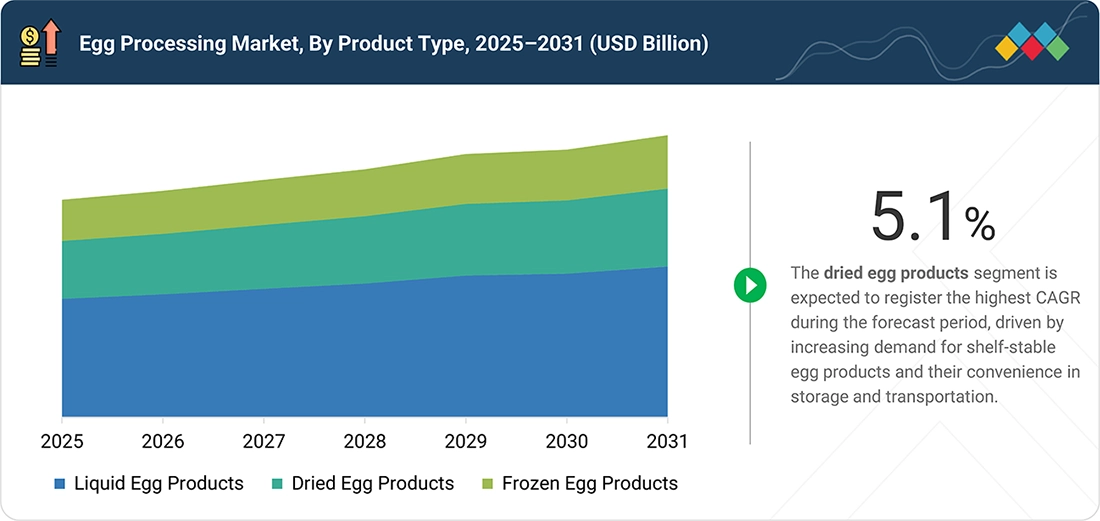
By product type, the dried egg products segment is expected to register the highest CAGR of 5.1% from 2026 to 2031.
By Nature
By nature, the inorganic egg products segment held the largest share of the egg processing market in 2025, accounting for ~95% of the market.
By End-use Application
By end-use application, the foodservice segment is projected to dominate the market during the forecast period.
By Region
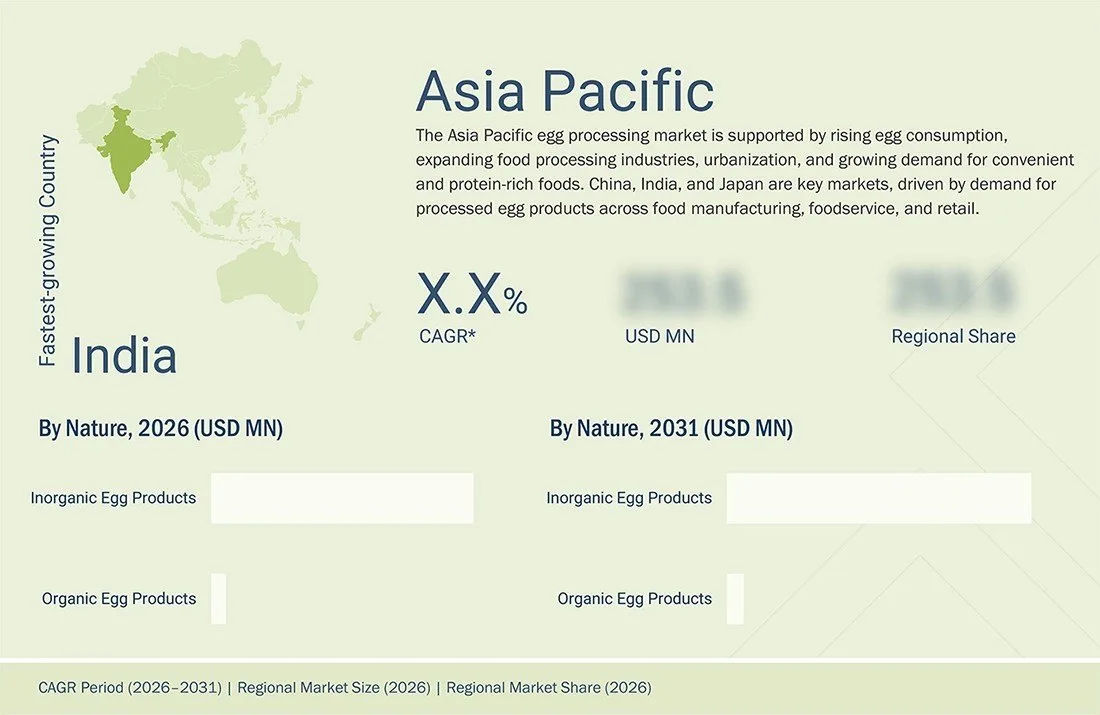
Asia Pacific is expected to be the largest and fastest-growing region in the egg processing market, registering a CAGR of 4.8% during the forecast period.
Competitive Landscape (Key Players)
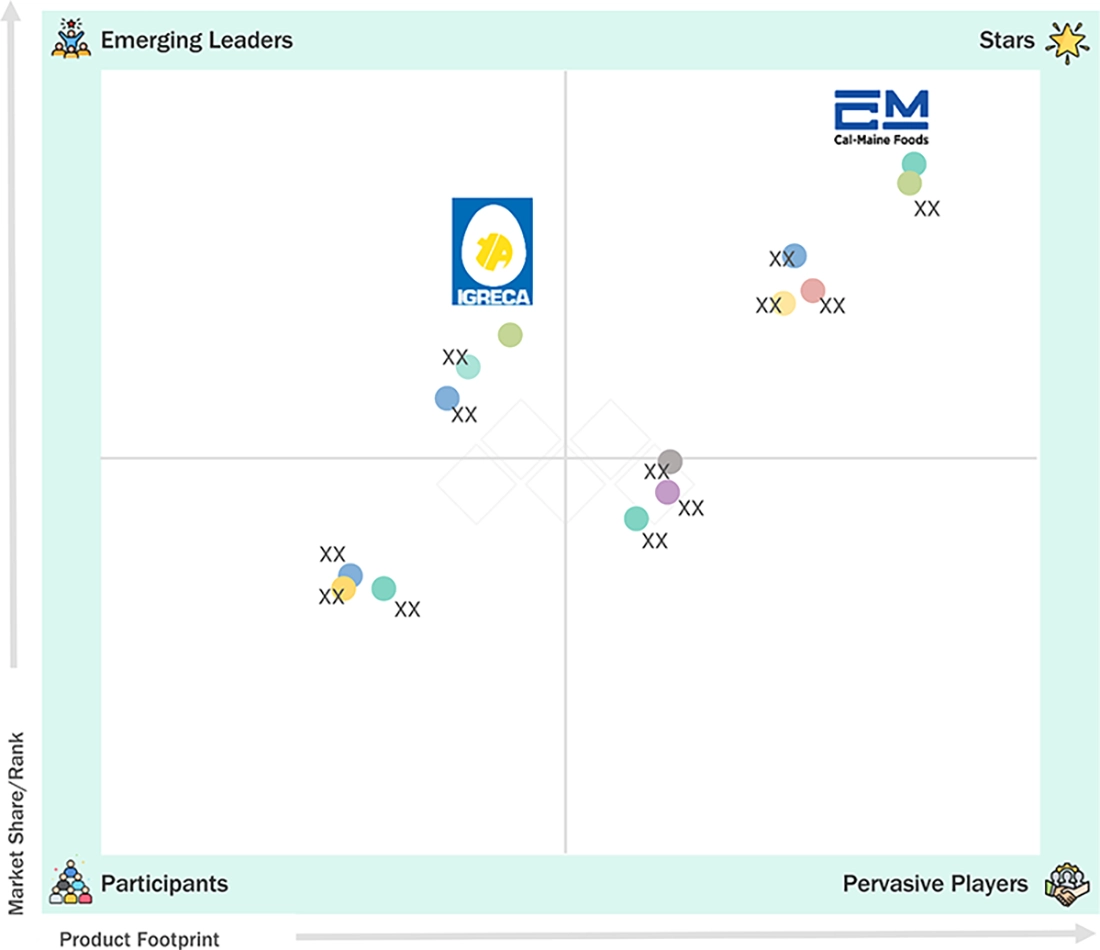
Cal-Maine Foods, Inc., Rose Acre Farms, and Rembrandt Foods are key players in the egg processing market due to their extensive egg processing capabilities, broad product portfolios, and established presence across multiple applications.
Competitive Landscape (Startups/SMEs)
Ready Egg Products, OVOVITA, and Deb-El Food Products have established a presence among SMEs due to their focus on specialized processed egg products and customized solutions for foodservice and food manufacturing applications.
The egg processing market is driven by the growing need for safe, convenient, and value-added egg products across the food industry. Increasing production of processed and packaged foods, rising demand for ingredients that offer consistent quality and functionality, and expanding use of egg-based ingredients in commercial food applications are supporting market growth. The market also benefits from the increasing preference for products with extended shelf life and ease of handling, particularly in large-scale food production environments. Furthermore, advancements in egg processing technologies are improving product quality, operational efficiency, and production scalability, while ongoing investments in processing infrastructure and capacity expansion continue to strengthen market development across diverse end-use sectors.
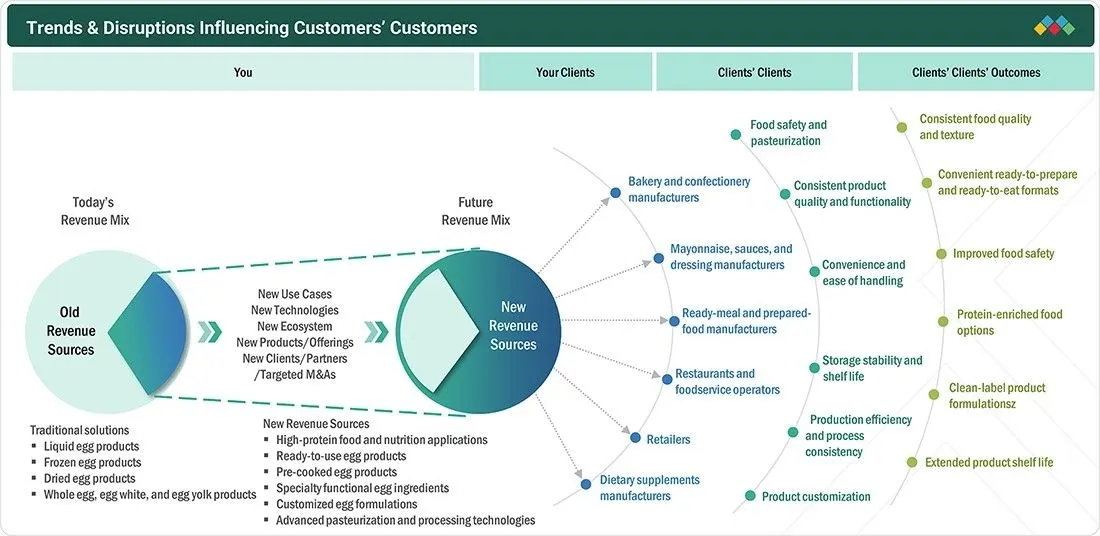
Customer business in the egg processing market is influenced by the demand for safe, convenient, functional, and easy-to-use egg products across food processing and manufacturing, foodservice, and retail applications. Traditional processed egg solutions include liquid, frozen, and dried whole egg, egg white, and egg yolk products, which are widely used for their functionality, convenience, storage benefits, and consistent performance. Demand is increasingly extending toward value-added solutions, including ready-to-use and pre-cooked egg products, specialty functional egg ingredients, customized formulations, and applications targeting high-protein food and nutrition products. Value-added formats such as pre-cooked egg patties, omelets, scrambled eggs, quiches, and hard-cooked eggs are used to simplify preparation and support consistency in foodservice and food manufacturing. These developments are influencing the revenues of egg processors, food manufacturers, foodservice operators, and retailers by supporting convenience, production efficiency, product consistency, and differentiated food formulations.
Source: Secondary Research, Interviews with Experts, MarketsandMarkets Analysis

Drivers
Impact
Level



RESTRAINTS
Impact
Level



OPPORTUNITIES
Impact
Level



CHALLENGES
Impact
Level


Source: Secondary Research, Interviews with Experts, MarketsandMarkets Analysis
Growing consumer focus on health, wellness, and balanced nutrition is supporting demand for eggs and egg-based products as a source of high-quality protein and essential nutrients. Consumers are increasingly seeking foods that align with active lifestyles and health-conscious dietary preferences, encouraging the use of processed egg products across a range of food applications. Egg products are widely utilized in bakery and confectionery products, ready meals, dietary supplements, and other protein-focused food formulations due to their nutritional profile and functional properties. As awareness of protein intake, ingredient quality, and nutritional value continues to increase, demand for processed egg products is expected to support the growth of the egg processing market.
The production of processed egg products involves investments in egg sourcing, pasteurization, drying, freezing, packaging, quality assurance, and cold-chain infrastructure, which can increase overall operating costs. In addition, fluctuations in feed prices, energy costs, and egg supply can affect production economics across the value chain. Consumer concerns regarding food processing, ingredient handling, and product freshness may also influence purchasing decisions in certain markets. These factors can limit the adoption of processed egg products among price-sensitive consumers and create challenges for market participants seeking to expand their customer base.
Sustainability initiatives across the egg industry are creating opportunities for growth in the egg processing market. Producers are increasingly investing in responsible sourcing practices, cage-free production systems, resource-efficiency measures, waste reduction programs, renewable energy adoption, and sustainable packaging solutions. These efforts are helping companies align with evolving consumer expectations regarding environmental responsibility and food production practices. As demand for sustainably produced food products continues to grow, egg processors have opportunities to differentiate their offerings and strengthen relationships with environmentally conscious consumers, retailers, and food manufacturers.
Consumer misconceptions surrounding conventional and processed egg products remain a challenge for the egg processing market. Some consumers continue to associate processed egg products with reduced freshness, lower nutritional quality, or excessive processing compared with shell eggs. In addition, perceptions related to cholesterol content, production practices, and ingredient processing may influence purchasing behavior despite advancements in food safety and processing technologies. Addressing these concerns requires ongoing consumer education, transparent labeling, and effective communication regarding product quality, nutritional value, and processing standards. Failure to address such misconceptions may limit broader adoption of processed egg products across certain consumer segments.
| COMPANY | USE CASE DESCRIPTION | BENEFITS |
|---|---|---|
|
|
McDonald’s uses liquid egg products across its breakfast menu, including pre-cooked and flash-frozen liquid eggs for folded eggs and sausage burritos. | The product enables standardized egg preparation across restaurant operations while supporting convenient handling and preparation at individual locations. |
|
|
Unilever Food Solutions uses pasteurized egg yolks in Knorr Professional Golden Salted Egg Powder, a ready-to-use powdered egg product for professional kitchens. The powder is used in applications including fried chicken and seafood, pasta, noodles, stir-fries, sauces, dips, fries, chips, and popcorn. | The product provides one-step preparation, consistent taste and quality, and reduced preparation time compared with preparing salted eggs from scratch, and it has a 9-month shelf life. |
|
|
NOW Foods uses pasteurized egg white powder in its Egg White Protein Unflavored Powder, a protein supplement containing 19.8 g of egg white powder and 15 g of protein per 20-g serving. | The product provides a convenient egg-derived protein format for protein supplementation and sports nutrition, and the powder can also be reconstituted for use as an egg-white replacement in recipes. |
Logos and trademarks shown above are the property of their respective owners. Their use here is for informational and illustrative purposes only.
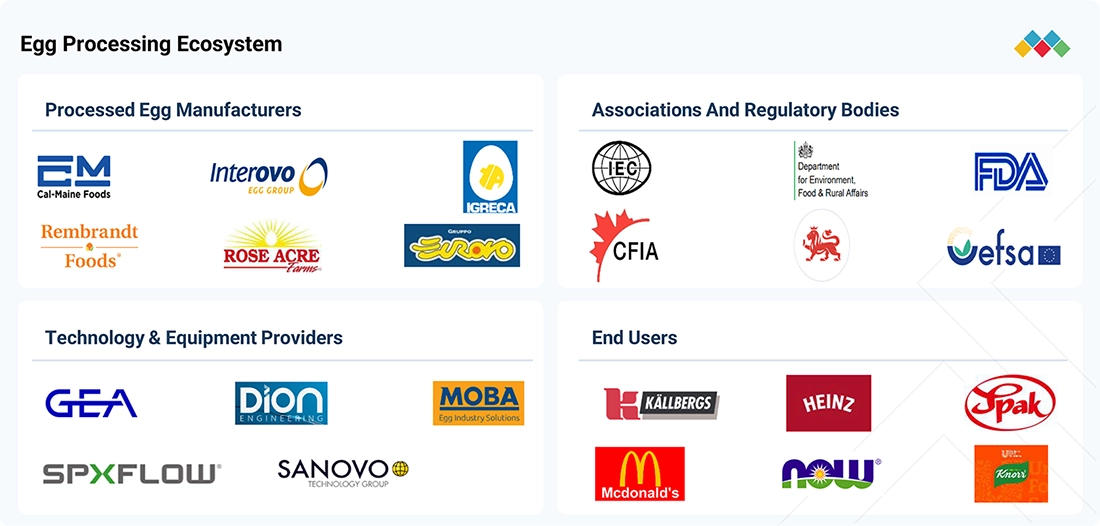
The egg processing ecosystem comprises processed egg manufacturers, technology and equipment providers, associations and regulatory bodies, and downstream end users. Processed egg manufacturers supply liquid, frozen, and dried egg products, including whole egg, egg white, and egg yolk products, for use across food manufacturing and foodservice applications. Technology and equipment providers support egg breaking and separation, pasteurization, processing, freezing, drying, and packaging. Associations and regulatory bodies support industry coordination, food safety, standards, scientific guidance, and regulatory compliance, while end users incorporate processed egg products into applications such as bakery and confectionery, sauces and dressings, prepared foods, dietary supplements, and foodservice products.
Logos and trademarks shown above are the property of their respective owners. Their use here is for informational and illustrative purposes only.
Source: Secondary Research, Interviews with Experts, MarketsandMarkets Analysis
Liquid egg products are expected to account for the largest share of the egg processing market by product type, supported by their widespread use across food manufacturing, foodservice, and retail applications. Liquid egg products offer convenience, consistency, and ease of handling while eliminating the need for egg breaking and reducing preparation time in commercial food production. They are widely incorporated into bakery and confectionery products, sauces, dressings, ready meals, and other food formulations due to their functional properties, including emulsification, foaming, binding, and coagulation. Demand is further supported by their suitability for large-scale processing operations, food safety advantages associated with pasteurization, and compatibility with automated production systems. In addition, the growing consumption of convenience foods and the expansion of foodservice establishments are contributing to increased adoption of liquid egg products. Their ability to provide operational efficiency and consistent product performance is expected to support their leading position in the egg processing market.
Inorganic egg products are expected to dominate the egg processing market, supported by their widespread availability, established supply chains, and extensive use across commercial food production. Inorganic egg products are commonly utilized by food manufacturers, foodservice operators, and retail-focused food producers due to their consistent supply, cost-effectiveness, and suitability for large-scale processing operations. These products are incorporated into a wide range of food formulations where functionality, product consistency, and production efficiency are important considerations. Demand is further supported by the well-developed conventional egg production industry, which enables processors to secure reliable raw material supplies and maintain competitive pricing. While interest in organic egg products continues to increase, the broader availability and lower production costs associated with inorganic egg products are expected to support their dominant position in the egg processing market during the forecast period.
The foodservice segment is expected to account for the largest share of the egg processing market, supported by the extensive use of processed egg products in restaurants, hotels, catering services, quick-service restaurants, bakeries, and institutional foodservice operations. Processed egg products help foodservice operators improve operational efficiency by reducing preparation time, minimizing product waste, and ensuring consistent quality across high-volume food preparation environments. Their convenience, food safety advantages, and compatibility with large-scale kitchen operations make them a preferred ingredient for a wide range of menu offerings. Demand is further supported by the continued expansion of organized foodservice establishments and increasing consumer consumption of breakfast foods, bakery products, and ready-to-eat meals. The ability of processed egg products to deliver consistency, convenience, and reliable supply is expected to support the leading position of the foodservice segment in the egg processing market.
The Asia Pacific region is estimated to dominate the egg processing market during the forecast period. The significant market share is primarily attributed to the region's large egg production base, expanding food processing industry, rising consumption of packaged and convenience foods, and increasing demand for processed egg products across food manufacturing and foodservice applications. Countries such as China, India, Japan, South Korea, and Australia are witnessing growing utilization of processed egg products as manufacturers seek ingredients that offer consistent quality, functionality, and food safety compliance. The region also benefits from increasing urbanization, changing dietary preferences, and the growing presence of domestic and international food manufacturers. Additionally, ongoing investments in egg processing infrastructure, production capacity expansion, and advanced processing technologies are further strengthening the region's position in the global egg processing market.
In the egg processing market matrix, Cal-Maine Foods, Inc. (Star) holds a strong position supported by its extensive egg production and processing capabilities, broad portfolio of shell eggs and value-added egg products, and established presence across retail, foodservice, and food manufacturing markets. IGRECA (Emerging Leader) has established a strong position through its specialized portfolio of liquid, frozen, and dried egg products, serving a wide range of food industry applications across Europe and international markets. While Cal-Maine Foods, Inc. benefits from a broader market presence and larger production scale, IGRECA is strengthening its position through its focus on processed egg products, application-specific solutions, and expertise in egg ingredient manufacturing for industrial food customers.
Source: Secondary Research, Interviews with Experts, MarketsandMarkets Analysis
| REPORT METRIC | DETAILS |
|---|---|
| Market Size in 2025 (Value) | USD 33.84 billion |
| Market Forecast in 2026 (Value) | USD 35.23 billion |
| Market Forecast in 2031 (Value) | USD 43.90 billion |
| Growth Rate | CAGR of 4.5% from 2026–2031 |
| Years Considered | 2022–2031 |
| Base Year | 2025 |
| Forecast Period | 2026–2031 |
| Units Considered | Value (USD Million/Billion), Volume (KT) |
| Report Coverage | Revenue forecast, company ranking, competitive landscape, growth factors, and trends |
| Segments Covered |
|
| Regions Covered | North America, Asia Pacific, Europe, South America, Rest of the World (RoW) |
We have successfully delivered the following deep-dive customizations:
| CLIENT REQUEST | CUSTOMIZATION DELIVERED | VALUE ADDS |
|---|---|---|
| Asia Pacific Egg Processing Market Opportunity Assessment |
|
|
| Egg Processor Evaluating Expansion into Organic Egg Products |
|
|
| Processed Egg Supplier Evaluating Value-Added Product Opportunities |
|
|
 Exclusive indicates content/data unique to MarketsandMarkets and not available with any competitors.
TITLE
PAGE NO
1
INTRODUCTION
15
2
EXECUTIVE SUMMARY
3
PREMIUM INSIGHTS
4
MARKET OVERVIEW
This section summarizes market dynamics, key shifts, and high-impact trends shaping demand outlook.4.1
INTRODUCTION
4.2
MARKET DYNAMICS
4.2.1
DRIVERS
4.2.2
RESTRAINTS
4.2.3
OPPORTUNITY
4.2.4
CHALLENGES
4.3
UNMET NEEDS AND WHITE SPACES
4.4
INTERCONNECTED MARKETS AND CROSS-SECTOR OPPORTUNITIES
4.5
STRATEGIC MOVES BY TIER-1/2/3 PLAYERS
5
INDUSTRY TRENDS
Covers the key developments, trend analysis, and actionable insights to support strategic planning and positioning.5.1
PORTER'S FIVE FORCES ANALYSIS
5.1.1
INTENSITY OF COMPETITIVE RIVALRY
5.1.2
THREAT OF NEW ENTRANTS
5.1.3
THREAT OF SUBSTITUTES
5.1.4
BARGAINING POWER OF SUPPLIERS
5.1.5
BARGAINING POWER OF BUYERS
5.2
MACROECONOMIC INDICATORS
5.2.1
INTRODUCTION
5.2.2
GDP TRENDS AND FORECAST
5.2.3
TRENDS IN GLOBAL EGG PROCESSING INDUSTRY
5.3
VALUE CHAIN ANALYSIS
5.4
ECOSYSTEM ANALYSIS
5.5
PRICING ANALYSIS
5.5.1
AVERAGE SELLING PRICE TREND OF KEY PLAYERS, BY PRODUCT TYPE (2022–2025)
5.5.2
AVERAGE SELLING PRICE TREND, BY REGION (2022–2025)
5.6
TRADE ANALYSIS
5.6.1
EXPORT SCENARIO (HS CODE 0407)
5.6.2
IMPORT SCENARIO (HS CODE 0407)
5.7
KEY CONFERENCES & EVENTS IN 2026–2027
5.8
TRENDS/DISRUPTIONS IMPACTING CUSTOMER BUSINESS
5.9
INVESTMENT AND FUNDING SCENARIO
5.10
CASE STUDY ANALYSIS
5.11
IMPACT OF US TARIFF ON THE EGG PROCESSING MARKET
5.11.1
INTRODUCTION
5.11.2
KEY TARIFF RATES
5.11.3
PRICE IMPACT ANALYSIS
5.11.4
IMPACT ON COUNTRIES/REGIONS
5.11.5
IMPACT ON END-USE INDUSTRIES
6
TECHNOLOGICAL ADVANCEMENTS, AI-DRIVEN IMPACT, PATENTS, INNOVATIONS, AND FUTURE APPLICATIONS
6.1
KEY TECHNOLOGIES
6.2
COMPLEMENTARY TECHNOLOGIES
6.3
ADJACENT TECHNOLOGIES
6.4
TECHNOLOGY/PRODUCT ROADMAP
6.5
PATENT ANALYSIS
6.6
FUTURE APPLICATIONS
6.7
IMPACT OF AI/GEN AI ON EGG PROCESSING MARKET
6.7.1
TOP USE CASES AND MARKET POTENTIAL
6.7.2
BEST PRACTICES IN EGG PROCESSING MARKET
6.7.3
CASE STUDIES OF AI IMPLEMENTATION IN THE EGG PROCESSING MARKET
6.7.4
INTERCONNECTED ECOSYSTEM AND IMPACT ON MARKET PLAYERS
6.7.5
CLIENTS’ READINESS TO ADOPT GENERATIVE AI IN THE EGG PROCESSING MARKET
6.8
SUCCESS STORIES AND REAL-WORLD APPLICATIONS
7
REGULATORY AND SUSTAINABILITY LANDSCAPE
7.1
REGIONAL REGULATIONS AND COMPLIANCE
7.1.1
REGULATORY BODIES, GOVERNMENT AGENCIES, AND OTHER ORGANIZATIONS
7.1.2
INDUSTRY STANDARDS
7.2
SUSTAINABILITY INITIATIVES
7.3
IMPACT OF REGULATORY POLICIES ON SUSTAINABILITY INITIATIVES
7.4
CERTIFICATIONS, LABELING, ECO-STANDARDS
8
CUSTOMER LANDSCAPE & BUYER BEHAVIOR
8.1
DECISION-MAKING PROCESS
8.2
BUYER STAKEHOLDERS AND BUYING EVALUATION CRITERIA
8.3
ADOPTION BARRIERS & INTERNAL CHALLENGES
8.4
UNMET NEEDS FROM VARIOUS END-USE INDUSTRIES
8.5
MARKET PROFITABILITY
9
EGG PROCESSING MARKET, BY PRODUCT TYPE
Market Size, Volume & Forecast – USD Million9.1
INTRODUCTION
9.2
DRIED EGG PRODUCTS
9.3
LIQUID EGG PRODUCTS
9.4
FROZEN EGG PRODUCTS
10
EGG PROCESSING MARKET, BY NATURE
Market Size, Volume & Forecast – USD Million10.1
INTRODUCTION
10.2
ORGANIC EGG PRODUCTS
10.3
INORGANIC EGG PRODUCTS
11
EGG PROCESSING MARKET, BY END-USE APPLICATION
Market Size, Volume & Forecast – USD Million11.1
INTRODUCTION
11.2
FOOD PROCESSING AND MANUFACTURING
11.2.1
PROCESSED FOODS AND READY MEALS
11.2.2
BAKERY AND CONFECTIONERY
11.2.3
DIETARY SUPPLEMENTS
11.2.4
OTHERS
11.3
FOODSERVICE
11.4
RETAIL
12
EGG PROCESSING MARKET, BY REGION
Market Size, Volume & Forecast – USD Million12.1
INTRODUCTION
12.2
NORTH AMERICA
12.2.1
US
12.2.2
CANADA
12.2.3
MEXICO
12.3
EUROPE
12.3.1
GERMANY
12.3.2
UK
12.3.3
FRANCE
12.3.4
SPAIN
12.3.5
ITALY
12.3.6
REST OF EUROPE
12.4
ASIA PACIFIC
12.4.1
CHINA
12.4.2
JAPAN
12.4.3
INDIA
12.4.4
AUSTRALIA & NEW ZEALAND
12.4.5
REST OF ASIA PACIFIC
12.5
SOUTH AMERICA
12.5.1
BRAZIL
12.5.2
ARGENTINA
12.5.3
REST OF SOUTH AMERICA
12.6
REST OF THE WORLD
12.6.1
AFRICA
12.6.2
MIDDLE EAST
13
COMPETITIVE LANDSCAPE
13.1
OVERVIEW
13.2
KEY PLAYERS' STRATEGIES/RIGHT TO WIN, 2022–2026
13.3
REVENUE ANALYSIS, 2023–2025
13.4
MARKET SHARE ANALYSIS,
13.5
BRAND/PRODUCT COMPARISON
13.6
KEY PLAYER ANNUAL REVENUE VS GROWTH
13.7
COMPANY VALUATION
13.8
GLOBAL SNAPSHOT OF KEY MARKET PARTICIPANTS
13.9
COMPANY EVALUATION MATRIX: KEY PLAYERS,
13.9.1
STARS
13.9.2
EMERGING LEADERS
13.9.3
PERVASIVE PLAYERS
13.9.4
PARTICIPANTS
13.9.5
COMPANY FOOTPRINT: KEY PLAYERS,
13.10
COMPANY EVALUATION MATRIX: START-UP/SME,
13.10.1
PROGRESSIVE COMPANIES
13.10.2
RESPONSIVE COMPANIES
13.10.3
DYNAMIC COMPANIES
13.10.4
STARTING BLOCKS
13.10.5
COMPETITIVE BENCHMARKING, STARTUPS/SMES
13.11
COMPETITIVE SCENARIO
13.11.1
NEW PRODUCT LAUNCHES
13.11.2
DEALS
13.11.3
EXPANSIONS
13.11.4
OTHERS
14
COMPANY PROFILES
14.1
KEY PLAYERS
14.1.1
CAL-MAINE FOODS, INC.
14.1.2
ROSE ACRE FARMS
14.1.3
IGRECA
14.1.4
OVOBEL
14.1.5
SKMEGG.COM
14.1.6
REMBRANDT FOODS
14.1.7
INTEROVO EGG GROUP BV
14.1.8
BURNBRAE FARMS LTD.
14.1.9
OVOSTAR UNION
14.1.10
WABASH VALLEY EGGS
14.1.11
OVOBEST EIPRODUKTE GMBH & CO.
14.1.12
KEWPIE EGG CORPORATION
14.1.13
BOUWHUIS ENTHOVEN
14.1.14
FARM PRIDE
14.1.15
EUROVO S.R.L.
14.2
OTHER PLAYERS
14.2.1
READY EGG PRODUCTS
14.2.2
TAIYO INTERNATIONAL
14.2.3
OVOVITA
14.2.4
TAJ AGRO INTERNATIONAL
14.2.5
VENKYS INDIA
14.2.6
MICHAEL FOODS, INC.
14.2.7
DEB EL FOOD PRODUCTS
14.2.8
DEROVO – DERIVADOS DE OVOS S.A.
14.2.9
DAYBREAK FOODS, INC.
14.2.10
OVOBRAND S.A.
15
RESEARCH METHODOLOGY
15.1
RESEARCH DATA
15.1.1.1
SECONDARY DATA
15.1.1.2
KEY DATA FROM SECONDARY SOURCES
15.1.2
PRIMARY DATA
15.1.2.1
KEY DATA FROM PRIMARY SOURCES
15.1.2.2
KEY PRIMARY INSIGHTS
15.1.2.3
BREAKDOWN OF PRIMARY INTERVIEWS
15.2
MARKET SIZE ESTIMATION
15.2.1
BOTTOM-UP APPROACH
15.2.2
TOP-DOWN APPROACH
15.3
DATA TRIANGULATION
15.4
RESEARCH ASSUMPTIONS
15.4.1
ASSUMPTIONS OF THE STUDY
15.5
LIMITATIONS AND RISK ASSESSMENT
16
ADJACENT & RELATED MARKETS
17
APPENDIX
17.1
DISCUSSION GUIDE
17.2
KNOWLEDGE STORE: MARKETSANDMARKETS’ SUBSCRIPTION PORTAL
17.3
CUSTOMIZATION OPTIONS
17.4
RELATED REPORTS
17.5
AUTHOR DETAILS
This study employed two primary approaches to estimate the current size of the egg processing market. Exhaustive secondary research was carried out to collect information on product type, nature, end-use application, and regions for the market. The next step involved validating these findings, assumptions, and sizing with industry experts across the value chain through primary research. The top-down and bottom-up approaches were employed to estimate the complete market size. Thereafter, data triangulation was used to estimate the market size of segments and subsegments.
Secondary ResearchThis research study used extensive secondary sources—directories and databases such as Bloomberg Businessweek and Factiva—to identify and collect information for a technical, market-oriented, and commercial market study. In the secondary research process, sources such as annual reports, press releases and investor presentations of companies, white papers, egg processing-related journals, certified publications, articles from recognized authors, directories, and databases were consulted to identify and collect information. Secondary research was mainly used to obtain key information about the industry’s supply chain, the pool of key players, and market classification and segmentation based on the industry trends to the bottom-most level, regional markets, and key developments from market- and technology-oriented perspectives.
Primary ResearchExtensive primary research was conducted after assessing the egg processing market scenario through secondary research. Several primary interviews were conducted with market experts from the demand and supply sides. Primary data was collected through questionnaires, emails, and telephone interviews. The primary sources from the supply side included various industry experts, such as C-level executives (CXOs); vice presidents (VPs); directors from business development, marketing, and research and development (R&D) teams; and related key executives from distributors and key opinion leaders.
Primary interviews were conducted to gather insights, including market statistics, revenue data from products and services, market breakdowns, market size estimations, market forecasting, and data triangulation. Primary research helped in understanding various trends related to product type, nature, end-use application, and regions.
Stakeholders from the demand side, including food processing and manufacturing companies, foodservice operators, retail food product manufacturers, bakery and confectionery producers, processed food manufacturers, and dietary supplement companies, were interviewed to understand buyers’ perspectives on egg product suppliers, purchasing trends, quality and functionality requirements, sourcing preferences, and the outlook for the egg processing market.
Breakdown of Primary Interviews

Notes:
|
COMPANY |
DESIGNATION |
|
Cal-Maine Foods, Inc. (US) |
Plant Manager |
|
Kewpie Egg Corporation (Japan) |
R&D Team Leader |
|
Rose Acre Farms (US) |
Production Manager |
|
IGRECA (France) |
Senior Commercial Director |
|
Venkys India (India) |
Business Development Executive |
To know about the assumptions considered for the study, download the pdf brochure
The top-down and bottom-up approaches were used to estimate and validate the total size of the egg processing market. These approaches were also used extensively to determine the size of various subsegments in the market.
The research methodology used to estimate the market size includes the following details:
Egg Processing Market: Bottom-up and Top-down Approaches

After determining the overall market size from the estimation process explained above, the total market was split into several segments and subsegments. The data triangulation procedure was employed, wherever applicable, to estimate the overall egg processing market and obtain precise statistics for all segments and subsegments. The data was triangulated by studying various factors and trends from the demand and supply sides. The market size was also validated using the top-down and bottom-up approaches.
According to the United States Department of Agriculture (USDA), egg processing refers to a series of mechanical, thermal, and chemical treatments that eggs undergo to meet specific quality, safety, and market requirements. The process involves cleaning, sorting, packaging, and sometimes cooking or pasteurizing eggs for various applications. The scope of this study focuses primarily on the market evaluation of processed eggs, including dried eggs, liquid eggs, and frozen eggs.
With the given market data, MarketsandMarkets offers customizations according to company-specific scientific needs. The following customization options are available for the report:
PRODUCT ANALYSIS
GEOGRAPHIC ANALYSIS
COMPANY INFORMATION
The global egg processing market is projected to grow from USD 35.23 billion in 2026 to USD 43.90 billion by 2031, registering a compound annual growth rate (CAGR) of 4.5% during the forecast period.
The egg processing market is driven by rising demand for convenient and value-added egg products, growing health consciousness, increasing consumption of processed and packaged foods, and the need for consistent ingredient quality. Advancements in egg breaking, pasteurization, drying, freezing, and packaging technologies are also supporting market growth.
The dried egg products segment is expected to register the highest CAGR of 5.1% from 2026 to 2031. Demand is supported by the convenience, storage benefits, and versatility of dried egg ingredients across food manufacturing and other applications.
Processed egg products are used in food processing and manufacturing, foodservice, and retail. Major applications include bakery and confectionery products, processed foods, ready meals, sauces, dressings, dietary supplements, and prepared egg products.
Asia Pacific is expected to be the largest and fastest-growing regional market, registering a CAGR of 4.8% during the forecast period. Growth is supported by a large egg production base, an expanding food processing industry, rising consumption of convenience foods, and investments in egg processing infrastructure.
Key trends include growing demand for ready-to-use and pre-cooked egg products, increasing adoption of advanced processing technologies, expansion of production capacities, and rising interest in specialty functional egg ingredients. Manufacturers are also focusing on customized formulations, sustainable sourcing, waste reduction, and improved packaging solutions.
Growth opportunities include investments in advanced egg processing technologies, development of value-added products, and sustainability initiatives. Manufacturers can explore opportunities in pre-cooked eggs, egg bites, protein-enriched egg products, specialty yolk ingredients, and customized solutions for food manufacturing and foodservice.
Key companies operating in the egg processing market include Cal-Maine Foods, Inc., Rose Acre Farms, IGRECA, Rembrandt Foods, Ovobel, EUROVO S.r.l., Interovo Egg Group BV, Burnbrae Farms Ltd., Ovostar Union, and Kewpie Egg Corporation. These companies participate in the market through egg production, processing capabilities, and portfolios of processed egg products.


Food and Ingredients Manufacturer
I highly appreciate the team's efficiency for a well conducted study that helped us clarify some blind spots in food and agricultural niche markets. Although compiling information for B2B markets is very difficult, the MnM team pulled out the task successfully. The quality of research, level of insights, and responsiveness of team were commendable.