Просмотр новости
Найдите то, что Вас интересует
 Спутники
 РН
РН SpaceX
 Роскосмос
 NASA
NASA
СпутникиРНSpaceXРоскосмосNASA
USD 22.87 BN
MARKET SIZE, 2033

CAGR 4.4%
(2026-2033)

350
REPORT PAGES

250
MARKET TABLES
Source: Secondary Research, Interviews with Experts, MarketsandMarkets Analysis
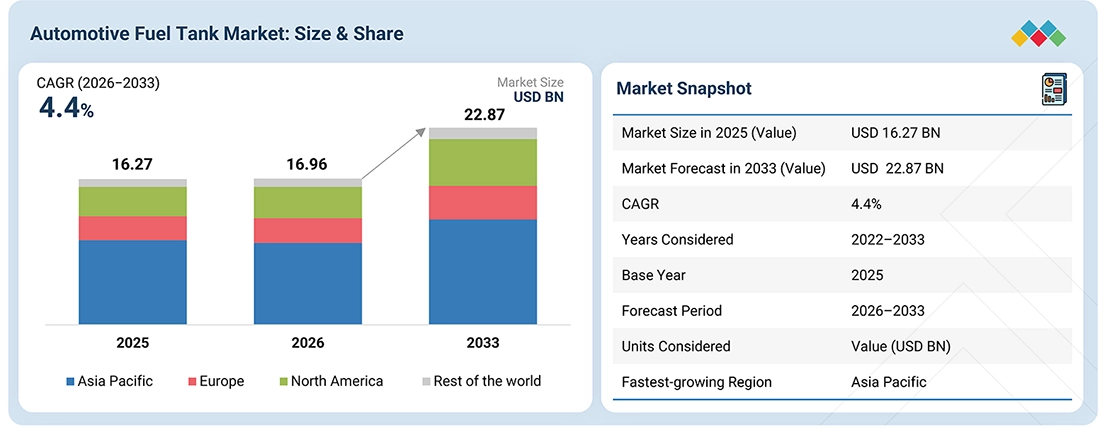
The automotive fuel tank market is projected to grow from USD 16.96 billion in 2026 to USD 22.87 billion by 2033, at a CAGR of 4.4%. The market is driven by rising vehicle production, continued demand for gasoline and diesel vehicles, increasing hybrid vehicle adoption, and stricter evaporative emission requirements. Growing use of lightweight multilayer plastic tanks, low-permeability materials, pressure-resistant tanks for hybrid applications, and optimized tank designs is supporting technology adoption across passenger cars and commercial vehicles. Increasing demand for higher fuel capacity in SUVs, pickups, and commercial vehicles, along with integration of fuel tanks with vapor management, fuel delivery, sensing, and leak detection systems, is further supporting market growth. Asia Pacific remains the largest regional market, supported by high vehicle production volumes across China, India, Japan, South Korea, and Southeast Asia.
By Region
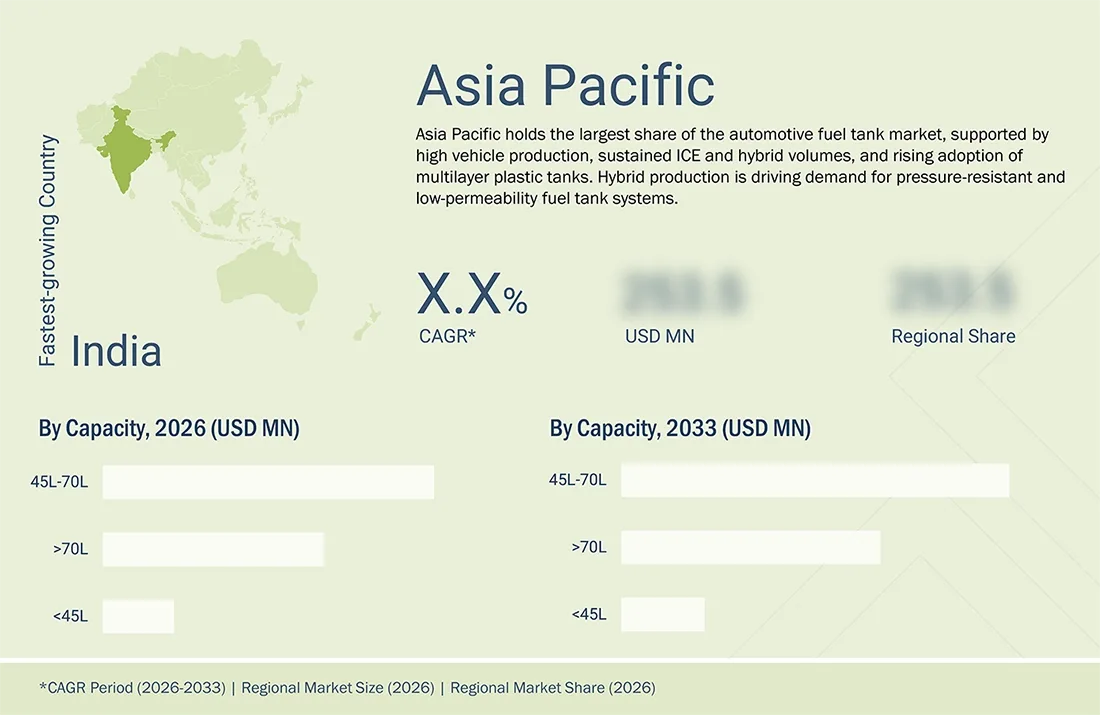
Asia Pacific is projected to lead the automotive fuel tank market during the forecast period. This segment is projected to grow from USD 9.49 billion in 2026 to USD 12.22 billion in 2033 at a CAGR of 3.7%.
By Vehicle Type
The passenger cars segment is projected to lead the automotive fuel tank market during the forecast period. This segment is projected to grow from USD 10.16 billion in 2026 to USD 13.58 billion by 2033 at a CAGR of 4.2%.
By Propulsion Type
The gasoline segment is projected to lead the automotive fuel tank market during the forecast period. This segment is projected to grow from USD 9.48 billion in 2026 to USD 12.61 billion in 2033 at a CAGR of 4.2%.
By Capacity Type
The 45L-70L segment is projected to lead the automotive fuel tank market during the forecast period. This segment is projected to grow from USD 9.73 billion in 2026 to USD 13.14 billion by 2033 at a CAGR of 4.4%.
By SCR Tank Type
The light commercial vehicles segment is projected to lead the automotive fuel tank market during the forecast period. This segment is projected to grow from USD 0.71 billion in 2026 to USD 0.86 billion in 2033 at a CAGR of 2.8%.
By Tank Type
The saddle fuel tank segment is projected to lead the automotive fuel tank market during the forecast period.
By CNG Tank Type
The Type 1 CNG tank segment is projected to lead the automotive CNG tank market during the forecast period.
By Material Type
The plastic Segment is projected to lead the automotive fuel tank market during the forecast period.
Competitive Landscape
The automotive fuel tank market is dominated by players such as OPmobility (France), Kautex Textron (Germany), TI Automotive (US), YAPP Automotive Systems (China), and Motherson Yachiyo Automotive Systems (Japan).
Competitive Landscape
The automotive fuel tank market is dominated by other key players, such as Continental (Germany), Futaba Industrial (Japan), Benteler (Germany), Toyoda Gosei (Japan), and Kongsberg Automotive (Norway).
The automotive fuel tank market is set to be driven by increasing hybrid vehicle adoption, stricter evaporative emission regulations, lightweighting requirements, and growing demand for integrated fuel storage and vapor management systems. Rising requirements for low-permeability, pressure-resistant, lightweight, and compact tanks will accelerate adoption of advanced fuel tank technologies across OEMs and Tier 1 suppliers. In the coming years, opportunities will emerge through integrated fuel tank modules, advanced multi-layer barrier structures, smart fuel level and pressure sensing, automated leak detection, and integrated vapor management systems, enabling improved emission control, optimized packaging, lower vehicle weight, and enhanced fuel system performance.
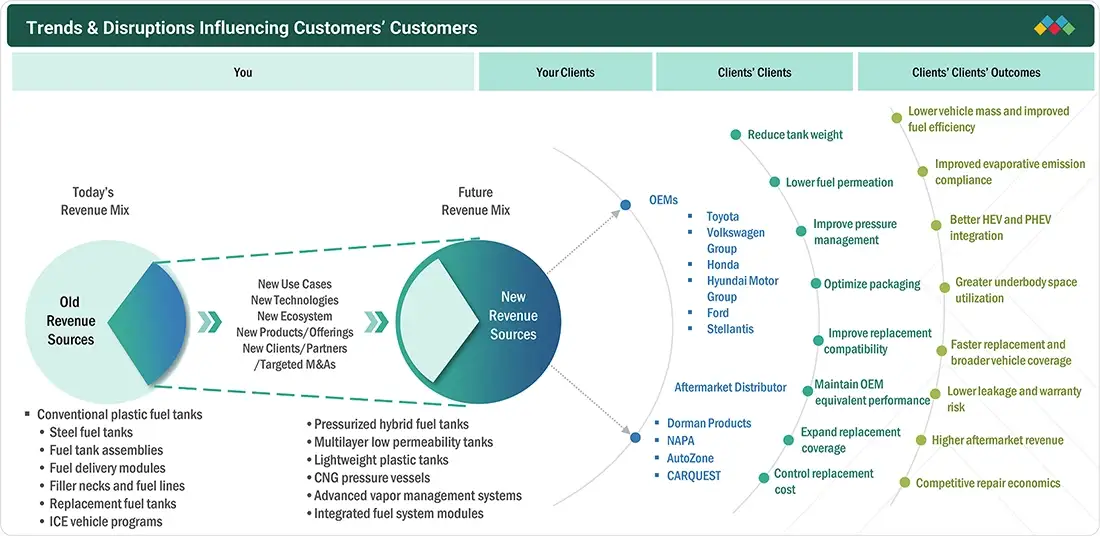
The automotive fuel tank market is shifting from conventional fuel storage toward integrated, lightweight, and low-permeability fuel system solutions. Traditional plastic and steel fuel tanks are increasingly complemented by pressurized hybrid tanks, multi-layer barrier tanks, integrated vapor management, smart sensing, and advanced fuel delivery systems. OEMs and Tier 1 suppliers are adopting these solutions to meet stricter emission requirements, optimize underbody packaging, reduce vehicle weight, and support hybrid powertrains. This is creating new revenue opportunities through integrated fuel tank modules, hybrid tank systems, vapor management, sensing, and leak detection, while enabling lower fuel permeation, improved packaging efficiency, reduced replacement costs, and greater vehicle platform compatibility.
Source: Secondary Research, Interviews with Experts, MarketsandMarkets Analysis

Drivers
Impact
Level



RESTRAINTS
Impact
Level



OPPORTUNITIES
Impact
Level



CHALLENGES
Impact
Level


Source: Secondary Research, Interviews with Experts, MarketsandMarkets Analysis
Growing adoption of hybrid and plug-in hybrid vehicles is increasing demand for pressure-resistant, low-permeability, and low-purge fuel tanks. Longer engine-off periods and tighter evaporative emission requirements are driving improvements in tank sealing, vapor management, pressure control, and fuel system integration.
Increasing battery electric vehicle adoption is reducing the production base of internal combustion engine vehicles and, consequently, the addressable volume for conventional fuel tanks. Higher EV penetration across passenger vehicles is expected to constrain long-term demand for gasoline and diesel fuel storage systems.
OEMs are increasingly seeking integrated solutions combining fuel tanks with fuel delivery, vapor management, sensing, valves, and leak detection. Suppliers can expand their role through integrated fuel tank modules, hybrid fuel systems, smart sensing, and system level validation.
Fuel tanks must maintain leak tightness, pressure resistance, structural integrity, and low permeation across temperature variations, crash conditions, fuel aging, and extended engine-off periods. Hybrid applications further increase requirements for pressure management, sealing, and long-term durability.
| COMPANY | USE CASE DESCRIPTION | BENEFITS |
|---|---|---|
|
|
Develops plastic fuel tanks, hybrid pressure resistant tanks, SCR systems, and integrated fuel systems for passenger and commercial vehicles | Lightweighting, lower permeation, improved packaging, and greater system integration |
|
|
Supplies conventional and pressurized plastic fuel systems, including multilayer and hybrid fuel tanks for cars, light trucks, and hybrid vehicles | Reduced weight and emissions, flexible tank geometry, improved packaging, and hybrid compatibility |
|
|
Provides fuel tank systems, filler pipes, pumps, and modules for gasoline, diesel, flex fuel, and hybrid applications | Integrated fuel storage and delivery, reduced evaporative emissions, lightweight construction, and packaging flexibility |
|
|
Develops plastic automotive fuel tanks and fuel system components for OEM vehicle platforms, with focus on lightweight and emission compliant designs | Weight reduction, corrosion resistance, packaging flexibility, and improved emission performance |
|
|
Manufactures multilayer plastic fuel tanks, including six-layer EVOH barrier tanks and pressure resistant tanks for hybrid applications | Low hydrocarbon permeation, lightweight construction, pressure management, and hybrid compatibility |
Logos and trademarks shown above are the property of their respective owners. Their use here is for informational and illustrative purposes only.
The automotive fuel tank market ecosystem is built around collaboration between raw material providers, fuel tank manufacturers, fuel system and component suppliers, testing service providers, automotive OEMs, and aftermarket companies to develop, manufacture, validate, and service fuel storage systems. Raw material providers such as BASF, SABIC, POSCO, and Baosteel supply polymers, barrier materials, and steel used in fuel tank production. Fuel tank manufacturers, including OPmobility, Kautex, TI Automotive, Unipres, YAPP, and Motherson Yachiyo, develop plastic, steel, multilayer, and hybrid fuel tank systems. Fuel system suppliers such as Bosch, DENSO, Continental, MAHLE, and AsteMo provide pumps, valves, sensors, fuel delivery, and vapor management components, while testing providers such as TÜV SÜD, ENGEL, and Husky support material, component, manufacturing, and compliance validation. OEMs including Toyota, Volkswagen, Ford, and General Motors integrate fuel tank systems into vehicle platforms, while aftermarket companies such as Spectra Premium, NAPA, Dorman, and NTSA support replacement fuel tanks and related components.
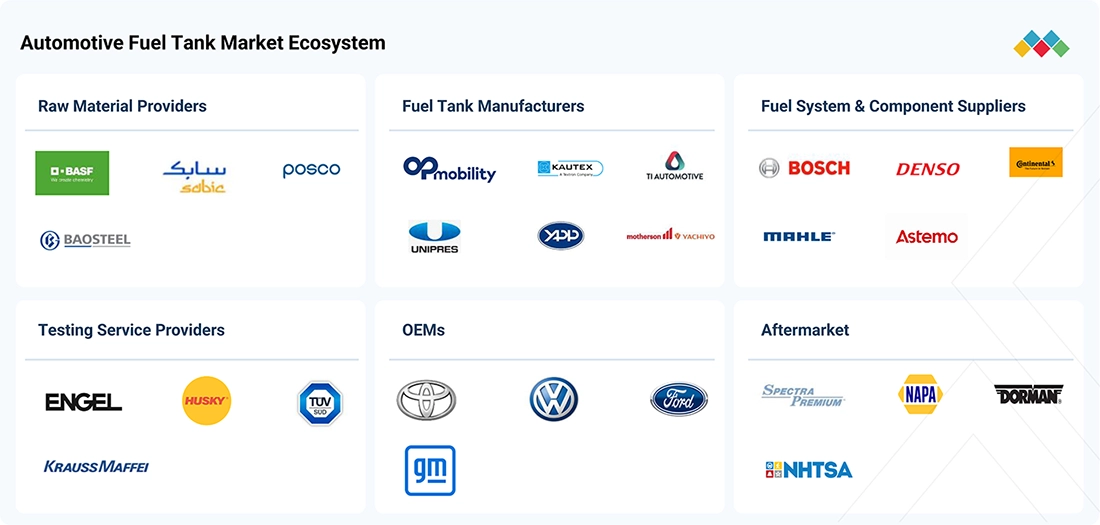
Logos and trademarks shown above are the property of their respective owners. Their use here is for informational and illustrative purposes only.
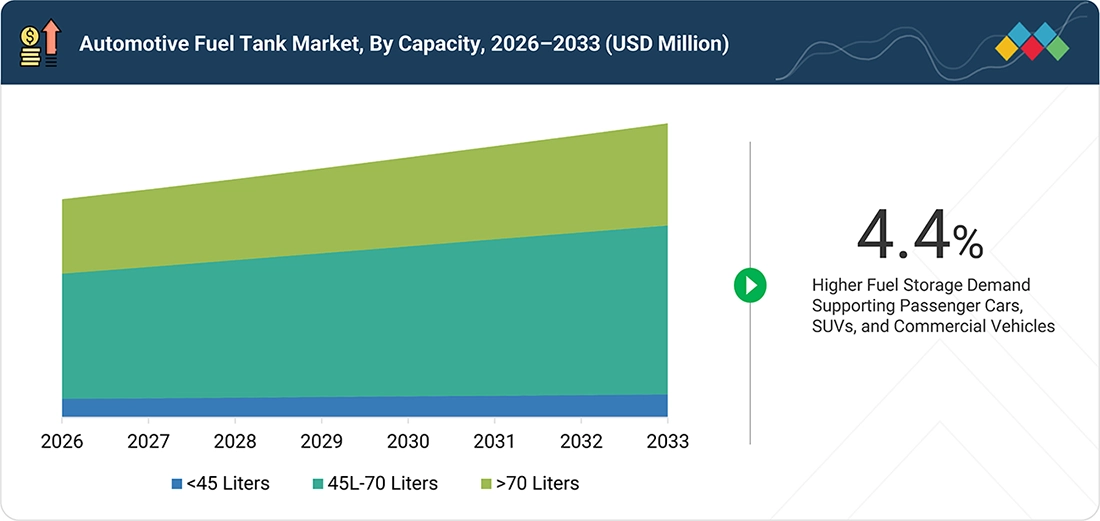
Source: Secondary Research, Interviews with Experts, MarketsandMarkets Analysis
Passenger cars account for the largest share, supported by high global production volumes and widespread use of gasoline, diesel, and hybrid powertrains. LCVs and HCVs support demand for higher-capacity and durable fuel tanks, particularly across logistics, commercial transport, and fleet applications.
Gasoline accounts for the largest share, supported by high passenger vehicle production and continued ICE vehicle use. Diesel remains important in LCVs and HCVs, while hybrid and alternative fuel vehicles are increasing demand for pressure-resistant, low-permeability, and specialized fuel storage systems.
45- to 70-liter tanks account for a significant share, supported by widespread use across passenger cars, SUVs, and LCVs. Below-45-liter tanks serve compact vehicles, while above-70-liter tanks are increasingly used in pickups, SUVs, trucks, and commercial vehicles requiring extended operating range.
HCVs account for the largest share, driven by high diesel penetration, stringent emission regulations, and widespread SCR adoption in trucks and buses. LCV adoption is also increasing as emission standards drive greater use of SCR systems in diesel vans, pickups, and commercial fleets.
Saddle tanks account for a significant share, supported by their ability to utilize available underbody space and provide higher fuel capacity in pickups, SUVs, and commercial vehicles. Their application is particularly relevant where vehicle platforms require optimized packaging around exhaust, suspension, driveshaft, and other underbody components.
Type 1 CNG tanks account for a significant share, supported by their cost advantage and widespread use in commercial vehicles and passenger vehicles. Type 2, Type 3, and Type 4 tanks are gaining adoption where lightweight construction, higher storage efficiency, and weight reduction are required.
Plastic fuel tanks account for a significant share, supported by their lightweight construction, corrosion resistance, design flexibility, and low permeability. Steel remains important for high capacity and commercial vehicle applications, while aluminum is used in weight sensitive and specialty applications requiring corrosion resistance and structural strength.
Asia Pacific holds the largest share of the automotive fuel tank market, led by China, Japan, India, South Korea, and Southeast Asia, supported by high vehicle production, large passenger and commercial vehicle fleets, and established automotive supply chains. Plastic fuel tanks, particularly multilayer low-permeability systems, remain widely used, while China, Japan, and South Korea are driving adoption of lightweight and pressure-resistant tanks for hybrid vehicles. India and Southeast Asia continue to support demand through strong ICE vehicle production, commercial vehicle applications, and growing adoption of CNG and hybrid powertrains.
OPmobility is categorized as a Star Player in the automotive fuel tank market, supported by its strong position in plastic fuel systems and integrated fuel storage solutions. The company offers lightweight, low-permeability, multilayer, and pressure-resistant fuel tanks for conventional and hybrid vehicles. Its fuel system portfolio, including vapor management and fuel delivery integration, supports lower emissions, optimized packaging, and hybrid vehicle requirements. Strong relationships with global OEMs and investments in advanced fuel system technologies strengthen its position across the global automotive fuel tank market. Magna is categorized as a Key Emerging Player in the market, supported by its fuel system and vehicle component capabilities across passenger and commercial vehicle platforms. The company provides fuel tank-related solutions with a focus on lightweight construction, packaging efficiency, and system integration. Its global manufacturing footprint and relationships with major OEMs support expansion across vehicle platforms, while increasing demand for lightweight and integrated fuel storage solutions creates opportunities for further market development.
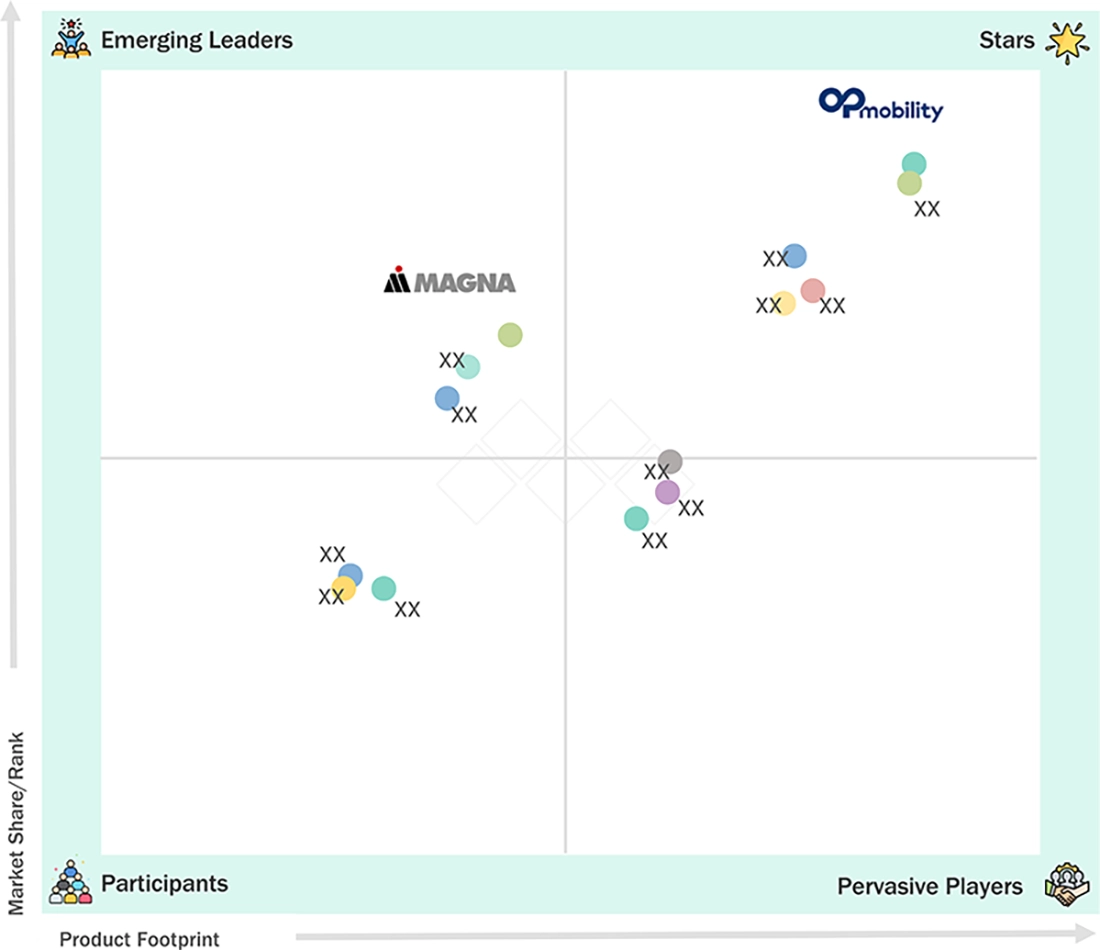
Source: Secondary Research, Interviews with Experts, MarketsandMarkets Analysis
| REPORT METRIC | DETAILS |
|---|---|
| Market Size in 2025 (Value) | USD 16.27 Billion |
| Market Size in 2026 (Value) | USD 16.96 Billion |
| Market Forecast in 2033 (Value) | USD 22.87 Billion |
| Growth Rate | CAGR of 4.4% from 2026–2033 |
| Years Considered | 2022–2033 |
| Base Year | 2025 |
| Forecast Period | 2026-2033 |
| Units Considered | Value (USD Million/Billion), Volume (Thousand Units) |
| Report Coverage | Revenue Forecast, Competitive Landscape, Company Share, Growth Factors and Trends |
| Segments Covered | The report covers vehicle type (passenger cars, light commercial vehicles, heavy commercial vehicles), propulsion (gasoline, diesel, AF), tank capacity (< 45 L, 45L-70L, > 70 L), tank type (saddle, contoured, rectangular, others), material (plastic, steel, aluminum), CNG tank type (Type 1, Type 2, Type 3, Type 4), SCR tank by vehicle type (passenger cars, light commercial vehicles, heavy commercial vehicles) |
| Regional Scope | Asia Pacific, North America, Europe, and Rest of the World |
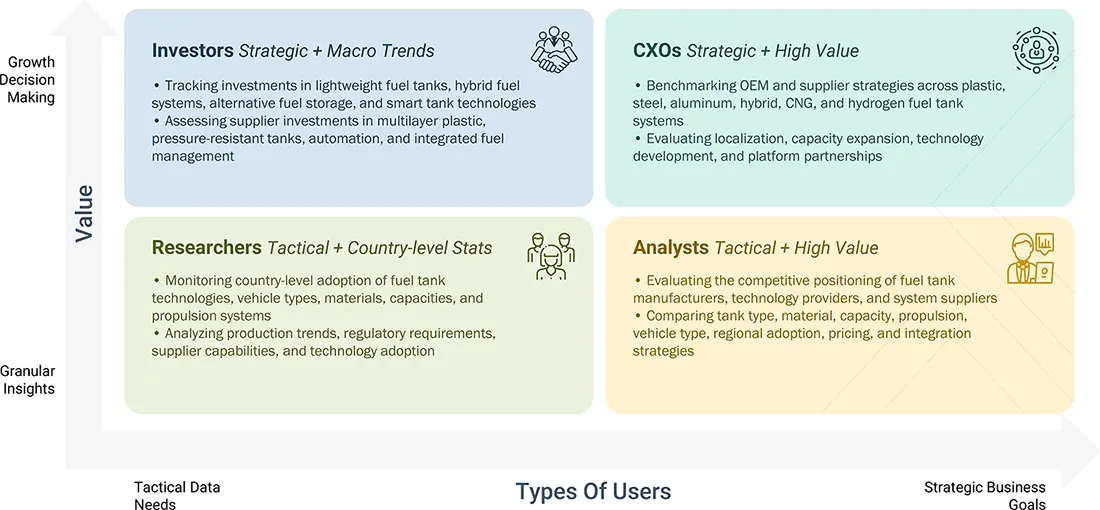
We have successfully delivered the following deep-dive customizations:
| CLIENT REQUEST | CUSTOMIZATION DELIVERED | VALUE ADDS |
|---|---|---|
| Fuel Tank Segmentation | Developed separate analysis for passenger cars, LCVs, HCVs, tank capacity, tank type, material type, propulsion type, and fuel type including gasoline, diesel, CNG, and hybrid applications | Helps prioritize high demand tank segments and technology opportunities |
| Fuel Tank Demand Drivers | Mapped demand drivers including vehicle production, hybridization, lightweighting, evaporative emission regulations, CNG adoption, and transition toward integrated fuel systems | Supports technology planning, capacity expansion, and investment decisions |
| OEM and Supplier Benchmarking | Benchmarked OEMs, Tier 1 suppliers, fuel tank manufacturers, and fuel system companies based on tank technologies, material capabilities, production footprint, OEM relationships, and system integration | Enables competitive positioning and partnership evaluation |
| Vehicle Platform Analysis | Assessed fuel tank requirements across passenger cars, SUVs, LCVs, HCVs, hybrid vehicles, CNG vehicles, and commercial vehicle platforms based on packaging, capacity, pressure, and emission requirements | Identifies platform specific fuel tank requirements and future technology needs |
| Application Level Insights | Analyzed demand across plastic, steel, and aluminum tanks, multilayer barrier structures, pressure resistant hybrid tanks, CNG tanks, vapor management, fuel delivery, sensing, and leak detection | Supports targeted product development and application specific positioning |
| Regional Market Deep Dive | Delivered country-level analysis covering vehicle production, powertrain mix, hybrid and CNG penetration, regulatory requirements, OEM production, supplier presence, and fuel tank manufacturing capacity across major markets | Supports regional expansion, manufacturing planning, and market prioritization |
| Regulatory and Compliance Assessment | Evaluated FMVSS, UNECE, EPA, CARB, China, Japan, and CNG and hydrogen related requirements covering crash safety, evaporative emissions, permeation, pressure resistance, and leak prevention | Identifies compliance driven demand and reduces regulatory investment risk |
| Fuel Tank Technology Mapping | Mapped conventional plastic and steel tanks against multilayer plastic, EVOH barrier, pressure-resistant hybrid tanks, integrated fuel tank modules, smart sensing, and vapor management systems | Improves technology visibility and supports future product and partnership strategies |
| Technology Investment Analysis | Assessed investment trends across multilayer plastic tanks, EVOH barrier technology, pressure resistant hybrid tanks, CNG storage, integrated fuel tank modules, vapor management, smart sensing, and leak detection | Identifies emerging technologies and future fuel tank opportunities |
| CAPEX and Utilization Analysis | Evaluated manufacturing CAPEX, tooling requirements, production capacity, utilization rates, automation levels, material costs, maintenance requirements, and potential return periods across major fuel tank manufacturing technologies | Supports manufacturing capacity planning, technology investment, and facility expansion decisions |
| Strategic Recommendations | Provided recommendations on fuel tank technology priorities, material selection, manufacturing localization, regional expansion, OEM targeting, supplier partnerships, and integrated fuel system opportunities | Enables informed investment decisions and stronger market positioning |
 Exclusive indicates content/data unique to MarketsandMarkets and not available with any competitors.
TITLE
PAGE NO
1
INTRODUCTION
15
2
EXECUTIVE SUMMARY
3
PREMIUM INSIGHTS
4
MARKET OVERVIEW
Maps the market evolution with focus on trend catalysts, risk factors, and growth opportunities across segments.4.1
INTRODUCTION
4.2
MARKET DYNAMICS
4.2.1
DRIVERS
4.2.2
RESTRAINTS
4.2.3
OPPORTUNITIES
4.2.4
CHALLENGES
4.3
UNMET NEEDS AND WHITE SPACES
4.4
INTERCONNECTED MARKETS AND CROSS-SECTOR OPPORTUNITIES
4.5
STRATEGIC MOVES BY TIER 1/2/3 PLAYERS
5
INDUSTRY TRENDS
Highlights the market structure, growth drivers, restraints, and near-term inflection points influencing performance.5.1
MACROECONOMICS INDICATORS
5.1.1
INTRODUCTION
5.1.2
GDP TRENDS AND FORECAST
5.1.3
TRENDS IN AUTOMOTIVE FUEL SYSTEM MARKET
5.1.4
TRENDS IN GLOBAL AUTOMOTIVE FUEL TANK INDUSTRY
5.2
SUPPLY CHAIN ANALYSIS
5.3
ECOSYSTEM ANALYSIS
5.4
PRICING ANALYSIS
5.4.1
INDICATIVE PRICING ANALYSIS, BY APPLICATION, 2024-2026
5.4.2
INDICATIVE PRICE TREND, BY REGION, 2024–2026
5.5
TRADE ANALYSIS
5.5.1
IMPORT SCENARIO (HS CODE 870899)
5.5.2
EXPORT SCENARIO (HS CODE 870899)
5.6
KEY CONFERENCES & EVENTS, 2026-2027
5.7
TRENDS/DISRUPTIONS IMPACTING CUSTOMER BUSINESS
5.8
INVESTMENT AND FUNDING SCENARIO
5.9
CASE STUDY ANALYSIS
5.10
IMPACT ANALYSIS
5.10.1
IMPACT OF HYBRIDIZATION ON AUTOMOTIVE FUEL TANK DEMAND
5.10.2
LIGHTWEIGHT AND MULTILAYER FUEL TANK TECHNOLOGIES
5.10.3
BEV PENETRATION AND CIRCULARITY REGULATIONS ON FUEL TANK SUPPLIERS
5.11
OPPORTUNITY ASSESSMENT ANALYSIS
5.11.1
INTEGRATED FUEL TANK MODULE
5.11.2
DIRECT OEM SUPPLY / TIER 1 (LONG-TERM PLATFORM CONTRACTS )
5.12
HYBRID VEHICLE FUEL TANK OPTIMIZATION
5.13
HYDROGEN STORAGE TECHNOLOGY
5.14
SMART SENSORS & TANK MONITORING
5.15
FUEL TANK THERMAL MANAGEMENT
6
OEM ANALYSIS
6.1
OEM FUEL TANK SELECTION CRITERIA
6.2
COST PER TANK
6.3
FUEL PERMEABILITY
6.4
RECYCLABILITY
6.5
MANUFACTURING LOCALIZATION
7
TECHNOLOGICAL ADVANCEMENTS, AI-DRIVEN IMPACT, PATENTS, INNOVATIONS, AND FUTURE APPLICATIONS
7.1
KEY EMERGING TECHNOLOGIES
7.1.1
ADVANCED MULTI-LAYER BARRIER FUEL TANKS
7.1.2
LOW PERMEABILITY POLYMER TECHNOLOGIES
7.1.3
LIGHTWEIGHT COMPOSITE FUEL STORAGE SYSTEMS
7.1.4
SMART FUEL TANK SENSING AND CONDITION MONITORING
7.1.5
ADVANCED FUEL TANK ARCHITECTURES FOR HYBRID PLATFORMS
7.2
ADJACENT TECHNOLOGIES
7.2.1
END-OF-LIFE VEHICLE RECYCLING AND MATERIAL RECOVERY TECHNOLOGIES
7.2.2
FUEL DELIVERY AND THERMAL MANAGEMENT SYSTEMS
7.2.3
FUEL VAPOR MANAGEMENT AND EVAP SYSTEMS
7.3
TECHNOLOGY/PRODUCT ROADMAP
7.3.1
STANDALONE TANK
7.3.2
INTEGRATED FUEL TANK MODULE
7.3.3
INTEGRATED FUEL & VAPOR MANAGEMENT SYSTEM
7.4
PATENT ANALYSIS
7.5
FUTURE APPLICATIONS
7.6
IMPACT OF ADVANCED TECHNOLOGIES ON AUTOMOTIVE FUEL TANK MARKET
7.6.1
TOP TECHNOLOGY APPLICATIONS AND MARKET POTENTIAL
7.6.2
BEST PRACTICES FOLLOWED BY OEMS AND FUEL TANK MANUFACTURERS
7.6.3
CASE STUDIES RELATED TO ADVANCED FUEL TANK TECHNOLOGY IMPLEMENTATION
7.6.4
INTERCONNECTED FUEL SYSTEM ECOSYSTEM AND IMPACT ON MARKET PLAYERS
7.6.5
OEM READINESS TO ADOPT NEXT-GENERATION FUEL TANK TECHNOLOGIES
8
REGULATORY LANDSCAPE AND SUSTAINABILITY INITIATIVES
8.1
REGIONAL REGULATIONS AND COMPLIANCE
8.1.1
REGULATORY BODIES, GOVERNMENT AGENCIES, AND OTHER ORGANIZATIONS
8.1.2
INDUSTRY STANDARDS AND REGULATIONS
8.1.3
REGIONAL REGULATORY COMPARISON
8.1.4
FUEL TANK CRASH SAFETY AND LEAKAGE REQUIREMENTS
8.1.5
ALTERNATIVE FUEL STORAGE STANDARDS
8.2
SUSTAINABILITY INITIATIVES
8.3
IMPACT OF REGULATORY POLICIES ON SUSTAINABILITY INITIATIVES
9
CUSTOMER LANDSCAPE & BUYER BEHAVIOR
9.1
DECISION-MAKING PROCESS
9.2
BUYER STAKEHOLDERS AND BUYING EVALUATION CRITERIA
9.3
KEY STAKEHOLDERS IN BUYING PROCESS
9.4
BUYING CRITERIA
10
AUTOMOTIVE FUEL TANK MARKET, BY MATERIAL
Market Size, Volume & Forecast – USD Million10.1
INTRODUCTION
10.2
PLASTIC
10.3
STEEL
10.4
ALUMINIUM
10.5
KEY PRIMARY INSIGHTS
11
AUTOMOTIVE FUEL TANK MARKET, BY VEHICLE TYPE
Market Size, Volume & Forecast – USD Million11.1
INTRODUCTION
11.2
PASSENGER CARS
11.3
LIGHT COMMERCIAL VEHICLES
11.4
HEAVY COMMERCIAL VEHICLES
11.5
KEY PRIMARY INSIGHTS
12
AUTOMOTIVE FUEL TANK MARKET, BY CAPACITY
Market Size, Volume & Forecast – USD Million12.1
INTRODUCTION
12.2
<45 LITERS
12.3
45–70 LITERS
12.4
>70 LITERS
12.5
KEY PRIMARY INSIGHTS
13
AUTOMOTIVE SELECTIVE CATALYTIC REDUCTION (SCR) TANK MARKET, BY VEHICLE TYPE
Market Size, Volume & Forecast – USD Million13.1
INTRODUCTION
13.2
PASSENGER CARS
13.3
LIGHT COMMERCIAL VEHICLES
13.4
HEAVY COMMERCIAL VEHICLES
13.5
KEY PRIMARY INSIGHTS
14
AUTOMOTIVE CNG TANK MARKET, BY TYPE
Market Size, Volume & Forecast – USD Million14.1
INTRODUCTION
14.2
TYPE
14.3
TYPE
14.4
TYPE
14.5
TYPE
14.6
KEY PRIMARY INSIGHTS
15
AUTOMOTIVE FUEL TANK MARKET, BY PROPULSION
Market Size, Volume & Forecast – USD Million15.1
INTRODUCTION
15.2
GASOLINE
15.3
DIESEL
15.4
ALTERNATIVE-FUEL
15.5
KEY PRIMARY INSIGHTS
16
AUTOMOTIVE FUEL TANK MARKET, BY TANK TYPE
Market Size, Volume & Forecast – USD Million16.1
INTRODUCTION
16.2
SADDLE
16.3
CONTOURED
16.4
RECTANGULAR
16.5
OTHERS
16.6
KEY PRIMARY INSIGHTS
17
AUTOMOTIVE FUEL TANK MARKET, BY REGION
Market Size, Volume & Forecast – USD Million17.1
ASIA PACIFIC
17.1.1
CHINA
17.1.2
JAPAN
17.1.3
INDIA
17.1.4
SOUTH KOREA
17.1.5
INDONESIA
17.1.6
REST OF ASIA PACIFIC
17.2
EUROPE
17.2.1
GERMANY
17.2.2
FRANCE
17.2.3
SPAIN
17.2.4
ITALY
17.2.5
UK
17.2.6
REST OF EUROPE
17.3
NORTH AMERICA
17.3.1
US
17.3.2
CANADA
17.3.3
MEXICO
17.4
REST OF THE WORLD
17.4.1
BRAZIL
17.4.2
SOUTH AFRICA
17.4.3
ARGENTINA
18
COMPETITIVE LANDSCAPE
18.1
OVERVIEW
18.2
KEY PLAYERS’ STRATEGIES/RIGHT TO WIN
18.3
MARKET SHARE ANALYSIS,
18.4
REVENUE ANALYSIS OF TOP LISTED/PUBLIC PLAYERS,
18.5
BRAND/ PRODUCT COMPARISON
18.6
COMPANY VALUATION AND FINANCIAL METRICS
18.7
COMPANY EVALUATION MATRIX: KEY PLAYERS,
18.7.1
STARS
18.7.2
EMERGING LEADERS
18.7.3
PERVASIVE PLAYERS
18.7.4
PARTICIPANTS
18.7.5
COMPANY FOOTPRINT: KEY PLAYERS,
18.7.6
COMPANY FOOTPRINT
18.7.7
REGION FOOTPRINT
18.7.8
VEHICLE TYPE FOOTPRINT
18.7.9
MATERIAL FOOTPRINT
18.7.10
PROPULSION FOOTPRINT
18.8
COMPANY EVALUATION MATRIX: STARTUPS/SMES,
18.8.1
PROGRESSIVE COMPANIES
18.8.2
RESPONSIVE COMPANIES
18.8.3
DYNAMIC COMPANIES
18.8.4
STARTING BLOCKS
18.8.5
COMPETITIVE BENCHMARKING: STARTUPS/SMES,
1.1.1.1
LIST OF KEY STARTUPS/SMES
1.1.1.2
COMPETITIVE BENCHMARKING OF KEY STARTUPS/SMES
18.9
COMPETITIVE SCENARIO
18.9.1
PRODUCT DEVELOPMENTS
18.9.2
DEALS
18.9.3
EXPANSIONS
18.9.4
OTHERS
19
COMPANY PROFILES
19.1
KEY PLAYERS
19.1.1
OPMOBILITY
19.1.1.1
BUSINESS OVERVIEW
19.1.1.2
PRODUCTS/SOLUTIONS/SERVICES OFFERED
19.1.1.3
NEW PRODUCT DEVELOPMENT/ENRICHMENT
19.1.1.4
DEALS
19.1.1.5
MNM VIEW
19.1.2
KAUTEX TEXTRON
19.1.3
TI AUTOMOTIVE
19.1.4
YAPP AUTOMOTIVE SYSTEMS
19.1.5
MOTHERSON YACHIYO AUTOMOTIVE SYSTEMS
19.1.6
MAGNA INTERNATIONAL
19.1.7
FUEL TOTAL SYSTEMS, FTS
19.1.8
UNIPRES CORPORATION
19.1.9
DONGHEE
19.1.10
SAKAMOTO INDUSTRY
19.1.11
SMA SERBATOI
*COMPANY PROFILES WOULD COVER BUSINESS OVERVIEWS, PRODUCTS OFFERED, RECENT DEVELOPMENTS, AND MNM VIEWS (TOP FIVE COMPANIES).
*DETAILS ON BUSINESS OVERVIEW, PRODUCTS OFFERED, DEALS, AND MNM VIEWS MIGHT NOT BE CAPTURED IN CASE OF UNLISTED COMPANIES.
19.2
OTHER KEY PLAYERS
(*QUALITATIVE WRITE-UP WOULD BE PROVIDED FOR OTHER KEY PLAYERS)
20
RESEARCH METHODOLOGY
20.1
RESEARCH DATA
20.1.1
SECONDARY DATA
KEY DATA FROM SECONDARY SOURCES
20.1.2
PRIMARY DATA
KEY DATA FROM PRIMARY SOURCES
KEY PRIMARY PARTICIPANTS
BREAKDOWN OF PRIMARY INTERVIEWS
Various secondary sources, directories, and databases were used to identify and collect information for an extensive automotive fuel tank market study. The study involved four main activities in estimating the current size of the market: secondary research, validation through primary research, assumptions, and market analysis. The research study involved various secondary sources, such as company annual reports/presentations, industry association publications, automotive wiring harness magazine articles, directories, technical handbooks, World Economic Outlook, trade websites, technical articles, and databases, which were used to identify and collect information for an extensive study of the automotive fuel tank market. Primary sources experts from automotive OEMs, Tier 1 suppliers, and fuel tank manufacturers were interviewed to obtain and verify critical information and assess prospects and market estimations.
Secondary ResearchSecondary sources referred to for this research study included automotive fuel tank industry organizations; corporate filings such as annual reports, investor presentations, and financial statements; trade and business whitepapers and databases; and articles from recognized associations and government publishing sources. The secondary data was collected and analyzed to arrive at the overall market size, which was further validated by primary research.
Primary ResearchExtensive primary research was conducted after acquiring an understanding of this market scenario through secondary research. Several primary interviews were conducted with market experts from the demand- and supply-side OEMs (in terms of component supply, country-level government associations, and trade associations) and component manufacturers across four major regions, namely, Asia Pacific- 40%, Europe- 25%, North America- 20%, and Rest of the World-15%. Approximately 60% and 40% of primary interviews were conducted from the demand and supply side, respectively. Primary data were collected through questionnaires, emails, LinkedIn, and telephonic interviews. In the canvassing of primary interviews, various departments within organizations, such as sales, operations, and administration, were covered to provide a holistic viewpoint in the report.
Brief sessions with highly experienced independent consultants were conducted to reinforce findings from primaries after interacting with industry experts. This, along with the in-house subject matter experts’ opinions, led to the findings, as described in the remainder of this report.
In the primary research process, various primary sources from the supply and demand sides were interviewed to obtain qualitative and quantitative information for the report. The primary sources from the supply side included industry experts, such as Vice Presidents (VPs), marketing directors, technology and innovation directors, and related key executives from various key companies and organizations. The primary sources from the demand side included end users, such as Chief Information Officers (CIOs), consultants, service professionals, technicians and technologists, and managers at public and investor-owned utilities.

Note: Tier 1 suppliers include automotive system and component suppliers using test equipment for component and system validation.
To know about the assumptions considered for the study, download the pdf brochure
The automotive fuel tank market was estimated and validated using both top-down and bottom-up approaches. In the top-down approach, the global market value was derived through revenue analysis of key fuel tank manufacturers. Average fuel tank penetration was established using secondary sources, paid databases, and primary research. Country-level market values were allocated based on the regional share of fuel tank segments, with regional values aggregated to derive the global market by material type and other segments. In the bottom-up approach, fuel tank-equipped vehicle production units were considered at the country level. Fuel tank penetration was identified through OEM model mapping, vehicle production data, company disclosures, and secondary research across passenger cars, LCVs, and HCVs. Fuel tank-equipped vehicles are segmented by vehicle type, propulsion, and tank capacity. Average fuel tank value per vehicle was determined through primary and secondary research, considering capacity, material, configuration, and vehicle application. Country-level volumes were multiplied by the average tank value to determine market value, which was aggregated to regional and global levels.

After arriving at the overall market size using the market size estimation processes as explained above, the market was split into several segments and subsegments. To complete the overall market engineering process and arrive at the exact statistics of each market segment and subsegment, data triangulation and market breakdown procedures were employed, wherever applicable. The data was triangulated by studying various factors and trends from both the demand and supply sides.
Automotive fuel tanks refer to fuel storage systems designed to safely store and supply fuel to internal combustion engines and hybrid vehicles while meeting requirements for safety, emissions, durability, and vehicle packaging. The market encompasses plastic fuel tanks, steel fuel tanks, aluminum fuel tanks, multilayer plastic tanks, pressure-resistant hybrid tanks, CNG tanks, saddle tanks, rectangular tanks, contoured tanks, and other specialized tank designs. These systems support gasoline, diesel, CNG, and hybrid vehicle applications across passenger cars, LCVs, and HCVs. The market also includes integrated fuel tank solutions incorporating fuel delivery, vapor management, venting, sensing, valves, leak detection, and pressure management, while excluding hydrogen storage systems and fuel tanks for two-wheelers.
With the given market data, MarketsandMarkets offers customizations in line with company-specific needs.
Company Information


PRODUCT DIRECTOR, WEASLER
Global Provider of Industrial Actuation & Control Solutions
Our organization was interested in learning more about the attractiveness of a particular market space. We contacted MarketsandMarkets to help us based on previous positive experiences we had with them. The results did not disappoint! We discussed our objectives with them, and the team at MarketsandMarkets developed and executed a proposal that met our needs precisely. We were very impressed by their level of expertise, the quality of the analysis and their insightful recommendations. We would not hesitate in working with them again in the future.

Vice President
A global technology company that develops safer, greener and more connected solutions.
We contracted with MarketsandMarkets to evaluate the value chain and potential go-to-market partners related to our interest in the Fleet Management space. The team successfully completed the work on time and at the pricing agreed. MarketsandMarkets listened and understood our objectives and collaborated well with us to help us get the visibility we needed to make an investment.
We have subsequently used MarketsandMarkets again related to Smart Cities to good results.