Просмотр новости
Найдите то, что Вас интересует
 Спутники
 РН
РН SpaceX
 Роскосмос
 NASA
NASA
СпутникиРНSpaceXРоскосмосNASA
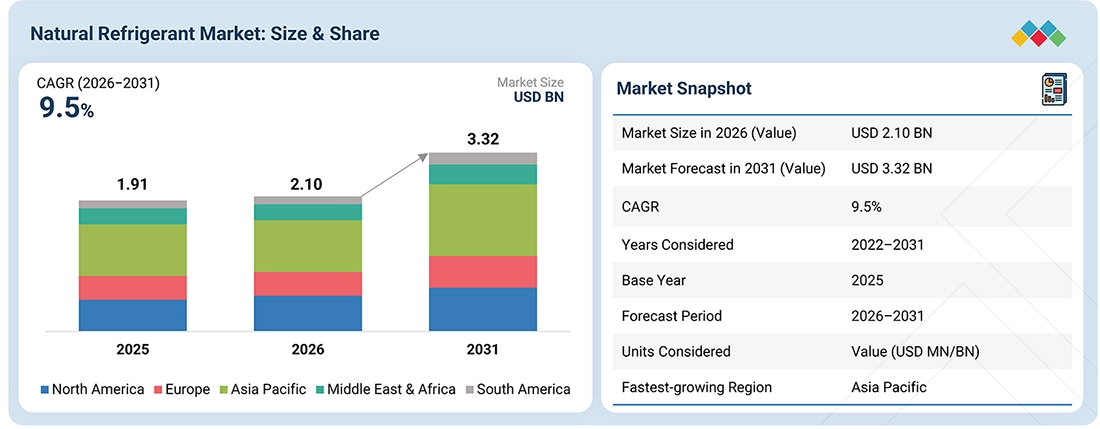
USD 3.32 BN
MARKET SIZE, 2031

CAGR 9.5%
(2026-2031)

300
REPORT PAGES

230
MARKET TABLES
Source: Secondary Research, Interviews with Experts, MarketsandMarkets Analysis
The natural refrigerants market size is projected to grow from USD 2.10 billion in 2026 to USD 3.32 billion by 2031, registering a CAGR of 9.5% during the forecast period. The natural refrigerants market is expected to grow steadily over the forecast period, driven by rising demand for sustainable, energy-efficient refrigeration and cooling systems. Natural refrigerants include ammonia, carbon dioxide, hydrocarbons, and other types of refrigerants; their use is high owing to their low GWP, environmental benefits, and applicability across a wide range of cooling applications. Rising concerns regarding GHG emissions, stricter environmental regulations, and the reduction of synthetic high-GWP refrigerants are expected to drive demand for natural refrigerants. In addition, investment in cold chain logistics, food processing, supermarkets, industrial refrigeration, energy-efficient HVAC systems, and sustainable cooling solutions will propel the growth of the natural refrigerants market.
By Region
Asia Pacific dominated the natural refrigeration market, with a share of 39%, in terms of value, in 2025.
By Type
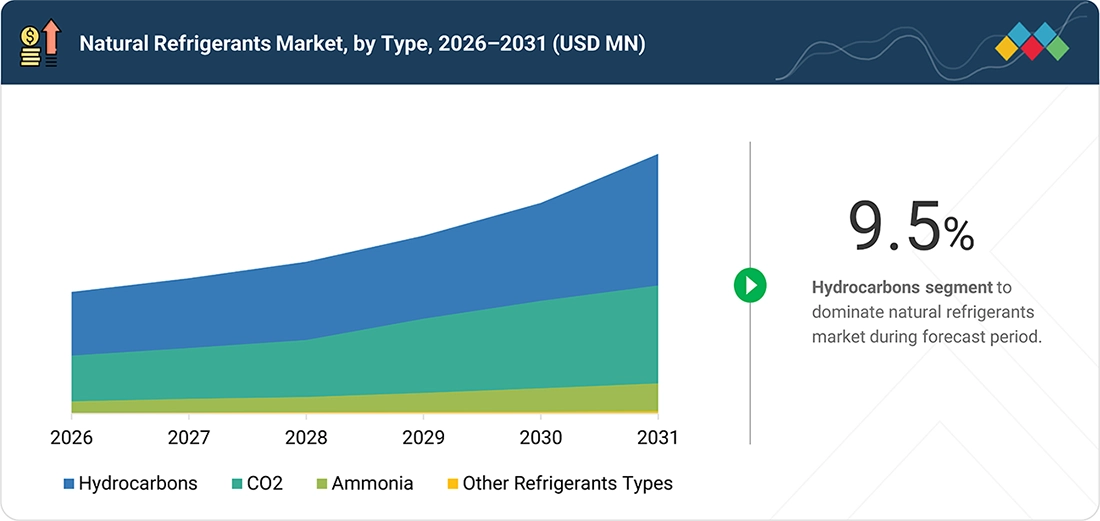
The hydrocarbons segment dominated the market with a share of 37%, in terms of value, in 2025.
By Application
Based on application, the commercial refrigeration is projected to register the highest CAGR of 12% in the natural refrigeration market during the forecast period.
COMPETITIVE LANDSCAPE- KEY PLAYERS
Companies such as Honeywell International, Inc, ABB Ltd and Emerson Electric Co were identified as some of the star players in the PTFE market , given their strong market share and product footprint
COMPETITIVE LANDSCAPE- STARTUPS
Keison International Inc, Inficon and Envitech Ltd among others, have distinguished themselves among startups and SMEs by securing strong footholds in specialized niche areas, underscoring their potential as emerging market leaders.
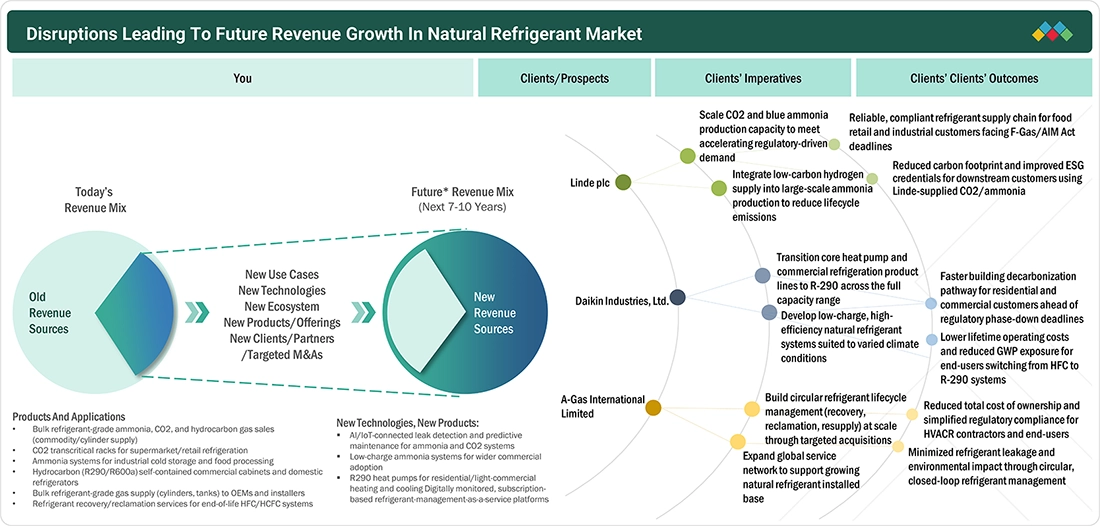
There are several reasons behind the constant growth of the natural refrigerants market. The first reason behind the growth of the natural refrigerants market is the rise in the demand for refrigeration and cooling solutions that are environmentally sustainable and efficient with a low global warming potential. Some other reasons behind the growth of the natural refrigerants market include the phase-out of high-GWP synthetic refrigerants, the strict environment regulations, and the use of natural refrigerants in commercial refrigeration, industrial refrigeration, domestic refrigeration, and stationary air conditioning sectors. The development of cold chain infrastructure, food processing plants, supermarkets, and industrial cooling systems has increased the demand for natural refrigerants. The development in refrigeration technologies and investments in energy-efficient cooling systems have also contributed to the use of ammonia, CO2, hydrocarbons, and other natural refrigerants.
Due to concerns about greenhouse gas emissions and environmental sustainability, the use of natural-refrigerant technologies is becoming increasingly important across commercial, industrial, and domestic refrigeration, as well as in stationary air conditioners. The phase-down of high-GWP artificial refrigerants, along with tightening environmental legislation, is driving greater adoption of natural refrigerants such as ammonia, carbon dioxide, propane, and isobutane. Innovations in refrigeration system design, energy-efficient compressors, heat exchangers, and safety technologies are improving performance and feasibility. Rising investments in the cold chain, food processing, supermarkets, and industrial refrigeration are creating new market opportunities. However, safety requirements, installation costs, system complexity, and the need for specialized expertise may affect their adoption.
Source: Secondary Research, Interviews with Experts, MarketsandMarkets Analysis

Drivers
Impact
Level



RESTRAINTS
Impact
Level



OPPORTUNITIES
Impact
Level



CHALLENGES
Impact
Level


Source: Secondary Research, Interviews with Experts, MarketsandMarkets Analysis
The regulatory phase-down of high-global-warming-potential (GWP) man-made refrigerants is another factor driving the growth of natural refrigerants. The strict measures have been taken by governments and regulatory bodies to limit the release of hydrofluorocarbons (HFCs) and promote green cooling solutions. The EU’s F-Gas Regulation (EU) 2024/573 will further tighten quota restrictions on HFCs and impose GWP constraints on refrigerants used in newly installed equipment, while the American Innovation and Manufacturing (AIM) Act aims to reduce HFC production and consumption by 85% by 2036. Such regulatory activities are promoting the transition from high-GWP refrigerants to natural refrigerants like CO2, ammonia, and hydrocarbons among refrigerating equipment manufacturers, retailers, and industrial users. Demand for natural refrigerant-based equipment is expected to increase as companies align with changing environmental standards and regulations.
High upfront capital expenditure and retrofitting costs are another major barrier to adopting natural refrigerant-based refrigeration systems. Switching from traditional HFC-based machines to those that use natural refrigerants, especially CO2 transcritical machines, will require special compressors, high-pressure-rated parts, and specialized controls. All of these increase the costs of purchasing the new equipment and installing them on the system. In addition, retrofitting will also require changes to the piping system, the heat-rejection system, and other safety systems. This will raise the total cost of performing the retrofits, thereby causing smaller retailers, food service providers, and industries that have small capital to delay their investment on natural refrigerants.
Growth in cold chain infrastructure in developing nations creates substantial business opportunities for natural refrigerants. Investment in cold storage facilities, food processing plants, distribution centers, and refrigerated transport is driven by urbanization, higher disposable incomes, food security needs, and the rise of online grocery deliveries in countries such as China, India, and across Southeast Asia. Establishing refrigeration infrastructure enables equipment manufacturers and end users to install natural refrigerant technology during the design and construction of the facility, making retrofitting less expensive. Several refrigerant systems may be considered, depending on the application’s needs, operating conditions, and regulations. Moreover, government efforts to upgrade food chains and reduce post-harvest losses may encourage investment in temperature-controlled distribution and storage. As food processing and logistics capacities in emerging economies grow, there will be opportunities to install natural refrigerant systems in new facilities being built.
The performance constraints associated with hot climate make natural refrigerant solutions such as carbon dioxide (CO2) transcritical refrigeration technology technologically difficult to implement. In hot ambient environments, CO2 systems tend to operate above their critical point, leading to elevated gas cooler discharge temperature and pressures. In addition, energy requirements for operation of the refrigeration cycle will be increased. These effects can lead to reduced efficiency of the system in operation in case of hot environmental temperatures, thus affecting operating costs in areas such as the Middle East, some parts of India, and southern part of the United States. In order to deal with these challenges, designers of the system might choose to integrate technologies such as parallel compression, ejector, adiabatic gas cooler, and control system among others into their designs. This integration of different components in the system leads to increased complexity, capital cost, and maintenance needs.
| COMPANY | USE CASE DESCRIPTION | BENEFITS |
|---|---|---|
|
|
Supply of refrigerant gases, including natural refrigerant-related gases such as carbon dioxide, ammonia, propane, and isobutane, for commercial refrigeration, HVAC systems, industrial cooling, and refrigerant servicing applications | Supports refrigerant availability, system maintenance, technical gas requirements, and refrigerant recovery and reclamation activities |
|
|
Supply of natural refrigerants, including R717 (ammonia), R744 (carbon dioxide), and hydrocarbon-based refrigerants, for industrial refrigeration, commercial cooling, and air-conditioning systems | Supports regulatory compliance, refrigerant transition, operational reliability, and the adoption of lower-GWP cooling solutions through technical assistance and supply services |
|
|
Blended natural hydrocarbon refrigerants for air-conditioning retrofits, commercial buildings, hospitality facilities, and refrigeration applications. Its reported applications include air-conditioning conversions in commercial buildings and winery refrigeration | Supports reduced electricity consumption, lower-GWP refrigerant adoption, and improved energy efficiency. The company reports energy savings from specific applications, which should be validated independently before generalizing across the market |
|
|
Supply and distribution of refrigerants and hydrocarbon-based products for refrigeration and air-conditioning applications across the UK and international markets, supported by replacement guidance and cylinder management services | Supports refrigerant replacement, supply continuity, compliance-related recordkeeping, and access to refrigerants for cooling system maintenance and servicing |
|
|
Supply and lifecycle management of refrigerants for commercial refrigeration, food retail, industrial process cooling, and heat pump applications. Services include refrigerant recovery, reclamation, and retrofit support | Supports refrigerant transition, reduced refrigerant emissions, equipment maintenance, regulatory compliance, and circular refrigerant management |
Logos and trademarks shown above are the property of their respective owners. Their use here is for informational and illustrative purposes only.
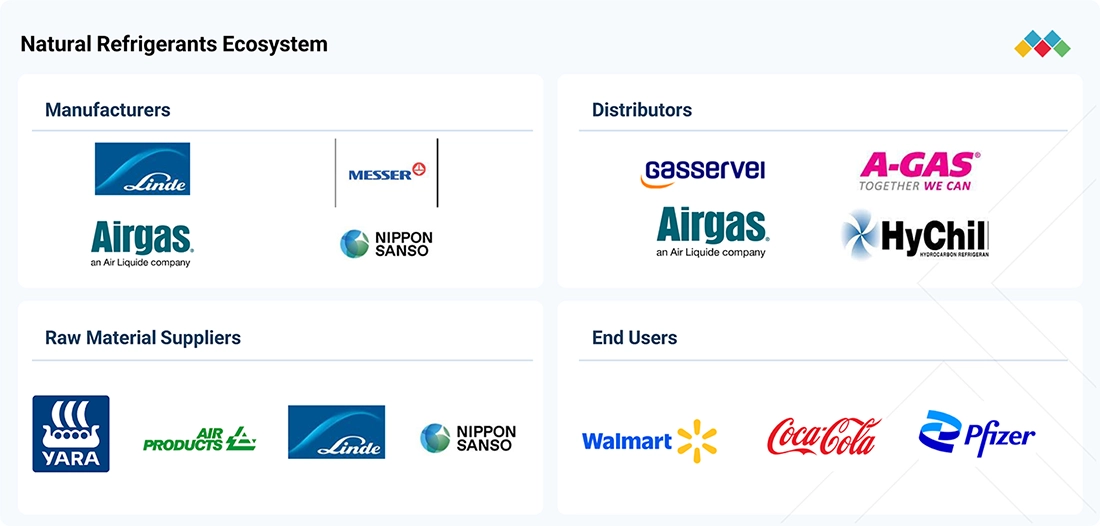
The natural refrigerants market operates through an extensive value chain comprising material and feedstock suppliers, refrigerant producers, gas processors and purifiers, refrigerant distributors, refrigeration equipment manufacturers, refrigeration system integrators, contractors, and OEMs serving end uses such as commercial refrigeration, industrial refrigeration, domestic refrigeration, stationary air conditioning, heat pumps, food processing, cold chain, supermarkets, and industrial process cooling. Natural refrigerants available in the market include ammonia (R717), carbon dioxide (R744), hydrocarbons such as propane (R290), butane (R600), and isobutane (R600a), as well as water and air. Value-added services in the market include refrigerant recovery and reclaim, design and engineering of refrigeration systems, charging and commissioning of refrigeration systems, leak detection, equipment installation and maintenance, safety inspections, technical support, energy efficiency, and retrofit services. Natural refrigerant and refrigeration equipment manufacturing facilities are primarily located in Asia Pacific, Europe, and North America, driven by the presence of key refrigerant producers and refrigeration equipment manufacturers, strict regulations on synthetic high-GWP refrigerants, increasing adoption of low-GWP refrigerants, cold chain infrastructure investments, supermarket refrigeration, food processing, industrial refrigeration, heat pumps, and energy-efficient HVAC&R systems.
Logos and trademarks shown above are the property of their respective owners. Their use here is for informational and illustrative purposes only.
Source: Secondary Research, Interviews with Experts, MarketsandMarkets Analysis
The market for natural refrigerants is classified by type into ammonia, hydrocarbon, CO2, and other refrigerants, with ammonia anticipated to command the largest market share. Ammonia's dominant position is due to its higher energy efficiency, no ozone depletion potential (ODP), and no global warming potential (GWP). It is used as a refrigerant in large-scale industrial refrigeration owing to its thermodynamic advantages, which make the system work efficiently at larger capacities. Additionally, the phasing out of synthetic refrigerants with high GWP and the rising use of refrigeration systems with low GWP are also contributing to the demand for ammonia refrigerants.
The natural refrigerant market is segmented by application into commercial refrigeration, industrial refrigeration, domestic refrigeration, stationary air conditioning, mobile air conditioning, and others, with industrial refrigeration expected to hold the largest market share. Industrial refrigeration's leading position stems from the widespread adoption of ammonia (R717) and carbon dioxide (R744) in systems with large cooling capacities. This trend is evident across the food processing industry, cold storage, meat & poultry processing plants, dairy, beverages, pharmaceutical, chemical, and other sectors. Natural refrigerants offer good thermodynamic properties, are highly energy-efficient, and have longer operating lifespans, making them well suited for continuous, high-capacity refrigeration operations. Moreover, the development of the cold chain, rising demand for processed and temperature-sensitive products, and investments in food processing and refrigerated storage warehouses are driving the adoption of industrial refrigeration systems. The phasing down of high-GWP synthetic refrigerants and a growing focus on energy efficiency are further promoting the adoption of ammonia and CO2 refrigeration systems.
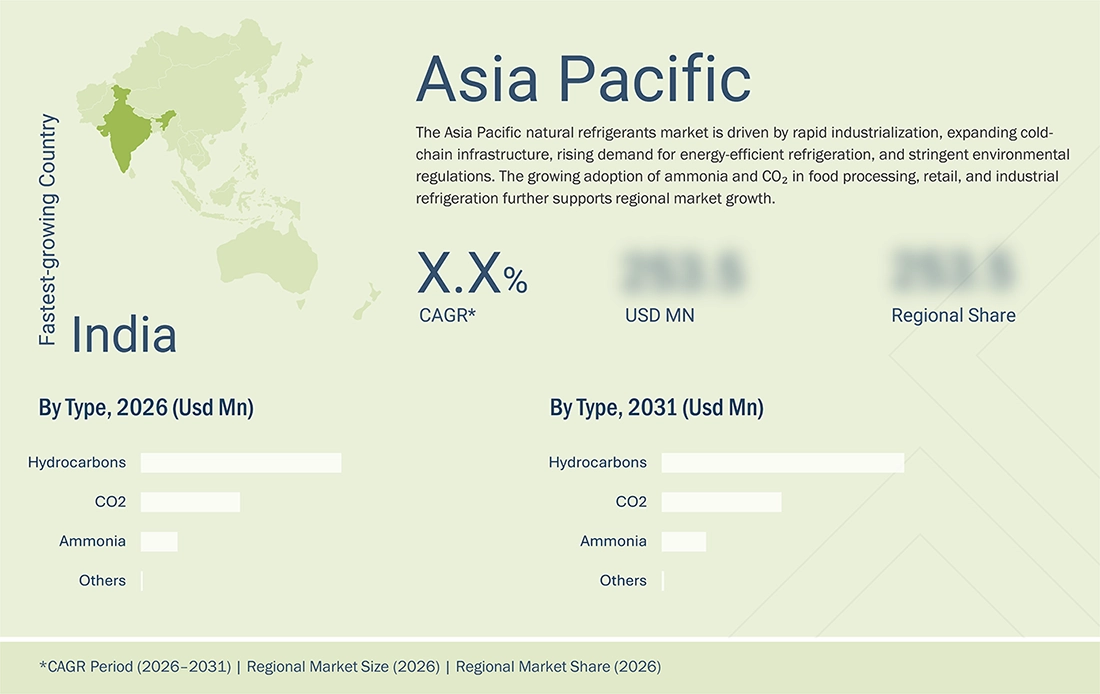
The Asia Pacific region is expected to grow at the fastest rate in the natural refrigerants industry, driven by rapid industrialization, cold chain development, and the growing need for energy-efficient cooling systems. Nations such as China, India, Japan, South Korea, and Australia are investing in food processing, supermarkets, cold storage, pharmaceuticals, and logistics, driving demand for natural-refrigerant systems. Regulatory efforts to reduce the use of high-GWP refrigerants, along with international efforts to phase out hydrofluorocarbons (HFCs), are another factor helping the adoption of ammonia, CO2, and hydrocarbons.
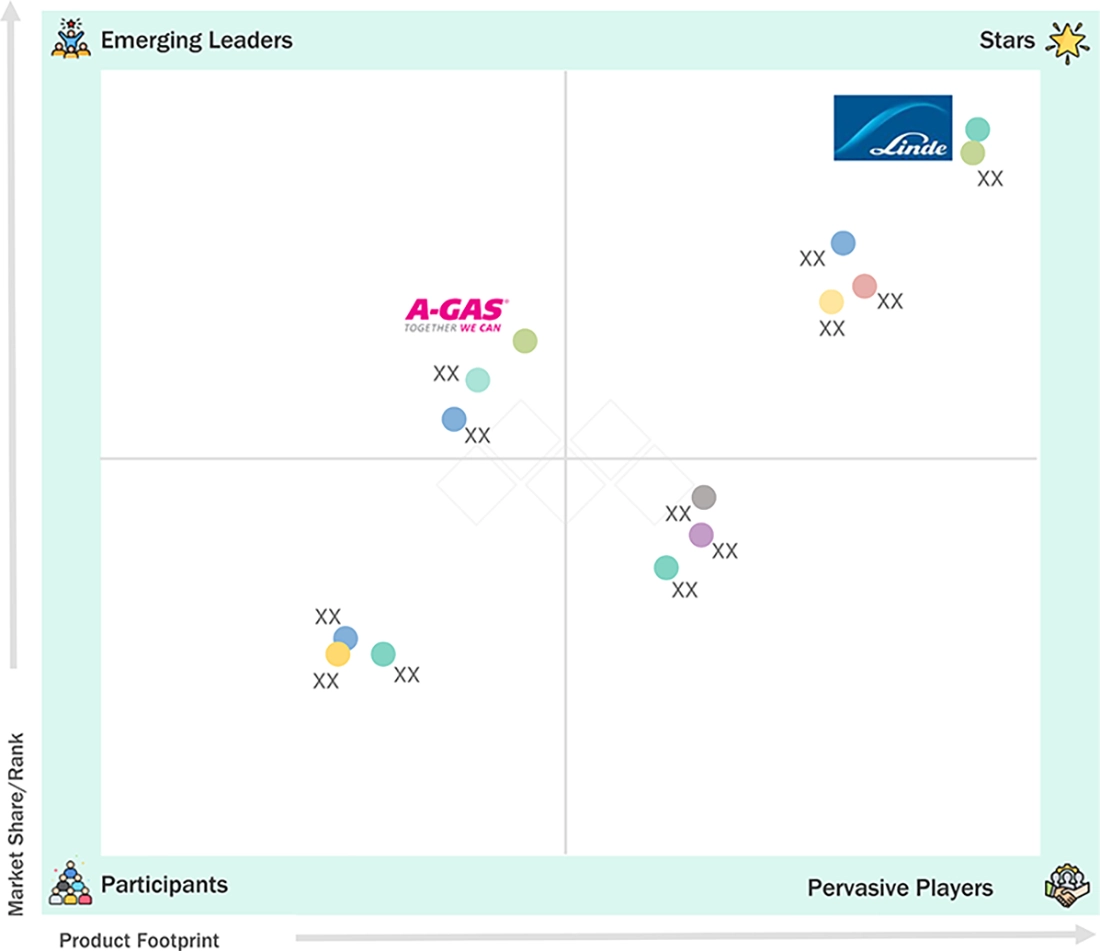
Linde plc is considered a leader in this industry due to several factors, including the wide range of industrial gases used (ammonia, carbon dioxide), a strong production and distribution infrastructure, technical expertise, and a strong global market presence. Linde serves end-user industries such as food processing, cold storage, industrial refrigeration, and chemicals, among others, that require a constant supply of refrigerants. With strong manufacturing and application engineering skills and a broad distribution network, Linde plc can provide customers with solutions for the supply of natural refrigerants. An emerging player in this industry is A-Gas International Ltd., which focuses on the supply, recovery, reclamation, and lifecycle management of refrigerants, including natural ones such as hydrocarbons and CO2. A-Gas International Ltd. is building its leadership position through skills in refrigerant recovery and reclamation and circular refrigerant management.
Source: Secondary Research, Interviews with Experts, MarketsandMarkets Analysis
| REPORT METRIC | DETAILS |
|---|---|
| Market Size in 2025 (Value) | USD 1.91 Billion |
| Market Forecast in 2026 (Value) | USD 2.10 Billion |
| Market Forecast in 2031 (value) | USD 3.32 Billion |
| Growth Rate | CAGR of 9.5% from 2026–2031 |
| Years Considered | 2022–2031 |
| Base Year | 2025 |
| Forecast Period | 2026–2031 |
| Units Considered | Value (USD Billion), Volume (Kiloton) |
| Report Coverage | Revenue Forecast, Company Ranking, Competitive Landscape, Growth Factors, and Trends |
| Segments Covered |
|
| Regions Covered | North America, Asia Pacific, Europe, South America, Middle East & Africa |
We have successfully delivered the following deep-dive customizations:
| CLIENT REQUEST | CUSTOMIZATION DELIVERED | VALUE ADDS |
|---|---|---|
| Demand for country-specific market insights | Provided in-depth analysis of natural refrigerant demand, regulatory frameworks, adoption trends, and market opportunities across key countries in North America, Europe, Asia Pacific, Latin America, and the Middle East & Africa | Helps clients identify high-growth regional markets, understand country-level adoption patterns, assess investment opportunities, and develop market-entry and expansion strategies |
| Request for competitor benchmarking | Delivered comprehensive benchmarking of natural refrigerant companies, covering refrigerant portfolios, production and distribution capabilities, geographic presence, recovery and reclamation activities, partnerships, expansions, and recent developments | Enables competitive positioning, identification of market gaps, evaluation of strategic partnerships, and development of differentiated business strategies |
| Application- and industry-specific insights | Provided detailed analysis of natural refrigerant adoption across commercial refrigeration, industrial refrigeration, domestic refrigeration, stationary air conditioning, mobile air conditioning, and other applications, with a focus on industries such as food & beverage, cold chain, retail, and industrial processing | Supports product portfolio optimization, identifies high-potential application areas, and helps companies align strategies with evolving refrigeration and cooling requirements |
| Technology and refrigerant-type analysis | Evaluated adoption trends and technological developments across ammonia, hydrocarbons, CO2, and other natural refrigerants, including system efficiency, safety considerations, charge requirements, and suitability across different refrigeration applications | Supports technology selection, product development, innovation planning, and identification of emerging opportunities in low-GWP refrigeration technologies |
| Regulatory and sustainability assessment | Provided detailed analysis of global and regional regulations, HFC phase-down initiatives, GWP restrictions, refrigerant transition policies, safety standards, and sustainability requirements affecting natural refrigerant adoption | Helps clients anticipate regulatory changes, support compliance planning, assess transition opportunities from synthetic refrigerants, and develop sustainable refrigeration strategies |
 Exclusive indicates content/data unique to MarketsandMarkets and not available with any competitors.
TITLE
PAGE NO
1
INTRODUCTION
15
2
EXECUTIVE SUMMARY
3
PREMIUM INSIGHTS
4
MARKET OVERVIEW
Explains the evolving landscape through demand-side drivers, supply-side constraints, and opportunity hotspots.4.1
INTRODUCTION
4.2
MARKET DYNAMICS
4.2.1
DRIVERS
4.2.2
RESTRAINTS
4.2.3
OPPORTUNITIES
4.2.4
CHALLENGES
4.3
UNMET NEEDS AND WHITE SPACES
4.4
INTERCONNECTED MARKETS AND CROSS-SECTOR OPPORTUNITIES
4.5
STRATEGIC MOVES BY TIER-1/2/3 PLAYERS
5
INDUSTRY TRENDS
Captures industry movement, adoption patterns, and strategic signals across key end-use segments and regions.5.1
PORTER’S FIVE FORCES ANALYSIS
5.2
MACROECONOMIC OUTLOOK
5.2.1
INTRODUCTION
5.2.2
GDP TRENDS AND FORECAST
5.2.3
TRENDS IN FOOD & BEVERAGE INDUSTRY
5.2.4
TRENDS IN PHARMACEUTICAL INDUSTRY
5.3
VALUE CHAIN ANALYSIS
5.4
ECOSYSTEM ANALYSIS
5.5
PRICING ANALYSIS
5.5.1
AVERAGE SELLING PRICE TREND, BY TYPE (2023–2025)
5.5.2
AVERAGE SELLING PRICE TREND, BY NATURAL REFRIGERANTS APPLICATION, BY KEY PLAYERS (2023–2025)
5.5.3
AVERAGE SELLING PRICE TREND, BY REGION (2023–2025)
5.6
TRADE ANALYSIS
5.6.1
IMPORT SCENARIO (HS CODE 281410)
5.6.2
EXPORT SCENARIO (HS CODE 281410)
5.7
KEY CONFERENCES AND EVENTS, 2026–2027
5.8
TRENDS/DISRUPTIONS IMPACTING CUSTOMER BUSINESS
5.9
INVESTMENT AND FUNDING SCENARIO
5.10
CASE STUDY ANALYSIS
5.11
IMPACT OF 2025 US TARIFF – NATURAL REFRIGERANTS MARKET
5.11.1
INTRODUCTION
5.11.2
KEY TARIFF RATES
5.11.3
PRICE IMPACT ANALYSIS
5.11.4
IMPACT ON COUNTRIES/REGIONS
5.11.4.1
US
5.11.4.2
EUROPE
5.11.4.3
ASIA PACIFIC
5.11.5IMPACT ON END-USE INDUSTRIES
6
TECHNOLOGICAL ADVANCEMENTS, AI-DRIVEN IMPACT, PATENTS, INNOVATIONS, AND FUTURE APPLICATIONS
6.1
KEY EMERGING TECHNOLOGIES
6.2
COMPLEMENTARY TECHNOLOGIES
6.3
ADJACENT TECHNOLOGIES
6.4
TECHNOLOGY/PRODUCT ROADMAP
6.5
PATENT ANALYSIS
6.6
FUTURE APPLICATIONS
6.7
IMPACT OF AI/GEN AI ON NATURAL REFRIGERANTS MARKET
6.6.1
TOP USE CASES AND MARKET POTENTIAL
6.6.2
BEST PRACTICES IN NATURAL REFRIGERANTS MANUFACTURERS
6.6.3
CASE STUDIES OF AI IMPLEMENTATION IN NATURAL REFRIGERANTS MARKET
6.6.4
INTERCONNECTED ECOSYSTEM AND IMPACT ON MARKET PLAYERS
6.6.5
CLIENTS’ READINESS TO ADOPT AI IN NATURAL REFRIGERANTS MARKET
7
REGULATORY LANDSCAPE AND SUSTAINABILITY INITIATIVES
7.1
REGIONAL REGULATIONS AND COMPLIANCE
7.1.1
REGULATORY BODIES, GOVERNMENT AGENCIES, AND OTHER ORGANIZATIONS
7.1.2
INDUSTRY STANDARDS
7.2
SUSTAINABILITY INITIATIVES
7.3
IMPACT OF REGULATORY POLICIES ON SUSTAINABILITY INITIATIVES
8
CUSTOMER LANDSCAPE & BUYER BEHAVIOR
8.1
INTRODUCTION
8.2
DECISION-MAKING PROCESS
8.3
KEY STAKEHOLDERS INVOLVED IN BUYING PROCESS AND THEIR EVALUATION CRITERIA
8.3.1
KEY STAKEHOLDERS IN BUYING PROCESS
8.3.2
BUYING CRITERIA
8.4
ADOPTION BARRIERS & INTERNAL CHALLENGES
8.5
UNMET NEEDS FROM VARIOUS END-USE INDUSTRIES
8.6
MARKET PROFITABILITY
9
NATURAL REFRIGERANTS MARKET, BY TYPE [MARKET SIZE & FORECAST TO 2031 – IN VALUE (USD MILLION) & VOLUME (KILOTON)]
COMPARATIVE ASSESSMENT OF KEY TYPES, THEIR MARKET POTENTIAL, AND DEMAND PATTERNS
9.1
INTRODUCTION
9.2
AMMONIA REFRIGERANTS
9.3
HYDROCARBON REFRIGERANTS
9.4
CO2 REFRIGERANTS
9.5
OTHER REFRIGERANTS
10
NATURAL REFRIGERANTS MARKET, BY APPLICATION [MARKET SIZE & FORECAST TO 2031 – IN VALUE (USD MILLION) & VOLUME (KILOTON)]
DEMAND POTENTIAL AND GROWTH PATHWAYS SHAPING ADOPTION OF NATURAL REFRIGERANTS IN VARIOUS APPLICATIONS IN MARKET
10.1
INTRODUCTION
10.2
COMMERCIAL REFRIGERATION
10.3
INDUSTRIAL REFRIGERATION
10.4
DOMESTIC REFRIGERATION
10.5
STATIONARY AIR CONDITIONING
10.6
MOBILE AIR CONDITIONING
10.7
OTHER APPLICATIONS
11
NATURAL REFRIGERANTS MARKET, BY REGION [MARKET SIZE & FORECAST TO 2031 – IN VALUE (USD MILLION) & VOLUME (KILOTON)]
ASSESSING GROWTH PATTERNS, INDUSTRY FORCES, REGULATORY LANDSCAPE, AND MARKET POTENTIAL ACROSS KEY GEOGRAPHIES AND COUNTRIES
15
.1 INTRODUCTION
15
.2 ASIA PACIFIC
15
.2.1 CHINA
15
.2.2 JAPAN
15
.2.3 INDIA
15
.2.4 SOUTH KOREA
15
.2.5 REST OF ASIA PACIFIC
15
.3 NORTH AMERICA
15
.3.1 US
15
.3.2 CANADA
15
.3.3 MEXICO
15
.4 EUROPE
15
.4.1 GERMANY
15
.4.2 FRANCE
15
.4.3 UK
15.4.4
ITALY
11.4.5
SPAIN
15
.4.6 REST OF EUROPE
15
.5 SOUTH AMERICA
15
.5.1 BRAZIL
15
.5.2 ARGENTINA
15
.5.3 REST OF SOUTH AMERICA
15
.6 MIDDLE EAST & AFRICA
15
.6.1 GCC COUNTRIES
15
.6.1.1 SAUDI ARABIA
15
.6.1.2 OTHER GCC COUNTRIES
15
.6.2 SOUTH AFRICA
15
.6.3 REST OF MIDDLE EAST & AFRICA
13
COMPETITIVE LANDSCAPE
STRATEGIC ASSESSMENT OF LEADING PLAYERS, MARKET SHARE, REVENUE ANALYSIS, COMPANY POSITIONING, AND COMPETITIVE BENCHMARKS INFLUENCING MARKET POTENTIAL
13.1
OVERVIEW
13.2
KEY PLAYER COMPETITIVE STRATEGIES/RIGHT TO WIN (2022–2026)
13.3
REVENUE ANALYSIS (2023–2025)
13.4
MARKET SHARE ANALYSIS (2025)
13.5
PRODUCT COMPARISON
13.6
COMPANY EVALUATION MATRIX: KEY PLAYERS,
13.6.1
STARS
13.6.2
EMERGING LEADERS
13.6.3
PERVASIVE PLAYERS
13.6.4
PARTICIPANTS
13.6.5
COMPANY FOOTPRINT: KEY PLAYERS,
13.6.5.1
COMPANY FOOTPRINT
13.6.5.2
REGION FOOTPRINT
13.6.5.3
TYPE FOOTPRINT
13.6.5.4
APPLICATION FOOTPRINT
13.7
COMPANY EVALUATION MATRIX: STARTUPS/SMES,
13.7.1
PROGRESSIVE COMPANIES
13.7.2
RESPONSIVE COMPANIES
13.7.3
DYNAMIC COMPANIES
13.7.4
STARTING BLOCKS
13.7.5
COMPETITIVE BENCHMARKING: STARTUPS/SMES,
13.7.5.1
DETAILED LIST OF KEY STARTUPS/SMES
13.7.5.2
COMPETITIVE BENCHMARKING OF KEY STARTUPS/SMES
13.8
COMPANY VALUATION AND FINANCIAL METRICS
13.9
COMPETITIVE SCENARIO
13.9.1
PRODUCT LAUNCHES
13.9.2
DEALS
13.9.3
EXPANSIONS
14
COMPANY PROFILES
IN-DEPTH REVIEW OF COMPANIES, PRODUCTS, SERVICES, RECENT INITIATIVES, AND POSITIONING STRATEGIES IN NATURAL REFRIGERANTS MARKET LANDSCAPE
14.1
KEY PLAYERS
14.1.1
AIRGAS INC
14.1.1.1
BUSINESS OVERVIEW
14.1.1.2
PRODUCTS/SOLUTIONS/SERVICES OFFERED
14.1.1.3
MNM VIEW
14.1.1.3.1
RIGHT TO WIN
14.1.1.3.2
STRATEGIC CHOICES
14.1.1.3.3
WEAKNESSES/COMPETITIVE THREATS
14.1.2
LINDE PLC
14.1.2.1
BUSINESS OVERVIEW
14.1.2.2
PRODUCTS/SOLUTIONS/SERVICES OFFERED
14.1.2.3
MNM VIEW
14.1.2.3.1
RIGHT TO WIN
14.1.2.3.2
STRATEGIC CHOICES
14.1.2.3.3
WEAKNESSES/COMPETITIVE THREATS
14.1.3
MESSER GROUP
14.1.3.1
BUSINESS OVERVIEW
14.1.3.2
PRODUCTS/SOLUTIONS/SERVICES OFFERED
14.1.3.3
MNM VIEW
14.1.3.3.1
RIGHT TO WIN
14.1.3.3.2
STRATEGIC CHOICES
14.1.3.3.3
WEAKNESSES/COMPETITIVE THREATS
14.1.4
NIPPON SANSO
14.1.4.1
BUSINESS OVERVIEW
14.1.4.2
PRODUCTS/SOLUTIONS/SERVICES OFFERED
14.1.4.3
MNM VIEW
14.1.4.3.1
RIGHT TO WIN
14.1.4.3.2
STRATEGIC CHOICES
14.1.4.3.3
WEAKNESSES/COMPETITIVE THREATS
14.1.5
IWATANI CORPORATION
14.1.5.1
BUSINESS OVERVIEW
14.1.5.2
PRODUCTS/SOLUTIONS/SERVICES OFFERED
14.1.5.3
MNM VIEW
14.1.5.3.1
RIGHT TO WIN
14.1.5.3.2
STRATEGIC CHOICES
14.1.5.3.3
WEAKNESSES/COMPETITIVE THREATS
14.1.6
EVONIK
14.1.7
ENGAS AUSTRALIA
14.1.8
HARP INTERNATIONAL LTD
14.1.9
PUYANG ZHONGWEI FINE CHEMICAL CO., LTD
14.1.10
SHANDONG YUEAN CHEMICAL INDUSTRY CO., LTD
14.1.11
A-GAS INTERNATIONAL LIMITED
14.1.12
HYCHILL AUSTRALIA
14.2
OTHER PLAYERS
15
RESEARCH METHODOLOGY
15.1
RESEARCH DATA
15.1.1
SECONDARY DATA
15.1.1.1
KEY DATA FROM SECONDARY SOURCES
15.1.1.2
LIST OF KEY SECONDARY SOURCES
15.1.2
PRIMARY DATA
15.1.2.1
KEY DATA FROM PRIMARY SOURCES
15.1.2.2
KEY PRIMARY PARTICIPANTS
15.1.2.3
BREAKDOWN OF PRIMARY INTERVIEWS
15.1.2.4
KEY INDUSTRY INSIGHTS
15.2
MARKET SIZE ESTIMATION
15.2.1
BOTTOM-UP APPROACH
15.2.2
TOP-DOWN APPROACH
15.2.3
MARKET SIZE CALCULATION FOR BASE YEAR
15.3
MARKET FORECAST APPROACH
15.3.1
SUPPLY SIDE
15.3.2
DEMAND SIDE
15.4
DATA TRIANGULATION
15.5
FACTOR ANALYSIS
15.6
RESEARCH ASSUMPTIONS AND LIMITATIONS
15.7
RISK ASSESSMENT
16
APPENDIX
16.1
DISCUSSION GUIDE
16.2
KNOWLEDGESTORE: MARKETSANDMARKETS’ SUBSCRIPTION PORTAL
16.3
CUSTOMIZATION OPTIONS
16.4
RELATED REPORTS
16.5
AUTHOR DETAILS
The study involves two major activities to estimate the current market size for natural refrigerants. Exhaustive secondary research was conducted to collect information on the market, peer market, and parent market. The next step was to validate these findings, assumptions, and sizing with industry experts across the value chain through primary research. Both top-down and bottom-up approaches were employed to estimate the total market size. After that, market breakdown and data triangulation were used to estimate the market size of segments and subsegments.
Secondary ResearchSecondary sources for this research study include financial statements of companies offering natural refrigerants and information from various trade, business, and professional associations. Secondary research was used to obtain critical information about the industry’s value chain, the total pool of key players, market classification, and segmentation by industry trends down to the bottom-most level and by regional markets. Secondary data were collected and analyzed to determine the overall size of the natural refrigerants market, which was validated by primary respondents.
Primary ResearchExtensive primary research was conducted after gathering information on the natural refrigerants market through secondary research. Several primary interviews were conducted with market experts from both the demand and supply sides across major countries in North America, Europe, Asia-Pacific, the Middle East & Africa, and South America. Primary data was collected through questionnaires, emails, and telephonic interviews. Primary sources from the supply side included industry experts such as chief executive officers (CXOs), vice presidents (VPs), directors from business development, marketing, and product development/innovation teams, and related key executives from natural refrigerants industry vendors; material providers; distributors; and key opinion leaders. Primary interviews were conducted to gather insights into market statistics, revenue from products and services, market breakdowns, market size estimates, market forecasting, and data triangulation. Primary research also helped in understanding the various trends related to type, application, and region. Stakeholders from the demand side, such as CIOs, CTOs, CSOs, and installation teams of customer/end users who are seeking natural refrigerants, were interviewed to understand the buyer’s perspective on suppliers and products, their current usage of natural refrigerants, and the future outlook of their business, which will affect the overall market.
The Breakup of Primary Research:

To know about the assumptions considered for the study, download the pdf brochure
The research methodology used to estimate the size of the natural refrigerants market includes the following details. Market sizing was undertaken from the demand side. The market was upsized based on demand for natural refrigerants across different end-use industries at the regional level. These procurement data provide information on the demand aspects of the natural refrigerants industry for each end-use industry. For each end use, all possible segments of the natural refrigerants market were integrated and mapped.
Natural Refrigerants Market : Top-Down and Bottom-Up Approach
After determining the overall market size through the market size estimation process described above, the total market was segmented into several segments and subsegments. The data triangulation and market breakdown procedures described below were implemented, wherever applicable, to complete the overall market engineering process and arrive at the exact statistics for various market segments and subsegments. The data was triangulated by analyzing factors and trends from both the demand and supply sides. In addition, the market size was validated using both the top-down and bottom-up approaches.
The natural refrigerants market comprises substances that occur naturally and are used as substitutes for artificial refrigerants in refrigeration, air conditioning, heat pumps, and cooling equipment. They include ammonia (NH3), carbon dioxide (CO2), hydrocarbons such as propane, butane, and isobutane, as well as other natural refrigerants such as water and air. These are employed in various fields, including commercial, industrial, and domestic refrigeration, as well as stationary and mobile air conditioning. Growth in the industry is expected on account of their low global warming potential (GWP) values and good environmental profile, the phase-down of high-GWP refrigerants, energy-efficiency requirements, and the growing trend toward sustainable cooling technologies across the globe.
MarketsandMarkets offers the following customizations for this market report:
Product matrix, which provides a detailed comparison of the product portfolio of each company’s market


We at Nissan Chemicals Corporation have been clients of MarketsandMarkets for more than a year now. We recently consulted MarketsandMarkets for a study, the team at MarketsandMarkets was extremely professional and organized. The business insights were very detailed and aligned well with our expectations that really helped us formulate the Business Plans and device new strategies for development themes. MarketsandMarkets offers a unique combination of expertise and dedicated engagement model. Their research findings have helped us in designing our Pricing Strategy which will make it easier for us to predict the future sales and profits for the next ten years. We look forward to working with MarketsandMarkets in the future.
The MarketsandMarkets Engagement Model, composed of both the Knowledge Store and advisory custom research, has greatly helped us in understanding our markets and making strategic decisions. The Knowledge Store is a fast way to allow everyone in our organization to understand more about most any market they are interested in. The ability to then get custom research done and get answers to specific strategic questions and market insight has been spectacular. The Markets and Markets team feel more like colleagues than vendors and their services have helped us change our culture where statements of things like growth opportunities and competitive position are always backed by industry research.

Director, Corporate Strategy
Leading Industrial Manufacturer of specialty chemical, floor covering, performance and protective textile materials, and healthcare
MarketsandMarkets is a trusted resource that helps us to better understand markets that are near-adjacencies-whether its technology, value chain or geography. Their Knowledge Store platform provides a dashboard of markets and their characteristics which is easy to use and saves us time.
Market Development and Strategy Manager
An American Leader in Chemicals
The Knowledge Store from MarketsandMarkets is a valuable tool which has helped my team acquire greater insight in to the end markets that our business serves. This has enabled us to help our company build stronger strategies throughout our planning process.
Senior Chif Consultion Research & Consulting Division
Leading Manufacturer of Chemical Products

We recently engaged with MarketsandMarkets for a study, the team not only clearly understood our business objectives but was also extremely professional in the way they handled the entire project. The study was efficiently conducted in a phase-wise manner, and the engagement model furnished us with high-quality business insights that far exceeded our expectations at each phase. We were especially happy that MarketsandMarkets could provide us with both, an English as well as a Japanese version of the study. A special thanks to the Analyst Team and Client Services Team, whose fluency in Japanese enhanced our comfort level, as we could converse with them in our preferred language.
We approached MarketsandMarkets for study on Proppants Market, and their work exceeded our expectations. The study conducted was comprehensive and enabled us to view the market through the various dimensions. In addition, the team was extraordinarily responsive throughout the process and resolved our queries on time. I strongly recommend MarketsandMarkets and will certainly consider them for additional market assessments we will need in the future.
Strategic Planning Office
The high-quality insights shared by the MarketsandMarkets team helped us understand the pharmaceutical plant designers in a specific geography. It also captured the risks that we may likely face in communicating with our potential partners. The study would enable us identify partners, which would impact our future growth.