Просмотр новости
Найдите то, что Вас интересует
 Спутники
 РН
РН SpaceX
 Роскосмос
 NASA
NASA
СпутникиРНSpaceXРоскосмосNASA
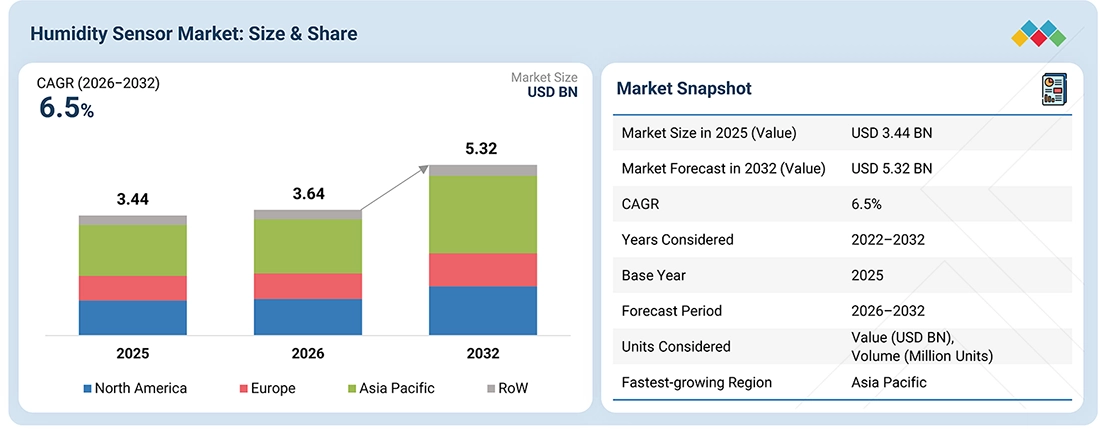
USD USD 5.32 BN
MARKET SIZE, 2032

CAGR 6.5%
(2026-2032)

250
REPORT PAGES

160
MARKET TABLES
According to Marketsandmarkets, the global humidity sensor market size is projected to grow from USD 3.64 billion in 2026 to USD 5.32 billion by 2032, growing at a CAGR of 6.5% from 2026 to 2032. The demand for humidity sensors is primarily driven by the deployment of building automation and heating, ventilation, and air conditioning systems. These environments require precise moisture measurement for climate control and indoor air quality regulation. The integration of industrial process control systems is further driving sensor demand. Manufacturing applications like pharmaceutical processing and chemical production require accurate absolute humidity control to maintain optimal production conditions. Additionally, the transition toward Industry 4.0 creates a requirement for automated real-time moisture compensation across enterprise operations.
| REPORT METRIC | DETAILS |
|---|---|
| Market Size in 2025 (Value) | USD 3.44 Billion |
| Market Size in 2026 (Value) | USD 3.64 Billion |
| Market Forecast in 2032 (Value) | USD 5.32 Billion |
| Growth Rate | CAGR of 6.5% from 2026–2032 |
| Years Considered | 2022–2032 |
| Base Year | 2025 |
| Forecast Period | 2026–2032 |
| Units Considered | Value (USD Billion), Volume (Million Units) |
| Report Coverage | Revenue forecast, company ranking, competitive landscape, growth factors, and trends |
| Top Companies |
|
| Growth Drivers |
|
| Segments Covered |
|
| Regional Scope | North America, Europe, Asia Pacific, and RoW |
Humidity Sensor MARKET, BY REGION
By region, Asia Pacific is expected to record the highest CAGR in the humidity sensor market during the forecast period.
Humidity Sensor MARKET, BY Type
By type, the capacitive segment is expected to dominate the market throughout the forecast period.
Humidity Sensor MARKET, BY Measurement Technique
By measurement technique, the absolute segment is expected to record the fastest CAGR during the forecast period.
Humidity Sensor MARKET, BY End User Application
The environmental monitoring segment is expected to register the highest CAGR in the humidity sensor market, by end-use application, during the forecast period.
COMPETITIVE LANDSCAPE - KEY PLAYERS
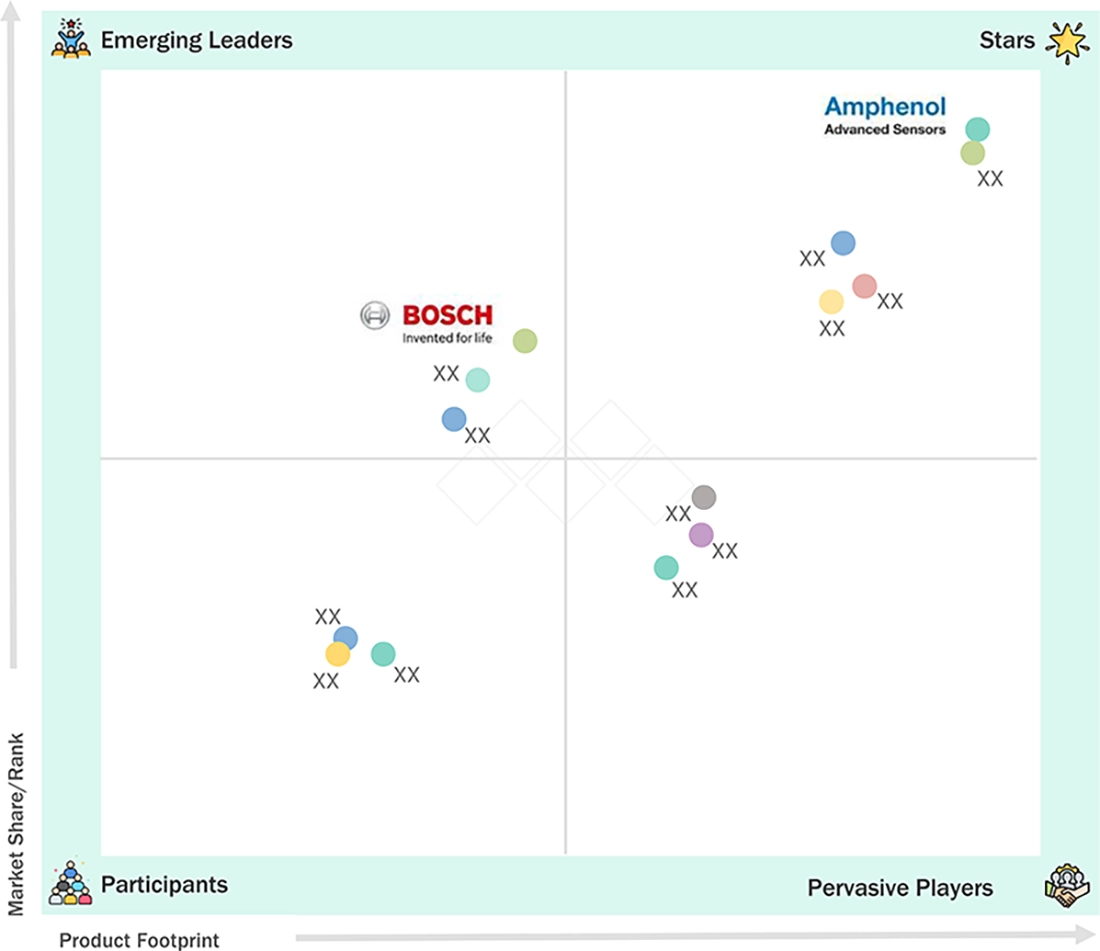
Amphonol Advanced Sensors (US), Honeywell International Inc. (US), Texas Instruments Incorporation (US), Setra Systems (US), and Sensirion AG (Switzerland) were identified as some of the star players in the global humidity sensor market, given their strong market share and product footprint.
COMPETITIVE LANDSCAPE - STARTUPS/SMES
AVTECH Software, Inc. (US), Novosense (China), Dickson (US), Sensoterra (Netherlands), and Viridix (Israel) among others have established themselves as specialized players in the humidity sensor market by focusing on high-performance materials and application-specific solutions.
The growth of the humidity sensor industry is being accelerated by the expansion of industrial automation and real time environmental data monitoring across enterprises. This leads to an increase in connected sensing nodes per individual facility. As accuracy tolerances tighten and building control architectures become decentralized, traditional analog sensing approaches are being replaced. Enterprise operators are adopting advanced technologies such as microelectromechanical systems (MEMS) sensors, CMOSens platforms, and integrated digital bus communication architectures. This technological transition expands the overall market value. Emerging applications include smart heating ventilation and air conditioning automation, automotive climate and anti-fogging control, medical cold chain monitoring, and cleanroom environmental regulation.
Source: Secondary Research, Interviews with Experts, MarketsandMarkets Analysis
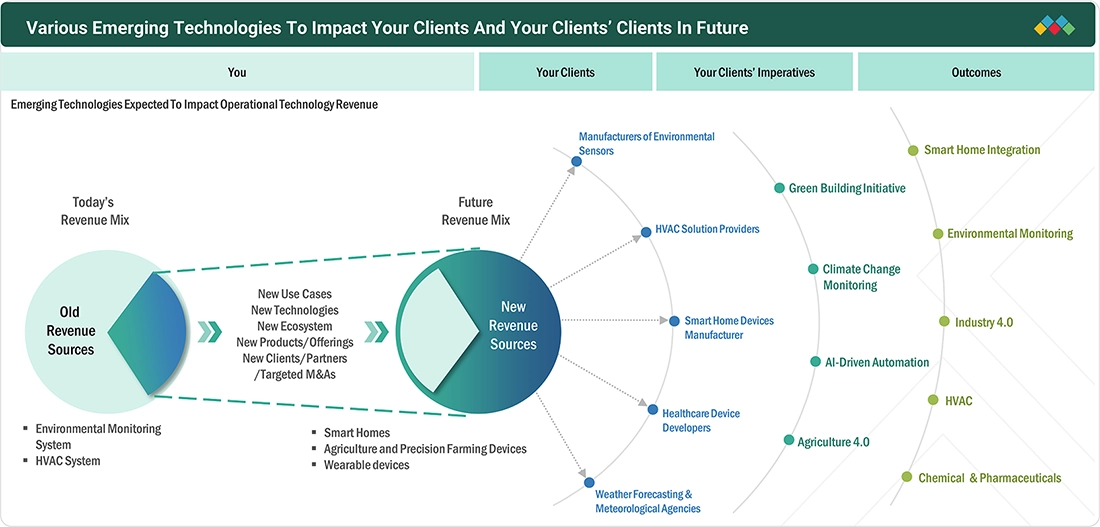
Humidity sensors are being shaped as companies replace traditional technology applications such as standalone environmental monitoring systems and basic HVAC setups. Operational technology providers are adopting new technology architectures. These include miniaturized MEMS sensors, connected modules for smart homes, agriculture and precision farming devices, and wearable electronics. This shift requires customized infrastructure integration for specific client operations. These clients operate across environmental sensor manufacturing, HVAC solution provision, smart home device manufacturing, healthcare device development, and weather forecasting or meteorological agencies. The new sensor architectures address specific client imperatives. These imperatives include green building initiatives, climate change monitoring, AI-driven automation, and Agriculture 4.0 execution. The adoption of these components leads to direct operational outcomes. These outcomes include smart home integration, comprehensive environmental monitoring, Industry 4.0 expansion, optimized HVAC operation, and precision regulation across chemical and pharmaceutical processes.
Source: Secondary Research, Interviews with Experts, MarketsandMarkets Analysis

Drivers
Impact
Level



RESTRAINTS
Impact
Level



OPPORTUNITIES
Impact
Level



CHALLENGES
Impact
Level


Source: Secondary Research, Interviews with Experts, MarketsandMarkets Analysis
Modern facilities integrate sensors into automated HVAC units to regulate heating, ventilation, and moisture levels in real time. This automated airflow control stabilizes indoor environments, ensures strict building standard compliance, and minimizes baseline energy waste across commercial properties.
Airborne pollutants, dust particles, and volatile chemical vapors coat the polymer and ceramic sensing layers over time. This continuous surface fouling alters electrical capacitance or resistance, creates baseline signal drift, degrades accuracy, and necessitates costly periodic sensor recalibration.
Miniaturized microelectromechanical systems provide ultra compact footprints and minimal battery power consumption. These design characteristics allow consumer electronics developers to embed environmental monitoring nodes into connected smart home devices, health tracking wearables, and portable asset monitoring tags.
Sudden ambient temperature shifts and sorption desorption lag inside sensing films cause significant measurement distortion. Sensors often fail to restore baseline readings promptly after saturation, introducing persistent tracking errors that compromise precision in dynamic operating conditions.
| COMPANY | USE CASE DESCRIPTION | BENEFITS |
|---|---|---|
|
|
Amphenol deploys Telaire series humidity transmitters and ChipCap sensors for commercial HVAC systems and agricultural green houses. The devices monitor relative humidity and ambient temperature in high moisture air ducts, ventilation lines, and climate chambers. | Features field replaceable sensing tips to eliminate recalibration factory returns | Provides IP67 water resistant enclosures for washdown zones | Delivers standard Modbus and analog outputs for direct building management integration | Reduces long term maintenance downtime |
|
|
Honeywell integrates HumidIcon digital humidity and temperature sensors into medical ventilators, incubators, and server room climate modules. The components provide continuous digital measurement inside airflow delivery circuits and enclosed telecom cabinets. | Combines relative humidity and temperature output on a single chip | Delivers low drift rates of 1.2 percent relative humidity over five years | Uses multilayer thermoset polymer coatings to resist dust and chemical exposure | Lowers overall board assembly component count. |
|
|
Texas Instruments incorporates HDC series digital capacitive humidity sensors into smart thermostats, cold chain tracking tags, and industrial white goods. The ultra low power chips measure local relative humidity alongside integrated microcontrollers on local printed circuit boards. | Minimizes battery consumption with sub microampere active draw modes | Features integrated internal micro heating elements to evaporate surface condensation | Delivers factory calibrated digital I2C output without external signal conditioning | Enables compact footprint layouts for portable instruments. |
|
|
Setra Systems installs SRH series wall and duct mount humidity transmitters across pharmaceutical compounding suites, cleanrooms, and hospital isolation areas. The units operate alongside building automation controllers to verify positive pressure airflow and humidity thresholds. | Maintains compliance with cleanroom regulatory documentation standards | Prevents pathogen transmission through precise environmental tracking | Provides dual BACnet and Modbus communication compatibility | Incorporates ceramic capacitive elements with protective coatings against cleaning chemicals. |
|
|
Sensirion supplies SHT series CMOSens humidity and temperature sensors for automotive cabin anti-fogging systems and high volume consumer electronics. The integrated sensors monitor air intake humidity levels to feed predictive climate algorithm controllers. | Delivers fast response times down to a few seconds | Integrates sensor element and signal processing on one silicon die | Supports automated high volume reflow soldering processes | Maintains low unit failure rates under severe automotive thermal cycling. |
Logos and trademarks shown above are the property of their respective owners. Their use here is for informational and illustrative purposes only.
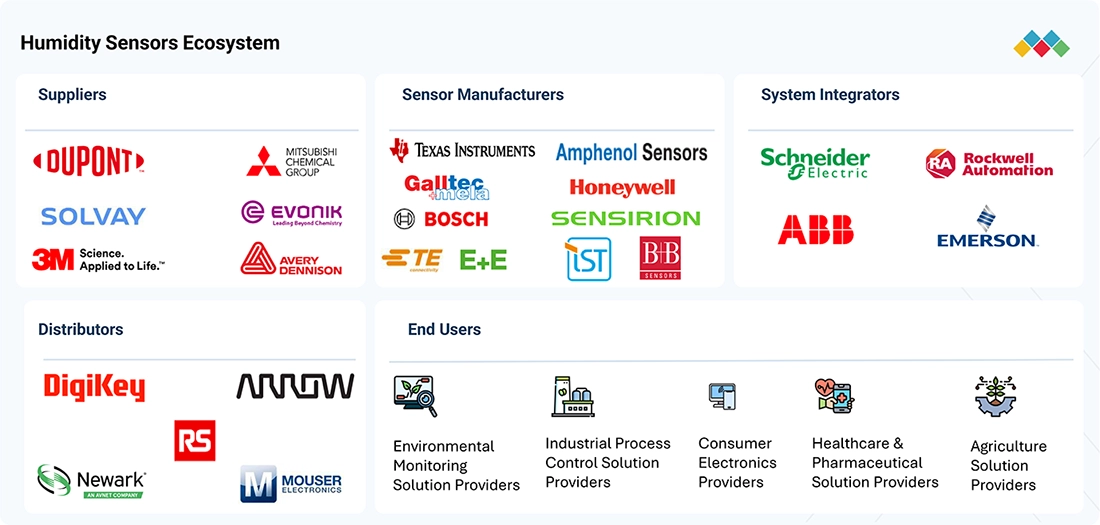
The humidity sensors ecosystem consists of raw material suppliers, sensor manufacturers, system integrators, component distributors, and end users. This structure forms a value chain supporting sensor component fabrication and commercial equipment deployment. Suppliers such as DuPont, Solvay, Evonik, 3M, Mitsubishi Chemical Group, and Avery Dennison supply core raw material inputs including polymers, chemical coatings, and specialized substrates. Sensor manufacturers including Texas Instruments, Honeywell, TE Connectivity, Amphenol Sensors, Sensirion, E+E Elektronik, Galltec Mela, Bosch, IST AG, and B+B Sensors fabricate these material inputs into sensing elements, digital integrated circuits, and packaged measurement modules. System integrators like Schneider Electric, Rockwell Automation, ABB, and Emerson manage equipment installation, software configuration, and automation integration to ensure continuous monitoring across operational facilities. Global distributors like DigiKey, Newark, Arrow, RS Components, and Mouser Electronics supply components to provide widespread product availability across international supply chains. End users deploy these tailored sensing instruments into daily operations across environmental monitoring solution providers, industrial process control solution providers, consumer electronics providers, healthcare and pharmaceutical solution providers, and agriculture solution providers.
Logos and trademarks shown above are the property of their respective owners. Their use here is for informational and illustrative purposes only.
Source: Secondary Research, Interviews with Experts, MarketsandMarkets Analysis
The capacitive humidity sensor segment holds the largest share and is projected to register the fastest growth. This architecture operates by measuring capacitance changes across a thin polymer or ceramic dielectric layer, utilizing integrated CMOS signal processing circuits to deliver high measurement accuracy, long term stability, and low power consumption. Enterprises across HVAC systems, automotive cabin control, and medical equipment favor capacitive humidity sensors to execute precise climate regulation and maintain strict process tolerances.
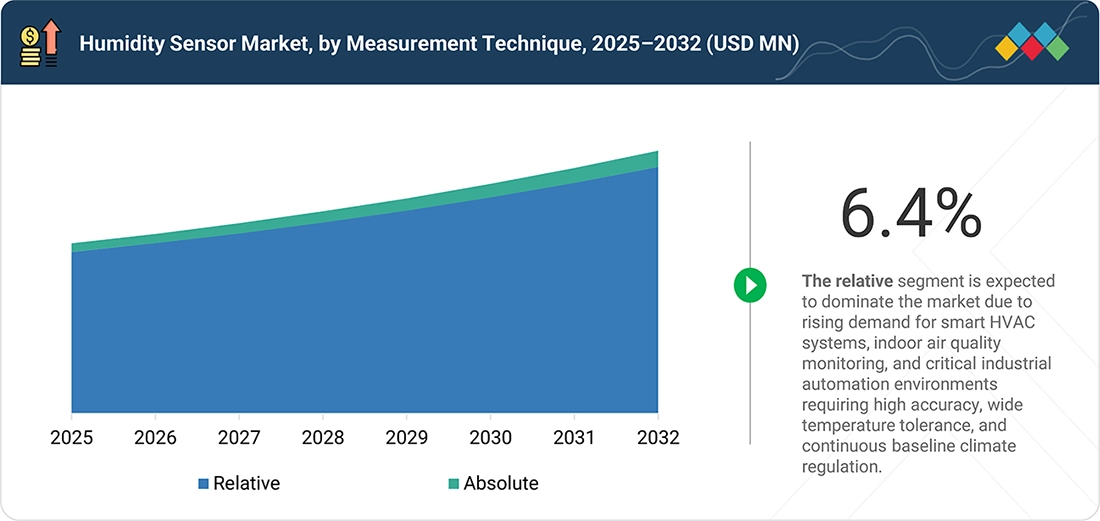
The relative humidity segment dominates the humidity sensor market. This measurement technique provides an optimal balance between temperature dependent moisture tracking, measurement accuracy, and integration cost. It is widely adopted across HVAC systems, pharmaceutical storage areas, and automotive passenger cabins where continuous environmental monitoring is required without complex gas volume compensation instrumentation.
The industrial process control segment holds the largest market share. Industrial facilities adopt dedicated humidity measurement instruments to monitor chemical reactions, cleanroom environments, and automated drying systems. Other expanding vertical sectors include heating ventilation and air conditioning, automotive, consumer electronics, healthcare, and precision agriculture.
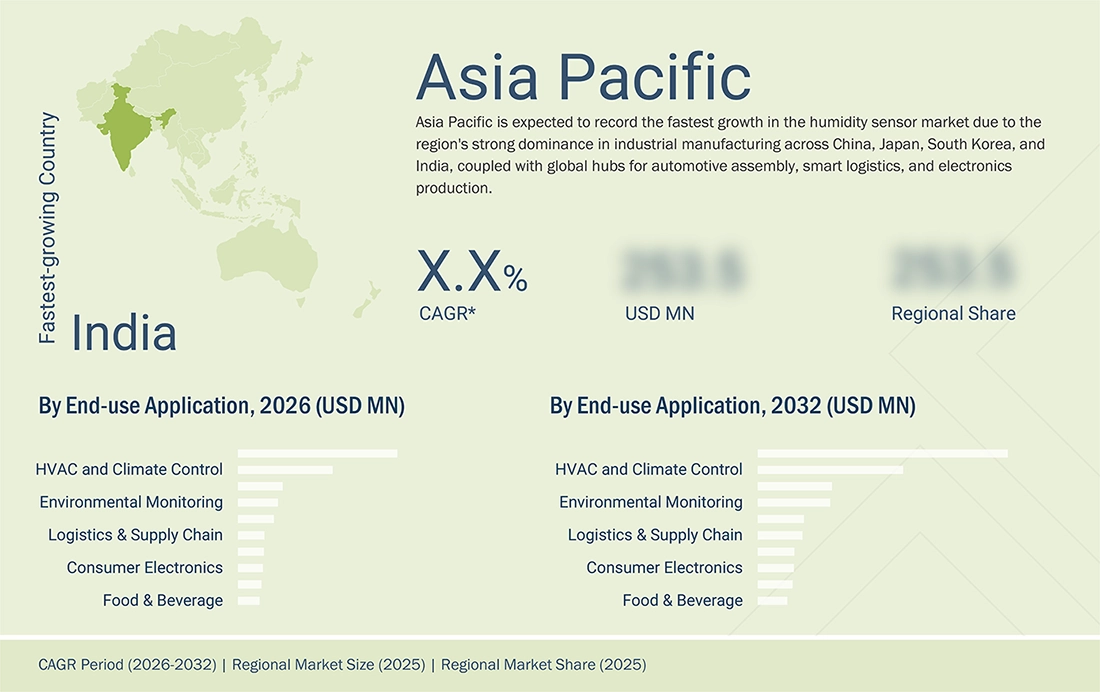
Asia Pacific accounts for the largest share of the global humidity sensor market. Dominance of this region is driven by high volume consumer electronics manufacturing, rapid industrial automation across China and India, alongside major investments in smart home and automotive production lines. Meanwhile, the region is also projected to maintain the fastest CAGR due to extensive smart city initiatives, expanding HVAC system installations, and growing government mandates for environmental monitoring across food processing and semiconductor facilities.
Asia Pacific is expected to register the fastest CAGR in the humidity sensor market. This growth is due to the region's strong dominance in industrial manufacturing across China, Japan, South Korea, and India, coupled with global hubs for automotive assembly, smart HVAC installations, and electronics production. Countries across the region operate as major deployment centers for smart factories and high volume environmental automation. The region contains an established ecosystem of component manufacturers, system integrators, and semiconductor foundries. Increasing investments in IoT enabled appliances, agricultural automation, and cleanroom air regulation drive the demand for compact sensing nodes. Additionally, supportive government policies, green building efficiency mandates, and scalable domestic manufacturing capabilities accelerate overall regional market growth.
In the global humidity sensor market matrix, Amphenol Advanced Sensors (Star) maintains a significant market share and product footprint. The company provides a comprehensive portfolio of relative and absolute humidity sensing solutions, including its Telaire series transmitters and ChipCap integrated sensor architectures. These measurement components deliver low drift, field-swappable calibration, and high-precision environmental tracking across smart HVAC setups, healthcare systems, and industrial processing sectors. Bosch Sensortec (Emerging Leader) is expanding its market position through dedicated microelectromechanical systems (MEMS) technology. It provides compact digital humidity and temperature sensors integrated with consumer electronics, wearable devices, and smart home IoT platforms. This focused operational approach supports its market presence within the global humidity sensor sector.
Source: Secondary Research, Interviews with Experts, MarketsandMarkets Analysis
We have successfully delivered the following deep-dive customizations:
| CLIENT REQUEST | CUSTOMIZATION DELIVERED | VALUE ADDS |
|---|---|---|
| Humidity Sensor Component & Material Manufacturer |
|
|
| Humidity Sensor Module & Transmitter Vendor |
|
|
| Humidity Sensor End User (HVAC / Healthcare / Industrial Process Control) |
|
|
 Exclusive indicates content/data unique to MarketsandMarkets and not available with any competitors.
TITLE
PAGE NO
1
INTRODUCTION
15
2
EXECUTIVE SUMMARY
3
PREMIUM INSIGHTS
4
MARKET OVERVIEW
Maps the market evolution with focus on trend catalysts, risk factors, and growth opportunities across segments.4.1
INTRODUCTION
4.2
MARKET DYNAMICS
4.2.1
DRIVERS
4.2.2
RESTRAINTS
4.2.3
OPPORTUNITIES
4.2.4
CHALLENGES
4.3
INTERCONNECTED MARKETS AND CROSS-SECTOR OPPORTUNITIES
4.4
STRATEGIC MOVES BY TIER -1/2/3 PLAYERS
5
INDUSTRY TRENDS
Provides a snapshot of current market scenario, value chain context, and factors impacting competitive intensity.5.1
PORTER’S FIVE FORCES ANALYSIS
5.2
MACROECONOMIC OUTLOOK
5.2.1
INTRODUCTION
5.2.2
GDP TRENDS AND FORECAST
5.2.3
TRENDS IN INDUSTRIAL PROCESS CONTROL
5.2.4
TRENDS IN HVAC & CLIMATE CONTROL
5.2.5
TRENDS IN ENVIRONMENTAL MONITORING
5.3
VALUE CHAIN ANALYSIS
5.4
ECOSYSTEM ANALYSIS
5.5
PRICING ANALYSIS
5.5.1
INDICATIVE PRICING OF HUMIDITY SENSOR, BY TYPE,
5.5.2
AVERAGE SELLING PRICE TREND OF HUMIDITY SENSOR, BY REGION, 2023-2025
5.6
TRADE ANALYSIS
5.6.1
IMPORT SCENARIO (HS CODE 902690)
5.6.2
EXPORT SCENARIO (HS CODE 902690)
5.7
KEY CONFERENCES AND EVENTS, 2026–2027
5.8
TRENDS/DISRUPTIONS IMPACTING CUSTOMER BUSINESS
5.9
INVESTMENT AND FUNDING SCENARIO
5.10
CASE STUDY ANALYSIS
5.11
IMPACT OF US TARIFF – HUMIDITY SENSOR MARKET
5.11.1
INTRODUCTION
5.11.2
KEY TARIFF RATES
5.11.3
PRICE IMPACT ANALYSIS
5.11.4
IMPACT ON COUNTRIES/REGIONS
5.11.4.1
US
5.11.4.2
EUROPE
5.11.4.3
ASIA PACIFIC
5.11.5
IMPACT ON END USE APPLICATION
6
TECHNOLOGICAL ADVANCEMENTS, AI-DRIVEN IMPACT, PATENTS, AND INNOVATIONS
6.1
KEY EMERGING TECHNOLOGIES
6.1.1
GRAVIMETRIC HUMIDITY SENSING
6.1.2
NANOMATERIAL- BASED SENSORS
6.1.3
FLEXIBLE ELECTRONICS
6.2
COMPLEMENTARY TECHNOLOGIES
6.2.1
CALIBRATION TECHNOLOGIES
6.2.2
WIRELESS COMMUNICATION MODULES
6.3
ADJACENT TECHNOLOGIES
6.3.1
ENVIRONMENTAL SIMULATION CHAMBERS
6.4
TECHNOLOGY ROADMAP
6.5
PATENT ANALYSIS
6.6
IMPACT OF AI ON HUMIDITY SENSOR MARKET
6.6.1
TOP USE CASES AND MARKET POTENTIAL
6.6.2
BEST PRACTICES FOLLOWED BY MANUFACTURERS/OEMS IN THE HUMIDITY SENSOR MARKET
6.6.3
CASE STUDIES RELATED TO AI IMPLEMENTATION IN HUMIDITY SENSOR MARKET
6.6.4
INTERCONNECTED/ADJACENT ECOSYSTEM AND IMPACT ON MARKET PLAYERS
6.6.5
CLIENTS' READINESS TO ADOPT HUMIDITY SENSOR NETWORKS
7
REGULATORY LANDSCAPE
7.1
REGIONAL REGULATIONS AND COMPLIANCE
7.1.1
REGULATORY BODIES, GOVERNMENT AGENCIES, AND OTHER ORGANIZATIONS
7.1.2
INDUSTRY STANDARDS
8
CUSTOMER LANDSCAPE AND BUYER BEHAVIOR
8.1
DECISION-MAKING PROCESS
8.2
KEY STAKEHOLDERS INVOLVED IN BUYING PROCESS AND THEIR EVALUATION CRITERIA
8.2.1
KEY STAKEHOLDERS IN BUYING PROCESS
8.2.2
BUYING CRITERIA
8.3
ADOPTION BARRIERS AND INTERNAL CHALLENGES
8.4
UNMET NEEDS OF VARIOUS VERTICALS
9
HUMIDITY SENSOR TECHNOLOGIES (QUALITATIVE)
9.1
INTRODUCTION
9.2
MEMS-BASED SENSORS
9.3
THIN-FILM SENSORS
9.4
PRINTED HUMIDITY SENSORS
9.5
WIRELESS SENSOR NODES
10
HUMIDITY SENSOR MARKET, BY TYPE (MARKET SIZE AND CAGR, 2022-2032)
Market Size, Volume & Forecast – USD Million10.1
INTRODUCTION
10.2
CAPACITIVE
10.3
RESISTIVE
10.4
THERMAL
10.5
OTHER HUMIDITY SENSORS
11
HUMIDITY SENSOR MARKET, BY MEASUREMENT TECHNIQUE (MARKET SIZE & CAGR, 2022–2032)
Market Size, Volume & Forecast – USD Million11.1
INTRODUCTION
11.2
ABSOLUTE
11.3
RELATIVE
12
HUMIDITY SENSOR MARKET, BY END-USE APPLICATION (MARKET SIZE & CAGR, 2022–2032)
Market Size, Volume & Forecast – USD Million12.1
INTRODUCTION
12.2
ENVIRONMENTAL MONITORING
12.3
HVAC & CLIMATE CONTROL
12.4
INDUSTRIAL PROCESS CONTROL
12.5
CONSUMER ELECTRONICS
12.6
HEALTHCARE & PHARMACEUTICAL
12.7
AGRICULTURE
12.8
AUTOMOTIVE
12.9
FOOD & BEVERAGE
12.10
BUILDING & CONSTRUCTION
12.11
LOGISTICS & SUPPLY CHAIN
13
HUMIDITY SENSOR MARKET, BY REGION (MARKET SIZE & CAGR, 2022–2032)
Market Size, Volume & Forecast – USD Million13.1
INTRODUCTION
13.2
NORTH AMERICA
13.2.1
US
13.2.2
CANADA
13.2.3
MEXICO
13.3
EUROPE
13.3.1
UK
13.3.2
GERMANY
13.3.3
FRANCE
13.3.4
NORDICS
13.3.5
REST OF EUROPE
13.4
ASIA PACIFIC
13.4.1
CHINA
13.4.2
JAPAN
13.4.3
INDIA
13.4.4
REST OF ASIA PACIFIC
13.5
ROW
13.5.1
SOUTH AMERICA
13.5.2
MIDDLE EAST
13.5.3
AFRICA
14
HUMIDITY SENSOR MARKET, COMPETITIVE LANDSCAPE
14.1
OVERVIEW
14.2
KEY PLAYER STRATEGIES/RIGHT TO WIN
14.3
REVENUE ANALYSIS, 2020–2025
14.4
MARKET SHARE ANALYSIS,
14.5
BRAND/PRODUCT COMPARISON
14.6
COMPANY EVALUATION MATRIX: KEY PLAYERS,
14.6.1
STARS
14.6.2
EMERGING LEADERS
14.6.3
PERVASIVE PLAYERS
14.6.4
PARTICIPANTS
14.6.5
COMPANY FOOTPRINT: KEY PLAYERS,
14.6.5.1
COMPANY FOOTPRINT
14.6.5.2
REGION FOOTPRINT
14.6.5.3
VERTICAL FOOTPRINT
14.6.5.4
OFFERING FOOTPRINT
14.7
COMPANY EVALUATION MATRIX: STARTUPS/SMES,
14.7.1
PROGRESSIVE COMPANIES
14.7.2
RESPONSIVE COMPANIES
14.7.3
DYNAMIC COMPANIES
14.7.4
STARTING BLOCKS
14.7.5
COMPETITIVE BENCHMARKING: STARTUPS/SMES,
14.7.5.1
DETAILED LIST OF KEY STARTUPS/SMES
14.7.5.2
COMPETITIVE BENCHMARKING OF KEY STARTUPS/SMES
14.8
COMPANY VALUATION AND FINANCIAL METRICS
14.9
COMPETITIVE SCENARIO
14.9.1
PRODUCT LAUNCHES
14.9.2
DEALS
14.9.3
EXPANSIONS
15
HUMIDITY SENSOR MARKET, COMPANY PROFILES
15.1
INTRODUCTION
15.1.1
AMPHENOL ADVANCED SENSORS
15.1.2
HONEYWELL INTERNATIONAL INC.
15.1.3
TEXAS INSTRUMENTS INCORPORATED
15.1.4
SETRA SYSTEMS
15.1.5
SENSIRION AG
15.1.6
TE CONNECTIVITY
15.1.7
SIEMENS
15.1.8
TERACOM
15.1.9
BOSCH SENSORTEC GMBH
15.1.10
SCHNEIDER ELECTRIC
15.1.11
RENESAS ELECTRONICS CORPORATION
15.2
OTHER PLAYERS
15.2.1
B+B THERMO-TECHNIK GMBH
15.2.2
E+E ELEKTRONIK GES.M.B.H
15.2.3
IST AG
15.2.4
HUNAN RIKA ELECTRONIC TECH CO. LTD
15.2.5
DICKSON
15.2.6
GALLTEC MESS-UND REGELTECHNIK GMBH
15.2.7
PCE HOLDING GMBH
15.2.8
SETRA SYSTEMS
15.2.9
SUNSUI PROCESS SYSTEM
15.2.10
PRESSAC COMMUNICATIONS LIMITED
15.2.11
SMART FOG
15.2.12
WINSEN
15.2.13
KELE PRECISION MANUFACTURING
15.2.14
RAYSTEK PROCESS INSTRUMENTS
15.2.15
AHLBORN
15.2.16
SHANDONG RENKE CONTROL TECHNOLOGY CO. LTD
15.2.17
AVITECH SOFTWARE, INC.
15.2.18
NOVOSENSE
16
RESEARCH METHODOLOGY
16.1
RESEARCH DATA
16.1.1
SECONDARY DATA
16.1.1.1
KEY DATA FROM SECONDARY SOURCES
16.1.1.2
LIST OF KEY SECONDARY SOURCES
16.1.2
PRIMARY DATA
16.1.2.1
KEY DATA FROM PRIMARY SOURCES
16.1.2.2
KEY PRIMARY PARTICIPANTS
16.1.2.3
BREAKDOWN OF PRIMARY INTERVIEWS
16.1.2.4
KEY INDUSTRY INSIGHTS
16.2
MARKET SIZE ESTIMATION
16.2.1
BOTTOM-UP APPROACH
16.2.2
TOP-DOWN APPROACH
16.2.3
MARKET SIZE CALCULATION FOR BASE YEAR
16.3
MARKET FORECAST APPROACH
16.3.1
SUPPLY SIDE
16.3.2
DEMAND SIDE
16.4
DATA TRIANGULATION
16.5
FACTOR ANALYSIS
16.6
RESEARCH ASSUMPTIONS
16.7
RESEARCH LIMITATIONS
16.8
RISK ASSESSMENT
17
APPENDIX
17.1
DISCUSSION GUIDE
17.2
KNOWLEDGESTORE: MARKETSANDMARKETS' SUBSCRIPTION PORTAL
17.3
CUSTOMIZATION OPTIONS
17.4
RELATED REPORTS
17.5
AUTHOR DETAILS
The research process for this study involved the systematic gathering, recording, and analysis of data on customers and companies operating in the Humidity Sensor market. This process involved the extensive use of secondary sources, directories, and databases (Factiva and OANDA) to identify and collect valuable information for the comprehensive, technical, market-oriented, and commercial study of the Humidity Sensor market. In-depth interviews were conducted with primary respondents, including experts from core and related industries, as well as preferred manufacturers, to obtain and verify critical qualitative and quantitative information and assess growth prospects. Key players in the Humidity Sensor market were identified through secondary research, and their market rankings were determined through a combination of primary and secondary research. This research involved studying the annual reports of top players and conducting interviews with key industry experts, including CEOs, directors, and marketing executives.
Secondary ResearchVarious sources were utilized in the secondary research process to identify and collect information relevant to this study. These include company annual reports, press releases, investor presentations, white papers, technology journals, certified publications, articles by recognized authors, directories, and databases.
Secondary research was primarily used to gather key information on the industry’s value chain, the total pool of market players, market classification by industry trends at the most detailed level, regional markets, and key developments from both market- and technology-oriented perspectives.
Primary ResearchPrimary research was also conducted to identify the segmentation types, key players, competitive landscape, and key market dynamics, including drivers, restraints, opportunities, challenges, and industry trends, as well as the key strategies adopted by players operating in the Humidity Sensor market. Extensive qualitative and quantitative analyses were conducted across the complete market engineering process to present key information and insights throughout the report.
Extensive primary research has been conducted following the acquisition of knowledge about the humidity sensor market scenarios through secondary research. Several primary interviews were conducted with experts from the demand side (end-user application and region) and the supply side (by type, measurement technique, and end use application) across four major geographic regions: North America, Europe, Asia Pacific, and RoW. Approximately 60% and 40% of the primary interviews were conducted from the supply and demand sides, respectively. These primary data have been collected through questionnaires, emails, and telephonic interviews.

Notes: The three tiers of companies have been defined based on their total/segmental revenue as of 2025: Tier 1 = > USD 1 billion, Tier 2 = USD 1 billion–USD 500 million, and Tier 3 = < USD 500 million.
Other designations include sales, marketing, and product managers.
To know about the assumptions considered for the study, download the pdf brochure
In the complete market engineering process, top-down and bottom-up approaches, along with several data triangulation methods, were used to estimate and validate the size of the Humidity Sensor market and various other dependent submarkets. Key players in the market were identified through secondary research, and their market share in each region was determined through a combination of primary and secondary research. This research methodology involved analyzing the annual and financial reports of the top players and conducting interviews with experts (including CEOs, VPs, directors, and marketing executives) to gather key insights (both quantitative and qualitative).
All percentage shares, splits, and breakdowns were determined using secondary sources and verified through primary sources. All possible parameters affecting the markets covered in this study were accounted for, examined in detail, verified through primary research, and analyzed to obtain final quantitative and qualitative data. These data were consolidated and supplemented with detailed inputs and analysis from MarketsandMarkets and presented in this report.
Humidity Sensor Market: Top-Down and Bottom-Up Approach
After determining the overall market size through the estimation process, as explained above, the total market was divided into several segments and subsegments. To complete the overall market engineering process and obtain precise statistics for all segments and subsegments, the data triangulation procedure was employed, as applicable. The data was triangulated by studying various factors and trends from the demand and supply sides. Additionally, the market has been validated using both top-down and bottom-up approaches.
A humidity sensor is a device designed to measure and monitor moisture levels in the air, ranging from handheld models to components integrated into air quality systems. Using a sensing element, often a thermistor, these sensors convert data into electrical signals to display humidity levels. They measure either relative humidity (RH) or absolute humidity (AH). RH compares current humidity to its maximum at a given temperature, while AH measures water vapor volume in grams per cubic meter.
Humidity sensors come in three main types: capacitive (measuring RH with a metal strip between electrodes), resistive (using ionized salts for RH), and thermal (measuring AH through temperature differences). Commonly installed indoors or in ducts, these sensors are vital for climate control, energy efficiency, preventing mold, and maintaining industrial environments. Their applications span HVAC systems, weather forecasting, agriculture, and more, enhancing operational efficiency and ensuring optimal living or working conditions.
With the given market data, MarketsandMarkets offers customizations according to the company’s specific needs. The following customization options are available for the report:
According to MarketsandMarkets, the global humidity sensor market is projected to grow from USD 3.64 billion in 2026 to USD 5.32 billion by 2032.
The global humidity sensor market is expected to grow at a CAGR of 6.5% during the forecast period from 2026 to 2032.
Key growth drivers include increasing adoption of smart building automation, integration of humidity sensors into HVAC systems, rising demand for environmental monitoring, expansion of industrial applications, and growing emphasis on energy efficiency and indoor air quality.
Major trends include increasing adoption of smart sensors, IoT-enabled environmental monitoring, advanced capacitive sensing technologies, real-time humidity measurement, and integration with automated building management systems.
Asia Pacific is expected to record the highest CAGR in the humidity sensor market during the forecast period from 2026 to 2032, supported by industrial expansion and increasing adoption of environmental monitoring technologies.
The capacitive segment is expected to dominate the humidity sensor market throughout the forecast period, owing to its accuracy, reliability, and suitability for a wide range of applications.
The absolute humidity measurement segment is expected to record the fastest CAGR during the forecast period, driven by demand for precise moisture measurement across industrial and environmental applications.
The environmental monitoring segment is expected to register the highest CAGR during the forecast period, supported by increasing demand for accurate humidity monitoring in environmental assessment and monitoring systems.
Major players include Amphenol Advanced Sensors (US), Honeywell International Inc. (US), Texas Instruments Incorporated (US), Setra Systems (US), and Sensirion AG (Switzerland). Specialized players include AVTECH Software, Inc. (US), Novosense (China), Dickson (US), Sensoterra (Netherlands), and Viridix (Israel).
The MarketsandMarkets report covers market size and forecasts for 2026–2032, growth trends, key drivers, market segmentation by sensor type, measurement technique and end-use application, regional analysis, and the competitive landscape, including leading and specialized market participants.


Business Development Manager-Technology Business
Leading Japanese MNC specializing in optics and imaging products
MarketsandMarkets™ response is quick. Their attitude is flexible and positive. Analyst Insights are globally considered and significant. Client Services quickly respond to our inquiry and demand. Their wide range of global surveys help us make our strategic plan.
We hope Knowledge Store will be easier to search for a report.
We engaged with MarketsandMarkets on a study to perform an analysis and recommend a Go-To-Market strategy for metrology and process control in the semiconductor market. The study was tailored to our targets and needs with well-defined milestones. Our overall experience with the MarketsandMarkets team was very good throughout the project in all aspects including the analysis methodologies used, the quality and depth of primary and secondary data sets, the professionalism and flexibility of the team and the ability to meet the target schedule and milestones. We want to thank MarketsandMarkets team for a job well done.